Thursday, June 13, 2013

Spring Camp - Part 3


My assumption was correct.  The K - 3 students and teachers did have fun at the spring camp on Tuesday afternoon.  Later in the week, those same feelings and comments were expressed by the Grade 5 - 9 students.  Inuujaq School's principal, A. Salam, also participated in the spring camp activities with the K - 3 group.  The spring camp is one of the school's most highly valued activity.  I can see why, because it's a change of scenery (outside of the classroom), and challenges students to use the traditional skills they've learned in school out on the land.  What I also noticed is that the Inuit are not bothered by the very dark face tans they receive from the sun.  And I do mean very dark.
            
With the majority of my students assisting elders at the camp, I chose to postpone teaching new material until the following week.  Instead, I did review work with the students who stayed behind on Wednesday & Thursday (May 15 & 16).    Morning and afternoon recess duties were much quieter and simpler due to so many students attending the spring camp.
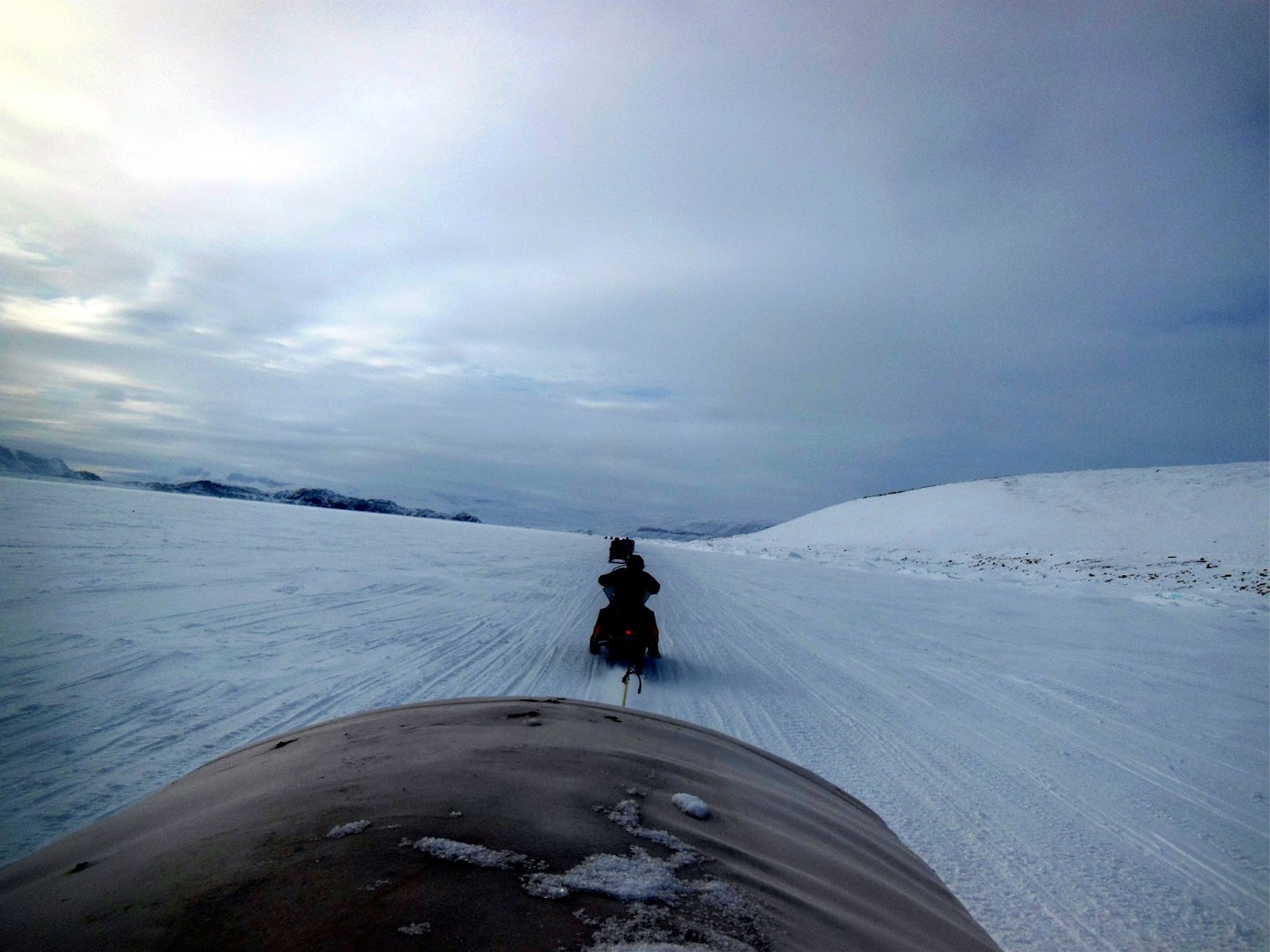
            

Friday, May 17 was the last day of the spring camp, and it was reserved for Inuujaq School staff.  While students slept in Friday morning, teachers and school administrators assembled out on the ice in front of the Northern Store, ready for another day trip.  Unlike the previous days, the sky was mostly covered with grey clouds.  And the temperature was a little warmer.  I decided not to wear my snow pants because I didn't want the added weight when hiking up rocky hills.  I did keep them in my backpack just in case the weather got colder.  The mood was festive as everyone sat & stood around the skidoos and qamutiqs, drinking hot beverages and wondering what the day would bring.  After a quick headcount, (between 20 - 30 people, including two students), everyone jumped into a skidoo or qamutiq and the convoy was on its way.  The principal would meet everyone at the camp site later in the morning because he had administrative work to complete.   
             

Me inside the luxurious qamutiq.
Picture taken by Ryan, the media/
computer studies teacher.
There was a feeling of deja vu as the convoy followed the same skidoo trails to the camp site.  The scenery was the same even though the sky was cloudy.  That didn't stop me from taking pictures.  The qamutiq I was riding in included a luxurious interior, fully decorated with blue curtains and mattresses.
            
The five white tents were still in place when the convoy arrived at the camp site.  Everyone helped to unload food, equipment, and personal bags off the qamutiqs.  The longest wooden qamutiq was then turned over because the black rubber treads needed to be sharpened and waxed.
            

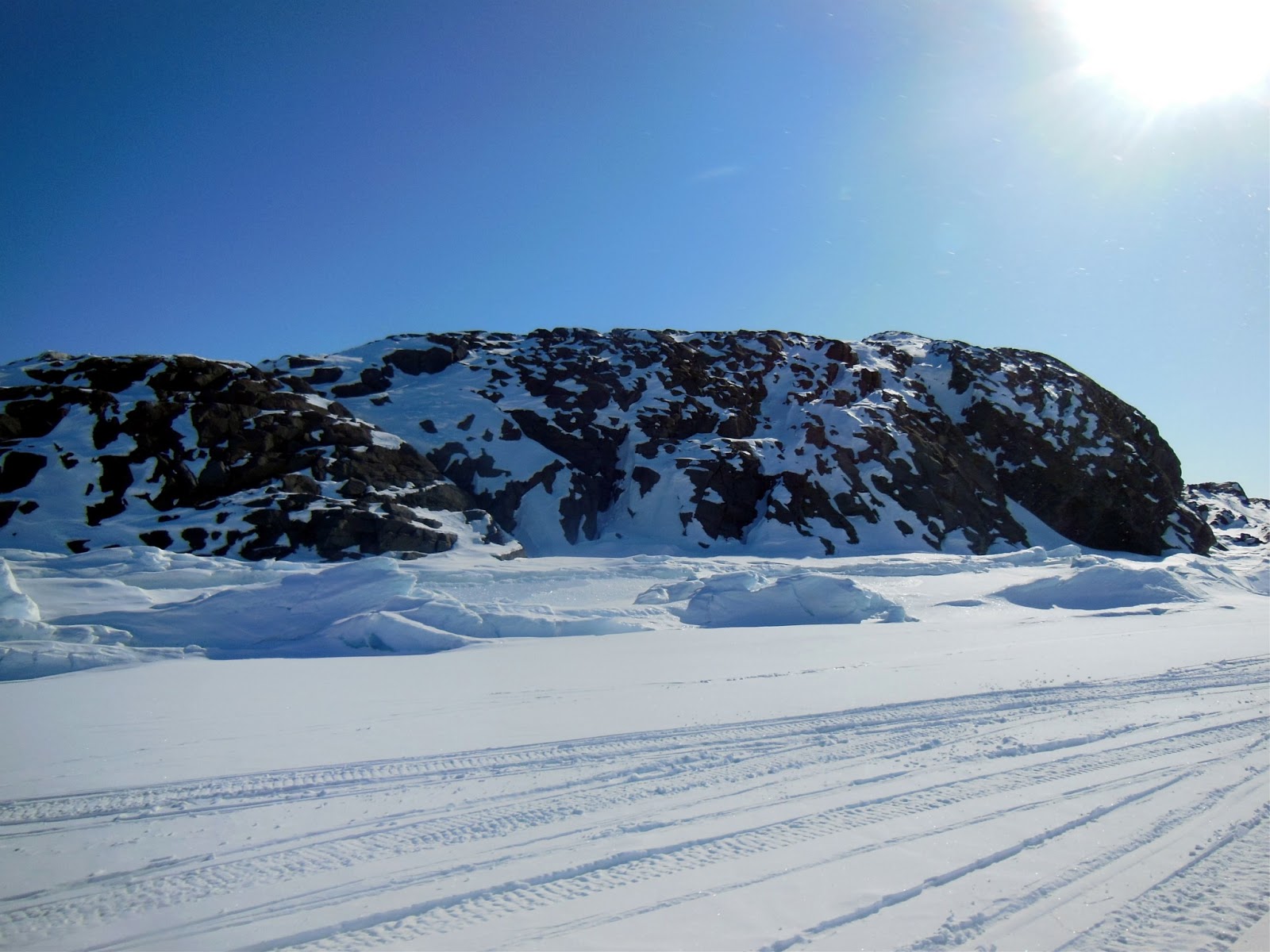
I tagged along with Sean, Kyle, and Ryan, three Inuujaq School teachers, who decided to hike up a nearby rocky hill line that connected to Holy Cross Point.  We were also joined by an elementary school student whose name I've unfortunately forgotten.  From a distance, the trek looked simple but it turned out to be a challenge.  First, we had to walk across very slippery ice patches and climb over frozen mounds of ice & snow.  These mounds were most likely created by the sea current underneath pushing the frozen ice on top against the shoreline.  Next came the hill climb.  The white snow was very tightly compact and slippery, forcing us to use the rocks as steps.  We eventually made it to the top and were treated to a wonderful 360 degree view of the surrounding area.  The camp site looked very small in the distance.
            

I left my backpack near a very large rock and continued the trek with the teachers.  The hill line is littered with large rocks.  We climbed up one tall rock face, being careful not to slip and fall.  Upon reaching the top, Ryan and I filmed videos of the scenery while Sean, Kyle, and the elementary student descended down to the other side of the hill.  The path they chose was a little steep and contained jagged rocks, but they made it safely down to the bottom.  Several minutes later, Ryan & I arrived at a collection of large boulders, littered with rabbit droppings.  An Arctic hare or family of hares were using these boulders as a home but we didn't see any.  While we continued to take photographs, we spotted the principal arriving at the camp in a rented skidoo. 
            
Sean & Kyle gazing at the spectacular scenery.
The tall hill (background) next to
Holy Cross Point.
Wanting a bigger challenge, I decided to hike to the top of the very tall rocky hill that sat next to Holy Cross Point.  Ryan chose to stay behind.  I continued alone, stepping around and over rocks of many shapes and sizes.  The overall ascent to the top wasn't difficult despite a few spots that required the use of all four limbs.  I was glad I didn't wear my snow pants, otherwise I would have sweat too much.  I raised my fists into the air when I reached the summit.  I filmed a 360 degree short video, capturing the surrounding mountains and the sounds of silence on film.  In the distance, I could see Arctic Bay and the airport.  Towards the entrance to the Northwest Passage, a low formation of clouds was slowly moving in my direction.  A snow storm appeared to be moving in.  I also saw the small outlines of Sean, Kyle, Ryan, and the student walking back to the camp site.  Looking at my watch, I realized it was nearly noon.  I quickly took some more pictures with my camera and slowly made my way back to camp.  I also made sure to pick up my backpack on the way.
            

"Was that you up there?" asked one of the Inuit teachers when I returned from my trek.
            
"Yes, it was," I replied.  "The view from up there is just great."
            
Me staring off into the distance.
Picture also taken by Ryan.
Lunch consisted of caribou stew, eggs, bacon, bread, tea, juice, and hot chocolate.  I ate my lunch in the same tent I slept in on Monday night.  At the moment, it was being used by the male staff as their eating area.  When I entered the tent, they asked me how I enjoyed my trek up to Holy Cross Point.  I replied that the trek was worthwhile and the views were fantastic.  Upon seeing a frying pan full of cooked bacon, I couldn't help but share a news story I had recently read on the Internet.
            
On May 9, an elderly lady in the United States celebrated her 105th birthday, and the local media asked her what was the secret to her longevity.  The Texas woman replied that she ate bacon every day.  To celebrate her birthday, Oscar Meyer gave her a free batch of bacon and let her ride 'shot-bun' in one of their Weinermobiles.       
            
After lunch, I thought about what to do next.  Most teachers were heading out for a seal hunt with the elder hunters but I didn't feel like going for a second round.  Feeling empowered by my hike up to Holy Cross Point, I decided to tackle an even bigger challenge: climbing the tall nameless mountain behind the camp site.  I had just 3 hours to get there and back.  Such a task looked daunting given the size of the mountain and the distances I would have to walk.  But, I believed I could do it given that I had previously hiked up the two smaller hills in front of the mountain.  Once publicly stating my intentions, I asked if any teachers wanted to join me?  Sadly, no one volunteered.  With everyone wishing me luck, I set off on my biggest hike yet in the Arctic Bay Area.
        
Climbing the nameless mountain. Route in Red.
The easiest part of the trek was getting over the two low hills in front of the mountain.  In fact, it felt like I got that portion out of the way fairly quickly.  While listening to roaring skidoos in the distance, I trudged forward, moving onto the mountain itself, whose slope had become steep.  There were plenty of rocks to grab onto but I quickly learned to be very selective because many rocks were loose.  About halfway up, I reached a large stack of rocks that formed a flat top.  Rather than climb up, I worked my way around.  When I got to the flat part, I stopped to catch my breath and to photograph the scenery.  I was surprised by how much I could see.
            
The last part of the hike was climbing the left side of the mountain; this proved to be most challenging because the snow was smooth and there were very little rocks to grab onto.  The smooth snow gave the impression that underneath was solid ice meaning I wouldn't get a secure footing.  However, after taking a few steps, I discovered that it was soft powdered snow, enabling me to sink in my heavy boots for better footing.  Rather than walk up the steep slope, I used my arms and legs, punching & kicking deep into the snow, creating a fresh path up the mountain.  By the time I reached the summit, my black gloves were covered by sticky wet snow.          
            

Spring Camp Site (centre).
I reached the summit at around 1:30pm; my ascent took ninety minutes.  Again, I lifted my fists into the air, like Rocky Balboa, to celebrate & signify my achievement.  I also waved to the very tiny people at the camp below.  I wasn't sure if anyone waved back.  The view was spectacular; I could see Arctic Bay, the airport, the cliffs I had explored in early May, the top of King George V Mountain, and the teachers & elders returning to camp after the seal hunt.  Looking through my binoculars, it didn't look like they caught anything.  I spent around fifteen minutes exploring the summit, photographing the jagged cliffs, the surrounding area, and filming a short video.
            

For the descent, I went back the way I came.  I faced the mountain when I descended the left side.  It was like doing the ascent but in reverse.  I could have slid down but I chose to play it safe.  After clearing that section, it was pretty much smooth sailing.  I still took my time because I wanted to relish in the fact that I had gone higher than anyone had gone during the spring camp.  About halfway, I noticed a convoy of skidoos and qamutiqs leaving the camp site and heading back to Arctic Bay.  The time was 2:30pm.  The tents had been disassembled and staff were leaving earlier than planned.  Before I could begin planning my 11km walk back to Arctic Bay, I was met by an Inuk man on a skidoo; he had been sent to retrieve me.                
            
The Spring Camp is no more . . . until
next year.
The Inuk was one of Rebecca's sons.  She is Inuujaq School's secretary.  I was surprised to see him this far up a rocky hill on a skidoo.  "Us Inuit can do anything with a skidoo," he boasted.  The ride down to the shoreline was quick and fun.  I really need to look at getting a skidoo, I thought.  Rebecca and the last remaining Inuit teachers were waiting for me at the shoreline next to a qamutiq.  All that was left of the camp site were piles of rocks.
            
"Did you have fun up there?" asked Rebecca.
            
"Of course!  I could see everything up there.  Did you see me?"
            
"Definitely," she replied.  "We all could see you clearly.  You looked like a tall black post.  Even the people who went seal hunting could see you when they were driving back.  A few of us even waved to you."
            
On the way back to town, I asked the Inuit teachers if the mountain I climbed had a name.  They said no but added they would call it 'Mount Adrian'  from now on.  I chuckled at the honour but wondered if the name would stick.  In return, the teachers asked me if I had any plans to climb any other mountains.  Looking around, I spotted my next target.
            
"King George," I replied.  "Yeah, King George," I confirmed with a nod.  "This Victoria Day Weekend."            
Arctic Bay and the airport in the distance.
As you probably can tell from all three posts, I definitely enjoyed spring camp.  It was a great way to experience living out on the land with Inuit elders and youth.  But it was also a great way to see the striking Arctic landscape.  The land is vast, picturesque, and untouched.  It makes you feel like you're on a different planet.  Truth be told, there were moments when I thought I was on the planet Hoth, and expecting to see AT-AT walkers and Rebel snow speeders passing by.          
            
I can't wait for next year's spring camp.


End of Spring Camp mini-series.

Tuesday, June 4, 2013

Spring Camp - Part 2


The sound of the gun was loud and echoed off the surrounding mountains as the bullet raced towards the white Arctic hare . . . and missed.  A collective groan of disappointment came from the students watching.  However, there still was a chance.  Instead of running away, the hare became petrified, trying to camouflage itself against the white snow.  One of the hired skidoo drivers, David Oyukuluk, reloaded the rifle and took over for the elder, Simeonie Olayuk.  Again, everything went silent as the driver took aim.  While I held my breath to hear the next loud gunshot, my eyes were searching for the petrified hare.  I still couldn't see it.  Either I was looking at the wrong place, or my eyes were not well trained.
            
The driver fired.
            
David Oyukuluk holding the Arctic hare
he caught.
A small puff of white fur flew up into the air, followed by a round of applause.  The bullet had found its target.  I had been looking too high up the snowy hill.  "Oh, there it is!" I said out loud.  The hare continued to bounce around as two Inuit boys went up to retrieve it.  The shock of the bullet impact must have caused the hare's nervous system to spasm uncontrollably.  The hare stopped moving when it was brought down from the hill.  I quickly took a photo of it before it was laid on the ground.  Using a Swiss Army knife, Simeonie removed the fur with his bare hands.  I was surprised by how easy the fur came off.  Next, he cut it open and removed the insides; a graphic process indeed.  I'll spare you the photographs.  I was surprised that I didn't get sick watching the whole procedure.  A part of me felt sorry for the hare, but at the same time, when you have to survive in an area where fruits and vegetables don't grow, you have to take what the land offers.
            
The meat was put into a plastic bag and the fur & insides were left behind.  The ravens would eat the insides but the fur may be recovered by the hunters later.  Everyone jumped back into their respective skidoos & qamutiqs and returned to camp.  I sat at the back of a qamutiq, watching the picturesque scenery fly by. 
            

Upon returning to camp, the high school students had free time to relax in their tents or to explore the area around the campsite.  I chose to tag along with Kyle who wanted to trek up one of the hills behind the camp.  Kyle teaches Grades 8 & 9 at Inuujaq School.  From a distance, the hill didn't look tough to climb, but when we got to the foot of the hill, we realized that that wasn't the case.  In the Arctic, it's difficult to judge distance and height from afar.  When you look at a natural landmark, be it a mountain or an island, it appears to be only a few kilometres away when in fact it's much, much further.  Or a mountain pass may look easy to climb but when you get up close, you see that the path is much steeper.
            
Inukshuk under construction.
I followed Kyle up the hill, letting him create a path in the deep snow with his heavy boots.  It didn't take long to start feeling the burn in my legs.  Since I was wearing my heavy Canada Goose parka and snow pants, the added weight quickly tired out my body.  I had to stop a few times to catch my breath.  We eventually made it to the top of the rocky hill and were treated to a great view of the enclosed inlet and surrounding area.  We could even see the airport and Arctic Bay to our right.  Skidoo paths crisscrossed the frozen ice and the camp site below looked very tiny.  At the top of the hill sat a very large boulder that a had a few rocks sitting on it: an inukshuk under construction.  Kyle and I added a rock each as a way of saying that we were there.  Trekking down the hill required a lot less work and time.  We even slid down two sides of the hill, leaving noticeable trails in the snow.  If only I had brought my skis. 
            

It was almost dinner time when Kyle and I strolled into camp.  I sat down on a qamutiq and rested, looking back at the hill I just climbed.  The main course was being prepared inside several tents.  When it was time, I grabbed my mug & utensils and proceeded to the adult tent that was serving delicious hot caribou (tuktu) stew with vegetables.  Iga, the high school Inuktitut teacher, was melting snow for people wanting hot water for tea or hot chocolate.  When out on the land, remember the golden rule: Don't melt yellow or brown snow! 
            
Cooked hare.
Just before I treated myself to a second helping of tuktu, a student came to me with an important question: the elders wanted to know if I wanted to try the Arctic hare (ukaliq) that was shot.  "Ii, (yes)," I replied.  In the elders tent, everyone was sitting in a circle, cutting pieces of hare.  I sat down and was offered a piece.  I took it and placed it in my mouth.
            
"Tastes just like chicken!" one of the elders exclaimed in English while the others laughed.  I nodded while chewing on the meat.
            
"It tastes like caribou to me."  I had a few more pieces of ukaliq before heading back to Iga's tent for more caribou stew.
            

I was bored after dinner with nothing to do.  Looking at the hill I had just climbed, I decided to climb it again and proceed further to the hill behind it.  With no one wanting to tag along, I set out on my trek alone.  I followed the same path Kyle & I had made going up the first hill.  The trek became easy after the first hill because there was only a small dip left to cross.  The summit of the second hill is slightly higher than the first one.  When I got there, I took pictures of everything around me.  The views were grand and the sun was beginning to set.  One view that caught my attention was the very tall mountain ridge line beyond the second hill.  Hmm, I wondered, I may not have the time now, but I'll see if hiking up that mountain will be a possibility on Friday.  I returned the way I came, remembering to slide down the first hill.
            
The mountain that caught my attention.
Malachi Kigutaq wearing a traditional
Inuit amauti.
By this time, I was sweating profusely.  When I got back to camp, I removed my heavy parka and sat down to catch my breath.  My body didn't mind that the temperature was -16ºC.  After hiking two tall rocky hills, the cold felt refreshing.  Several students pointed out that my face was tanned.  I wasn't surprised because I hadn't applied any sunscreen all day.  I borrowed some from Paulette, the art teacher, and put a bit on my face.   
            
In the evening, two of my guitar students, Bryan and Donovan, built a half iglu (missing the top) near the camp.  The iglu would serve as a private woman's toilet area.  I was impressed by their iglu building skills.  They carefully measured, cut, and placed each piece of thick solid snow & ice in the proper place.  The only tool they used was a hand saw.  As I mentioned in my previous post, there are no outhouses out on the land; you have to build your own.  'Serious business' is either left buried in the snow or removed in bags.  Very Important Papers (VIP), aka toilet paper, are also essential and placed in bags after use.  Hands are cleaned with paper towels, hand sanitizer, and/or snow.  I'm not sure what the traditional ways were but I can bet they weren't pretty.
            

Everyone retired to their tents for the night at 11:45pm.  The sun was setting, but would remain like that for the whole night.  Just before I went to my tent, I photographed a qulliq that an elder had lit in her tent.  A qulliq (or kudlik) is a traditional Inuit oil lamp used to provide light and heat inside a tent or iglu.  Once inside my tent, I removed my snow pants and parka, using the latter as my pillow.  I made sure to keep my feet, hands, and head covered so that no body heat would escape.  At the same time, I didn't wear too many layers, otherwise I would sweat, and the sweat would get cold.  Since I am a light sleeper, I also wore earplugs to block out unwelcome noises (ie. snoring).  Sleeping in the two Arctic army sleeping bags was comfortable and warm. 

           
I woke up on Tuesday, May 14, at around 9am.  After going to the washroom some 3 minutes away from the campsite, I rolled up my sleeping bag and packed it in a green duffel bag.  Everyone was up by 9:45 and making breakfast.  For breakfast, there were scrambled eggs, bacon, juice, tea, and hot chocolate.
            
Breakfast in tent.
The only activity after breakfast was preparing the camp site for the next group of students and teachers.  Garbage was collected, tents were cleaned, and sleeping bags & personal bags were packed onto qamutiqs.  At 11:30, everyone with the exception of a few high school students, hopped onto a skidoo or qamutiq and headed back to Arctic Bay.  The students left behind would continue assisting the elders with the spring camp. 
            

Inuujaq School student Darlene
waves for the camera.
The ride back to Arctic Bay took thirty minutes and was mostly uneventful.  Upon arrival, everyone disembarked with their gear and were dismissed for lunch and the rest of the day.  I went home, took a hot shower, put on clean clothes, and had lunch.  I headed back to school to get some work done and to do afternoon recess duty.  While walking towards the school, I saw Kindergarten to Grade 3 students & teachers amassing out on the frozen ice.  They were just getting ready to leave.      
            
Holy Cross Point
They're going to have a lot of fun, I thought to myself.

      To be continued . . .

Saturday, June 1, 2013

Spring Camp - Part 1


Every year, Inuujaq School organizes a week-long spring camp for all students and teachers.  The camp gives everyone the opportunity to experience living out on the land, and learning traditional Inuit skills, such as, seal hunting, sewing, preparing country foods, and setting up camp.  The planning and preparation of the spring camp is done by the Spring Camp Committee but the activities are led by local elders and volunteers.  Teachers provide added supervision. Students must get written permission from their parents before they can participate in the spring camp.      
            
David Oyukuluk winding rope.
This year, the camp ran from May 13 to 17, near Holy Cross Point, some 11 kilometres to the southeast of Arctic Bay.  The location has been used in previous years because of its close proximity to the community.  Rather than travel en masse, classes were organized into five excursion groups, one for each day of the school week.  High school students were first because they would be setting up the campsite and staying overnight.  Tuesday afternoon was reserved for Kindergarten to Grade 3 classes.  Grades 5 to 7 spent all of Wednesday at the spring camp and Grades 7 - 9 had all of Thursday.  Friday was reserved for Inuujaq School staff meaning students had that day off.
            
Arctic Bay Sign
I was excited about Spring Camp because I would be spending my first 'night' out on the Arctic land.  (I added quotations to the word night because there would really be 24 hour sunlight).  I assumed the experience would be similar to the weekend Field Training eXercises (FTXs) I had attended when I was an army cadet down south in Ottawa.  The winter FTXs occurred in February and were staged at CFB Connaught.  Just to make the Spring Camp excursion feel a bit more like cadets, I borrowed two Arctic sleeping bags from the local 3045 army cadet corps.  This small but smart act saved me from having to buy a new sleeping bag at the Northern Store.
            

On the sunny morning of May 13, I walked to Inuujaq School with my knapsack packed with a change of clothes, a mug, an extra pair of gloves, ski goggles, and health kit (toothpaste, toothbrush, deodorant, band-aids, etc.)  Within my large Canada Goose parka, I was carrying: sunglasses, a digital camera, compass, multi-tool, binoculars, and a small utensil set.  To further combat the cold, I was also wearing snow pants and heavy boots.  Underneath the thick outer layers, I was wearing comfortable civilian clothing, a far cry from the formal clothing I normally wear to work.
            
At 9am, high school students and teachers (Paulette, Iga, and I (Adrian)) headed down to the ice in front of the Northern Store where a convoy of skidoos and qamutiqs (sleds) would ferry them to the camp site.  There was a lot of excitement in the air as everyone carried their backpacks and sleeping bags down to the ice.  Small wooden huts were built onto each qamutiq to provide shelter for passengers wanting to 'escape' from the cold Arctic winds.  The insides are fitted with mattresses and curtains to make the ride more comfortable.  The huts also allow additional storage space for supplies, such as, food, fuel, ground sheets, tents, cutlery, and hunting equipment.  After the headcount was completed, everyone found a seat where they could.  This meant jumping onto a qamutiq or riding on the backseat of a skidoo.  The hired drivers started up their snow machines and began slowly pulling the qamutiqs that were connected by tough ropes.  Once the entire convoy was in motion, the drivers maintained a steady speed of 25km/h.  The camping experience had begun.
            
The cliffs I explored on May 4th.

The ride in the qamutiq was and is bumpy.  It also can be windy if you choose not to seek shelter in the qamutiq hut, or if you're riding on a skidoo.  The Inuit didn't look bothered at all by the cold wind blowing across their faces but for us qaullunaqs, it was an annoyance.  Thankfully, I had my ski goggles.  With my eyes protected from the cold, I continued snapping pictures of the surrounding landscape.  Above me, I was surprised to see a seagull flying in the clear blue sky.  I was later informed that seagulls do live around Arctic Bay during the summer months but migrate down south for the winter.  About halfway to the camp site, I was treated to a very wide panoramic view of the tall red cliffs I explored on May 4th.  It was a little hard to believe that I had walked along the tops of those cliffs.
            
The hill next to Holy Cross Point.
The convoy turned left and followed a line of rocky hills after passing the airport.  Holy Cross Point came into view on our right side, marked by a tall wooden stick.  The vast frozen ice suddenly shrunk into a small enclosed inlet as we neared the camp site.  Up ahead, the lead skidoo drove up onto the flat snow covered ground and stopped.  All the other skidoos and qamutiqs stopped around it.  We had arrived at the camp site.
            
Char in a bag.
As students hopped off the skidoos and qamutiqs to stretch their legs, I quickly reviewed the photos I took on the way over.  Luckily, very few photos were blurred.  Snow, rocks, and tall jagged mountains formed the surrounding landscape.  The temperature was around -16ºC.  The students and hired drivers helped the elders unload the tents, ground sheets, food, and Coleman stoves from the qamutiqs.  While the tents were being pitched, rocks were collected into piles.
            

The white tents are held up by three pieces of wood each; two act as posts while the third is a crossbeam.  Guy ropes are tied to large rocks for added stability and to expand the tent's interior space.  Like sandbags, smaller rocks are placed around the tents to prevent the wind from lifting the bottom tent flaps and to keep the cold out.  When all five tents were pitched, ground sheets and mattresses were placed inside them.  Next came sleeping bags, personal belongings, assigned food rations, and Coleman stoves.  The Coleman stoves serve two purposes: to prepare hot meals & beverages, and to heat the tents. 
            
Going to the washroom is a bit of a tricky affair.  For men, it's not much of a hassle because they just can walk several metres and go.  Women require more privacy.  Since it's not practical to bring an outhouse on a land trip, one has to be constructed from ice.  The women's washroom is basically a half completed iglu with the top part of the dome missing.
            
Leah Kalluk, (wearing green jacket),
cuts raw pieces of Arctic Char.
For lunch, the high school students ate boiled hot dogs with ketchup and sliced cheese.  For drinks, there were juice boxes, hot chocolate, and tea.  I ate two hotdogs before being invited to the elder tent for raw Arctic char.  Naturally, I accepted.  The elders sat around in a circle, cutting up a frozen char with their ulus.  They used pieces of cardboard as their cutting boards.  I sat down with them and ate quite a bit of char, lightly seasoning each piece with salt.  While we ate, the elders asked me my age and if I was enjoying my time in Arctic Bay.  I replied that my time in Arctic Bay had been really exciting.  They were surprised when I told them my age because to them, I look a lot younger.  I thanked them for inviting me and added that the char tasted great.      
            

After lunch, Simeonie Olayuk, an elder and experienced hunter, took the high school students and I seal hunting.  The small convoy of three skidoos and one qamutiq made their way around Holy Cross Point before continuing southeast, deeper into the wide frozen waterway that eventually comes to a stop some 42 kilometres away.  (I've been trying to find the name of this waterway but Google Earth & Maps haven't been helpful.  They've only listed this wide body of water as Northern Passages).  Many seals and their breathing holes can be found in this area.  Of course, the ride in the qamutiq was bumpy but I was beginning to get used to it.  The students told me that that was just part of the experience.  What was also part of the experience is taking in the majestic landscape.  All around us were tall picturesque mountains with snow covered tops.  Looking at the summits I now wanted to climb, I envied the Inuit for having all this land as their backyard.
            
Inuujaq School students.
The seal hunting trip was more of a stop-and-go affair.  We first stopped at the foot of a mountain with a very steep 90 degree cliff-face.  Simeonie climbed up the small rocky hill in front of it with a telescope to scout for seal holes out on the ice.  Rather than wait by the skidoos, several students and I trekked up the rocky hill to get a better view.  We got about halfway up the hill before being called back down.  I quickly took a photo of the snowy landscape.
            

Hunters mark seal holes with small pieces of ice, placing them like small totem poles.  When we arrived at the first seal hole, Simeonie measured the thickness of the ice with a long metal rod.  Shaking his head, we moved on to the next seal hole.  We were joined by another group of students at the second seal hole.  Kyle, the Grade 8 & 9 teacher, brought them there in a qamutiq that he pulled with his powerful Renegade skidoo.  While Simeonie tested the thickness of the ice, everyone waited and talked.  Unfortunately, we had to move on.  This process was repeated two more times without any luck.  It looked like the seals had retreated deep into the sea beneath the frozen ice.
            

The convoy suddenly stopped on its way to the fifth seal hole.  Simeonie had spotted an Arctic hare perched on a hill.  No matter how hard I squinted my eyes, I couldn't see the white hare against the white snow.  Even when one of my students pointed to it, I still couldn't see it.  Simeonie quickly retrieved a rifle with a telescopic sight and several rounds of ammunition.  He loaded one bullet into the chamber and crouched behind a boulder of ice.  Using the ice to steady the rifle, he looked through the scope and took aim.  Everything suddenly became quiet.  All eyes were fixed on the hare.  I held my breath, waiting for the inevitable bang.
            
The elder fired.

             
To be continued . . .