Thursday, July 3, 2014

Spring Camp 14 - Part 1


The last week of May was dedicated to review and final exams.  I was glad that I had prepared my English and Social Studies exams the week before because there was no time during the May 23-25th weekend and the few days I spent reviewing all the necessary materials with my students.  My guitar students had a final performance test instead of a written exam, where they were required to perform a chosen piece in front of the class.  They were allowed to read the notes and would receive extra marks if they played the piece from memory.  I spent the last weekend of May marking exams & class work, and writing final comments on report cards.  I breathed a sigh of relief when all the paper work was completed.
            
The first week of June was the last week of school and it was set aside for the annual spring camp.  Every year, the teachers and students of Inuujaq School head out on the land to experience the traditional Inuit way of life.  Elders teach life skills such as seal hunting, sewing, fishing, preparing country food, and setting up camp.  Originally, it was to be held during the second week of May, but the school couldn't hire enough drivers because of the annual fishing derby that weekend.  Rather than cancel the event, the Spring Camp Committee decided to move it to the last week of school.  There was some concern that by then, the weather would be too warm and the ice would turn to slush, but the elders assured everyone that that wouldn't be the case.  Unfortunately, it would be too warm to build igloos. 
            
High school students and teachers were tasked to go out first, set up camp, and spend a night at the camp site.  Students could stay longer if the elders required assistance with the other classes during the week and if they got permission from school administrators.  I and another teacher would overnight with the students. 
            

It was a cloudy, overcast Monday morning (June 2), as I walked to Inuujaq School, carrying a backpack and duffle bag packed with clothing and other camping items.  Looking out towards the frozen bay, I noticed that visibility was poor behind the local airport.  Since the camping area was in that location, I assumed we would be dealing with cold winds and even snow.  I was surprised by this sudden change of weather because the skies had been clear for the last several days.  Old Man Winter had come back for a final sendoff.  To prevent cold & sickness, I wore my thick Canada Goose parka with lighter clothing underneath so that I wouldn't sweat.  I knew I would get many surprised looks from the students and staff because wearing Canada Goose clothing in June is practically unheard of.
            
Minutes before we were to head out, a meeting was called in the science classroom.  The elders had deemed the ice and weather conditions unsatisfactory, forcing them to postpone the trip until the afternoon.  Everyone was disappointed by the announcement.  High school students were dismissed for the rest of the morning and were instructed to be back at school right after lunch.
            
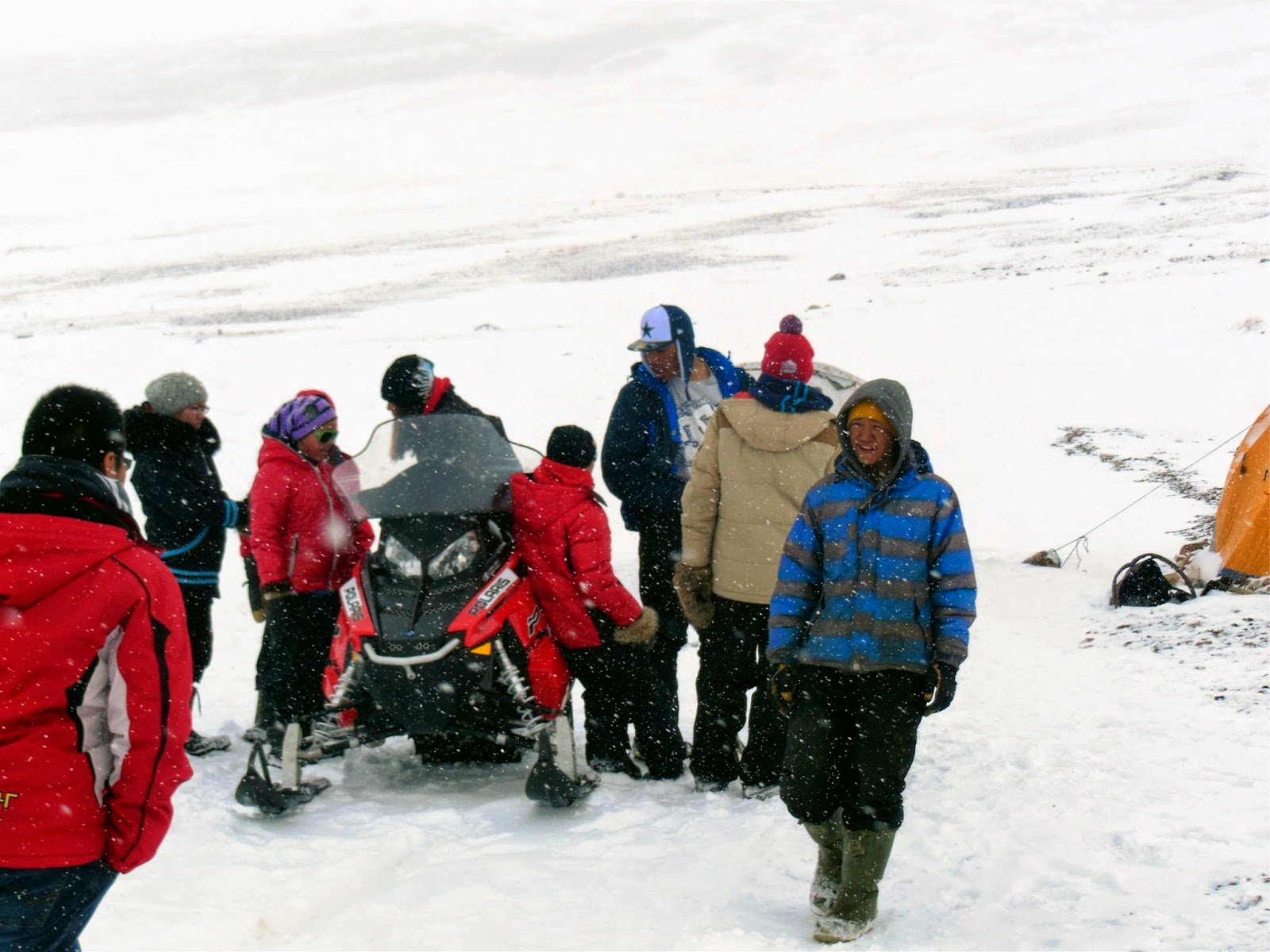
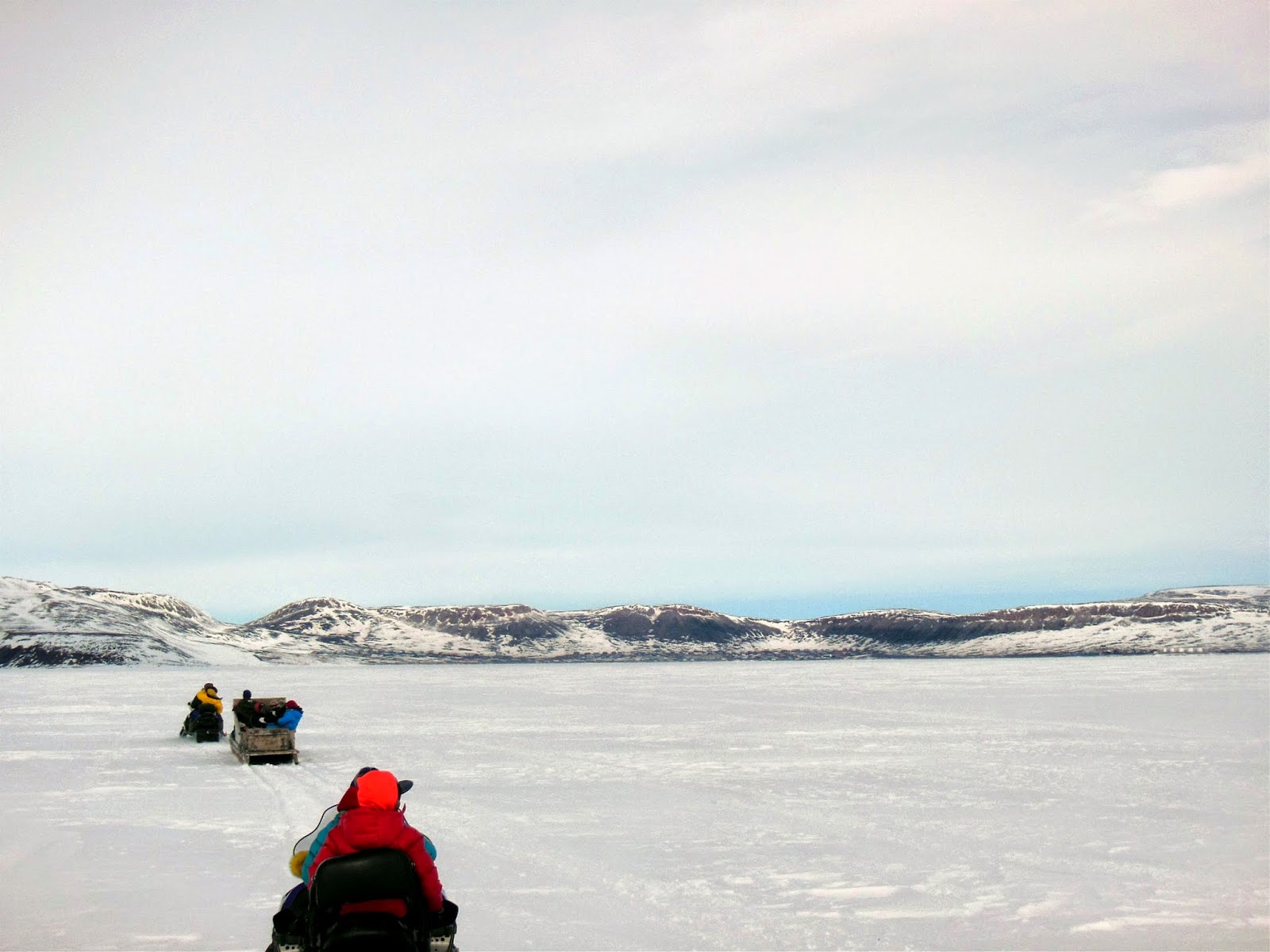
At 1:30pm, high school teachers & students, and elders made their way down to the ice where a convoy of skidoos and qamutiks were waiting.  Once everyone's belongings were loaded into the qamutiks, the students went back to school to get the food.  The convoy left at 2pm.  The weather was still overcast and it looked like there would be snow.  We arrived at the camp site thirty minutes later.  
            
We have arrived.
As we were unloading the tents and camp supplies, a few Inuit boys spotted a flock of snow geese congregating many metres inland, just to the right of the camping area.  They immediately gathered rifles, ammunition, and a white sheet on a wooden frame.  The sheet would be used as camouflage.  The boys went off to hunt geese, leaving the girls to help the elders pitch the tents.  The girls didn't mind because traditionally, the Inuit men did the hunting.  A Canadian Ranger, who was one of the drivers, spotted a smaller flock to the left of the camp, near the road to Nanisivik.  He headed off in that direction with his rifle, hoping to shoot at least one goose. 
            

I was surprised to see two dome-like camping tents, the ones you see down south, being pitched.  The Inuit prefer the large white Fort McPherson tents but I guess they were in short supply.  The silver and orange dome tents were for the male students, teacher (me), and skidoo drivers.  A women's washroom tent, that only contained a bucket inside, was set up at the rear of the camp.  I didn't want to know how or where the bucket would be emptied.  I also felt sorry for the person who would get stuck with that job.  As for the males . . . just make sure you're far enough from the camp.
            

Once the tents were up, the Coleman stoves were moved inside and turned on to heat the tents.  In the distance, a rifle shot was heard, echoing off the mountains.  The geese fled into the sky but landed in a clearing to the left of the camp, near the road to Nanisivik.  Another shot was heard several minutes later, but it came from where the geese landed.  The Ranger was the first to return with a snow goose in his hands.  The Inuit boys returned later, also with a snow goose.  Everyone congratulated them for successfully shooting the geese and took pictures of the fallen prey.
            
We feasted on hot dogs, chicken soup, granola bars, crackers, arctic char, and bannock to keep our stomachs full.  There were also juice, water, and hot chocolate to drink.
            
Snow began to fall in the late afternoon, leading to the cancellation of the seal hunt.  The low visibility would make it difficult to spot the creatures lying on the ice.  I was hoping to see the successful capture of at least one seal because last year, we only shot a hare.  To pass the time, the high school students went tobogganing and I went hill climbing.  I only hiked up the two small hills behind the camp; I would wait until Friday to climb the tall & large mountain for the second time (the first time was during last year's spring camp).  Despite the falling snow, I was able to get some decent pictures of the camp and landscape below.  Upon returning to camp, I passed the time doing whatever before retiring to my assigned tent for the night.     
            

Middle school students.
I was woken by a student the following morning, having enjoyed sleeping in for an extra hour.  I had breakfast in a nearby elder's tent, eating scrambled eggs on bread, with a side order of bacon.  The elders and students wanted to know if I was having fun, to which I replied yes.  After breakfast, I hung out in the tent reading Saqiyuq and sharpening my knives.  At 10am, I was interrupted by the sounds of approaching skidoos and loud voices.  The middle school students had arrived.  It was still snowing outside and a mild wind was blowing through the camp.  The students asked me how I enjoyed my overnight stay and I replied that it was quite good.  


An hour or two before lunch, several high school students took a few middle school students geese hunting near the road to Nanisivik.  Unfortunately, they were unable to shoot any snow geese.  The remaining middle school students played soccer baseball out on the ice.     
            

The high school students & I were driven back to Arctic Bay at lunch time.  A few students were allowed to stay behind to help the elders.  The ride was interesting because the falling snow made it appear that we were travelling in the middle of a serious whiteout.  Upon arrival, I headed home to unpack, shower, and change into cleaner clothes.  I had the afternoon off from school.


To Be Continued . . .

Saturday, June 28, 2014

Operation Spring Fix 14 - Part 3


I woke up the following morning with a part of the green tent flapping in my face.  The arctic wind had managed to push one of the ropes holding down the tent off the rock it was secured to.  Thankfully, the tent was still standing, but the grey pole in the centre was leaning off to the side.  Judging from all the commotion coming from outside, the wind was also pushing off the ropes from the other tents.  I quickly packed my sleeping bags, air mattress, and duffel bag, and headed outside.  It's one of the many golden rules in cadets & the military: on your last day in the field, pack up your bedding and kit so that you're ready to move at a moment's notice.
              
Cadet Sergeant Reid's tarp cape.
After breakfast, everyone went to work on tearing down the camp.  Originally, the plan was to stay until lunch time but the wind convinced us that leaving earlier was a better option.  Duffel bags, sleeping bags, and air mattresses were packed and brought out of the tents and loaded into qamutiks.  The interiors were emptied of garbage, tarps, and "cardboard flooring" before the tents were taken down.  Some cadets had to run after some garbage before it was blown away by the wind.  The fire & fuel storage points were also disassembled.  I used the handyman's secret weapon, duct tape, to secure all the unopened MRE packages in large boxes.  I then handed them off to the lead Ranger who secured them to a qamutik.  The final task was to do a garbage sweep of the entire camp area, picking up any leftover garbage, and placing them in a garbage bag.  Taking care of the land means leaving no human trace behind.
            
Camp tear down.
The Commanding Officer (CO) & I held a debriefing with the cadets, briefly reviewing the lessons they learned, and what they liked & disliked about the FTX.  Overall, they enjoyed the FTX and definitely wanted to have another one next year.  The CO & I also agreed.
            
CO's Debriefing.
We were two skidoos short because we were leaving earlier than planned.  Our other two drivers did not stay at the camp site over the weekend and had agreed with the CO to pick us up at around lunchtime on Sunday.  Thankfully, this wasn't a problem because the two skidoos we did have were strong enough to pull two qamutiks at once.  I gave the go-ahead to "return-to-unit" after making one final sweep of the area.  Everyone found a seat on a qamutik and we were off.  
       
The first leg of the ride back to Arctic Bay was uneventful.  The sky was covered with overcast clouds and we rode past the same picturesque mountains we saw on Friday.  The ice in Admiralty Inlet was still frozen but in the distance, I could see a few places where the ice was beginning to melt.  About halfway to Arctic Bay, we spotted two black dots approaching us in the distance.  As they neared, we saw that it was the other two skidoo drivers.  The convoy stopped and waited for them to come closer.  They were happily greeted by everyone and they attached a qamutik to their skidoos.  With the loads now even, we continued on our journey.
            
We noticed several large cracks in the ice closer to Arctic Bay.  And some of them were wide.  In fact, we stopped at one large crack that was almost too wide to let a skidoo cross.  If it had been too wide, there would have been a problem.  I photographed the cadets jumping across the crack, and how far it stretched across the ice.  "By the end of June," commented a cadet, "this will all be water."   
            
We arrived in Arctic Bay at 12:30pm.  I quickly jumped off the qamutik I had been riding in and walked up to the CO's house to get his pickup truck.  I drove it down to the ice so that the cadets could load their gear onto it and get a ride home.  After picking up my belongings, I declined the CO's offer to drive me home and walked back to my place.  I showered, changed, unpacked everything, and placed all my dirty clothes into the washing machine.  I then had a quick power nap before undertaking the task of transferring & editing all the photos I collected on my digital camera.   

Arctic Bay in the distance.
End of Operation Spring Fix 14 mini-series.

Wednesday, June 25, 2014

Operation Spring Fix 14 - Part 2


Morning reveille was at 0800 hours.  As I slowly emerged from the warm comforts of my two sleeping bags, I noticed the arctic wind being a lot stronger than the day before.  The green arctic tent shook with every passing gust while I crawled into my boots, parka, and snow pants.  Sounds like today is going to be a breeze, I quietly remarked.  When I stood outside the tent, I noticed the wind wasn't actually as strong as I was led to believe.  However, there were a few occasions when I had to pull over my hood.
            
I went into the large McPherson tent after returning from the designated male washroom (an open space behind a snow bank).  The CO was inside watching the Coleman stoves melt snow collected from outside.  The male cadets had pushed their sleeping bags and duffel bags to the sides of the tent to make room for the stoves and cadets who would be eating breakfast.  The CO instructed me to head outside and open the MRE boxes and select enough breakfast meals for everyone.  He also told me to make a mental note to bring another white McPherson tent next time so that a male tent wouldn't have to double as a mess area.
            
Eating breakfast with my hood up.
American Meals-Ready-to-Eat (MREs) are similar to Canadian Individual Meal Packages (IMPs), but they are not labeled nor categorized as breakfast, lunch, or dinner when packaged in large boxes.  It is up to the consumer to decide which meals should be eaten at a certain mealtime.  After examining the MRE menus online, I don't think there's one meal that can be eaten at all three mealtimes.  Thankfully, IMPs do not have this problem and the meals are designated breakfast, lunch, or dinner.  That's another reason why I prefer IMPs - there's more structure.
            
Eating breakfast with my hood down.
A few cadets assisted me in finding enough "breakfast friendly" MREs.  We brought them to the white tent, removed the main course packages from their cardboard wrappings, and placed them in the pots of boiling water.  Everyone got a meal package that contained a side dish, dessert, crackers, bread, spread of some kind, powdered beverage, spoon, and an accessory pack.  When all the cooked meals were distributed, breakfast began.  I ate my meal outside because they were too many people in the tent.  I felt like a true arctic explorer, eating with the wind blowing in my face.  I forgot what I had but it was filling enough to hold me until lunch.  Everyone cleaned up, placing garbage in garbage bags, and putting unopened MRE packages into a box.           
            
Before we left for Qajuutinnguat on Friday, the cadets had been organized into two training groups, making it possible to have two classes running simultaneously on Saturday (May 24).  For the morning, one group would stay in camp and learn orienteering with the Commanding Officer (CO) and the other would go ice fishing/jigging with the Rangers.  The groups would switch halfway. 
            

My group & the Rangers went to the nearby fishing lake the cadets explored from the cliffs the night before.  There barely was any wind because of the cliffs surrounding the lake.  This was my first time ice fishing in the arctic.  The Rangers used their skidoo to bring all the necessary equipment: drill, shovel, fishing lines, jigging sticks, and mats to sits on.  The Rangers drilled several holes into the thick ice allowing several people to jig at once.  Jigging, as it is known in the north, involves catching fish using a fishing line attached to a short stick.  There is a lure attached to the line.  You lower it down the hole and wait for a fish to bite it.  When you get one, you quickly pull the line up so that the fish doesn't escape. 
            
I unsuccessfully try to catch a fish with the help of a cadet.
I gave it my best shot but I didn't catch a single fish.  Luck was with everyone else and I think my group caught around six.  Even though I didn't catch anything, it was still fun looking down the hole and trying to spot small forms of life frolicking beneath the thick ice.     
            

Adrian. May 2014.
Before my group headed back to camp for the orienteering lesson, we found some small rocks on the ground and wrote our names on the cliff face behind the lake.  I wrote my name in Inuktitut.
            
The wind was still strong, but not fierce, as the CO instructed my group in the McPherson tent.  While he taught orienteering and map & compass, I stood outside drinking hot chocolate and keeping an eye out for aggressive wildlife.
            
When the other group came back with the Rangers, we melted ice using the Coleman stoves and broke out the lunch rations.  My lunch was a chicken meal of some kind. 
            

After lunch, the corps assembled around a tall rock spire for a group photo.  Our affiliated unit, the Royal Canadian Regiment, wanted a few pictures showing the cadets out on the land.  I acted as the photographer and took several pictures, hoping that at least one was the perfect shot.  I would review the photographs after the FTX and email the best one down south.
            
Frozen waterfall.
The RCMP arrived some time later to teach survival skills.  Since both of the town's officers were present, I humourously asked them if the town would descend into anarchy.  They replied that that was really unlikely and if there were any problems, they would be contacted on their SAT phone.  They were only staying for two hours.  Their lesson lasted a good 90 minutes and included a Q&A session.
            
I taught the next class which centered on the use of handheld GPS devices.  I'm not a GPS expert but I know enough to teach the basics (menu selection, compass use & calibration, creating & selecting waypoints, finding locations, etc).  If I got stumped by a question or an unfamiliar function, I could refer to the binder I brought that contained all the GPS lesson plans in the Silver Star training manual.  My lesson was okay but the only problem was that twelve cadets had to share four Garmin handhelds.  I made a mental note to speak to the CO after the FTX about getting funding to buy a few more handhelds.    
            

The cadets were granted a period of free time after dinner.  (My dinner was another chicken meal of some kind).  The cadets just had to stay within the boundaries.  At 2000hrs, everyone headed over to the western side of the camp for the evening bonfire.  On the last day of August last year, the corps cleaned up the shoreline behind the airport, picking up trash and collecting large discarded pieces of wood.  We held a bonfire at the site in mid-October, but there was still plenty of leftover wood.  The CO had decided to burn the remaining wood during the Spring Fix FTX and brought it over a few days earlier using a skidoo and qamutik.  He picked a spot where the wind wouldn't be a problem. 
            

Ranger Napassi takes aim.
As we headed to the bonfire site with coolers full of marshmallows and hot dogs, the cadets spotted a snow goose walking around.  They called over Ranger Napassi who was walking with her .303 rifle.  She had never hunted a snow goose before and decided this one would be her first.  She and a few male cadets quietly crawled closer to the snow goose as we all crouched and waited in silence.  It took me several minutes to spot the goose and take a picture.  Napassi got on top of a small hill, laid in the prone position, and fired a shot.  Unfortunately, the bullet missed but the goose landed several feet away from where it stood.  Napassi took two more shots but was unsuccessful.  You can't win them all.  As the goose flew high into the sky, we continued on towards the bonfire site.
            

Upon arrival, the cadets began taking pieces of discarded wood and assembling it into a pile.  Ranger Napassi and a few cadets left the group to hunt the snow goose that surprisingly came back.  "I think that goose is taunting her," I remarked to the CO.  Using some fuel, we got the fire going and it slowly grew into a large bonfire.  As gunshots echoed in the distance, we all huddled around the fire for warmth and to roast hotdogs & marshmallows.  I sat down with my boots pointed towards the fire and took pictures of the flames and glowing embers.  I roasted a few tasty hot dogs and marshmallows using my machete.   
            
Ranger Napassi returned with a big smile on her face.  She finally managed to shoot the snow goose.  Flanked by her mentors, she prominently held the goose in her right hand and displayed it for everyone to see.  The final bullet had penetrated the goose's main body.  It would have taken me many more bullets to score a kill shot.  The goose would later be skinned and the meat eaten.  I'm not sure what would we done with the feathers.
            
The bonfire was extinguished at 2200hrs using large amounts of snow.  We returned to camp with the coolers & shovel, and got ready for bed.  Lights out was at 2300hrs.  As I settled into my sleeping bags for the second night, I concluded that the training day went very well.
            

The wind continued to blow against the tent, causing it to flap, but somehow, I fell asleep.


To be continued . . .