Saturday, September 23, 2017

Nunavut Hitmakerz Workshop


Kelly & Thor
Kelly Fraser is an Inuk singer, activist, and motivational speaker from Sanikiluaq.  She became known in the music world for her Inuktitut rendition of the song “Diamonds” by Rihanna.  She recently released her second studio album Sedna.  Thor Simonsen is a “Danish-Canadian author, artist, designer, music producer, and media consultant.”  He is currently based in Iqaluit, Nunavut.  The two recently came together in 2016 to create Nunavut Hitmakerz, “an initiative specifically designed to engage, inspire, and empower Nunavummiut youth by promoting life and career development opportunities through the arts.”  Their goal is to visit every Nunavut community, at least once.
            
Hitmakerz officially began its tour in 2016 by visiting Clyde River, Pond Inlet, and Qikiqtarjuaq.  In each community, Kelly & Thor held workshops on song writing, recording, singing, personal storytelling, and understanding the music industry.  A concert, talent show, and community feast were also organized.  They ended each visit by donating a mobile music studio to a local arts organization in the community.
            
Funding for the tour was provided by the Government of Nunavut’s Department of Culture & Heritage and the Qikiqtani Inuit Association.  Due to the success of the first tour, Kelly & Thor worked hard to secure funding for another tour in the fall of 2017.  The lucky five communities were: Arctic Bay, Igloolik, Hall Beach, Cambridge Bay, and Iqaluit. 
            

Arctic Bay was the first stop on the 2017 tour.  Kelly & Thor were in the community from September 14 to 18.  Posters had been put up in the school and around town in advance.  The concert, talent show, and workshops would all take place at the community hall.  I was only able to attend the final workshop on September 18 due to other commitments.  My students filled me in about the excellent evening concert and talent show.  My students wanted me to enter the talent show but I politely declined.
            

The workshop began after lunch.  I left a note on my classroom door, telling my students that I would be at the community hall.  I walked to the hall because there wasn’t any snow in town, thus preventing me from using my skidoo.  It would be another week or two before the snow would arrive.  A large circle of chairs was set up in front of a grey table.  The table was actually covered with a black table cloth that displayed the Hitmakerz logo.  Kelly & Thor welcomed everyone and everyone took a seat. 
            
This last workshop was more about Kelly & Thor talking about what it’s like working in the music industry, how to get started, and what is needed to turn your musical passions into a successful career.  The workshop was conducted in Inuktitut & English.  Kelly & Thor also sang several of their newest songs of their latest albums.  Kelly sang “Sedna”, “Looking For a Seal”, and “Fight For The Rights.”  Thor sang “Friends Are Free”, “Calling 867”, and “Traintracks.”  The live performances were well received.
            
At the end of the workshop, the people in attendance were given a survey to complete.  The Hitmakerz wanted to know what people liked about the workshops and what could be improved.  I thanked Kelly & Thor for donating the mobile music studio to the school.  The kit includes: a Mac laptop, microphone, headphones, a mini-synthesizer keyboard, and small mixing board.  The equipment would be kept in my classroom.  My homework now was to find out who was interested in using the equipment and create a studio recording schedule.


Tuesday, September 19, 2017

Community Feast & Operation Hill Top 17

Community Feast. September 14, 2017.
An evening community feast was held on Thursday, September 14.  The community hall was packed with people, excited and eager to get their hands on freshly caught country foods.  The crew of the Kiviuq I, a fishing vessel, were giving out free char, muskox, halibut, lobster, and narwhal to the people of Arctic Bay.  (The staff of Inuujaq School visited the Kiviuq I in 2015).  Large blue tarps occupied the centre of the hall and the country foods sat on top.  From what I could see, there was enough food to feed the entire town.
            

Lobster
Muskox
Everyone came armed with plastic bags, cardboard boxes, and ulus.  The feast began with the Hunters & Trappers Organization thanking the crew of the Kiviuq I for harvesting and donating all the food.  An elder blessed the food and then everyone charged into the centre.  I didn’t stand back; I joined in the mad dash to get the best pieces.  You’re not allowed to push & shove.  I was able to get: a large piece of muskox, one small lobster, and two small halibut steaks.  All the steaks were vacuum packed.
            
Halibut
Second Bridge (right).
The first Field Training eXercise (FTX) of the 2017-18 training year took place over the weekend of September 15 – 17.  The junior cadets of 3045 Army Cadet Corps were heading out to the Second Bridge to complete a 7km hike and also learn survival skills.  A few senior cadets were tagging along to assist me in keeping the FTX running smoothly.  The FTX is codenamed, Operation Hill Top.  We’ve been staging the FTX at the Second Bridge since 2013 out of convenience.  The bridge is part of the Road to Nanisivik and if an emergency were to occur, anyone can be quickly driven to Arctic Bay in the emergency vehicle. 
            
Following the same preparation procedures as before – because they work – the cadets prepared their sleeping bags, and checked the tents & Coleman stoves a week in advance.  The adult staff also gave the cadets personal kit lists – a piece of paper that stated what they should bring for the weekend.  I borrowed Frank’s truck and drove out to the Second Bridge to check out the conditions of the road and camping area.  Last year, we had to contend with an icy road and an incoming blizzard.  This time, there were no ice patches on the part of the road that descends towards the Second Bridge and there was barely any snow around the camping area.  The temperature was surprisingly cool even though the bridge is many feet above sea level.  These signs reassured me that the weather conditions would be different.
            
Roll Call.
RCMP Trucks.
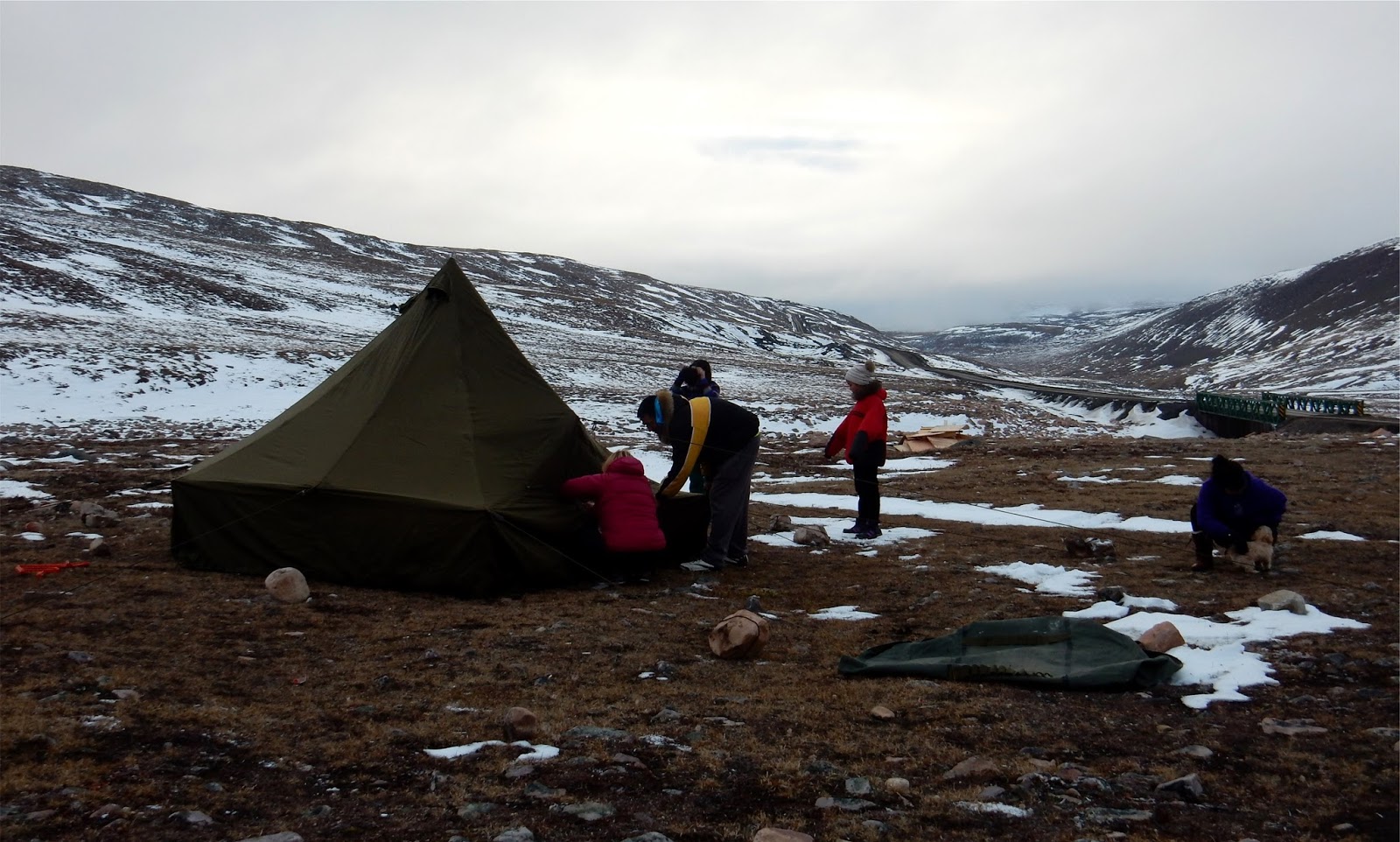
Everyone assembled in front of Inuujaq School’s gym on Friday, September 15.  The time was 7pm.  Even though the temperature was higher than usual, I still arrived wearing my Canada Goose parka.  I was sweating but I didn’t want to take any chances.  The weather can change at any moment; especially in the mountains.  A senior cadet took roll call.  The cadets then loaded their personal kit in several trucks.  The local RCMP had volunteered to provide transportation to the Second Bridge.  The cadets divided themselves up and found a seat in a truck.  I drove Frank’s truck.  Frank and his grandson had spent much of the day transporting the corps-owned equipment to the Second Bridge and setting up the supply tent.  The drive to the Second Bridge took about 20 minutes.


Everyone disembarked from the vehicles and removed their personal items from the trucks.  The RCMP wished everyone a good weekend and returned to Arctic Bay.  The cadets went to work setting up their tents.  The two Canadian Rangers providing predator control brought their own tent and pet dog.  We would have a guard dog for the weekend.  The male cadets pitched a white Fort McPherson tent and the females pitched a green Arctic five-person tent.  The cadets used large flattened cardboard boxes as flooring before setting up their air mattresses & sleeping bags.
            
Cardboard flooring.
Guard dog.
I held a quick briefing with the cadets, once they had their living arrangements in order.  I welcomed them to Operation Hill Top 17 and explained the program and the camp rules.  I also pointed where the boundaries were.  I answered several questions before dismissing the cadets to their tents.  Everyone had an evening snack break before going to bed.
            
Saturday, September 16, 2017.
Frank's Truck.
Reveille was 8:00am the next morning.  I was glad I brought my Canada Goose parka because the weather had changed.  Snow had fallen during the night.  There were low clouds in the valley and the temperature had dropped.  Breakfast consisted of American made Meals-Ready-to-Eat (MREs).  Each tent was given a garbage bag to collect trash.  We didn’t want any unwanted visitors.  Once breakfast was complete, I taught classes in survival skills, cloud formations, and radio communication procedures.  I had to alter many things in the survival lesson because the content primarily focuses on the southern Canadian landscape.  By lunch time, the clouds had disappeared and the sun came out.
            
Three cadets hiked up a nearby hill before lunchtime.

Arctic Bay in the distance.
The 7km hike began after lunch.  We would walk from the Second Bridge to the First Bridge.  The second-year junior cadets were required to carry packed rucksacks.  The first-year cadets were not.  We packed juice boxes, granola bars, toilet paper, and garbage bags.  One ranger, armed with a .303 rifle, would walk with us.  Civilian Instructor Reid would drive ahead in a pickup truck.  I gave him a walkie-talkie to stay in contact.  Several cadets chose to use walking poles for the duration of the hike.
            
Break Time.
The cadets walked as a platoon and did their best to keep to one side of the road.  I explained to them that when they travel down south for the Silver & Gold Star Expeditions, they would be required to do the same, but for more than 7km.  The ground slowly began to change.  The further we walked, the less snow there was.  We took several snack & bathroom breaks.  Since there are no porta-potties around, you just walk behind a hill and go.  It took us about three hours to reach the First Bridge.  I ran ahead to photograph the cadets crossing the bridge.  Everyone was driven back to the camp site.
            

Building a bonfire.
The cadets were given free time after dinner.  In the evening we had a bonfire.  Two senior cadets brought the wood with the help of their father and his pickup truck.  The Rangers instructed the cadets on how to build the perfect bonfire.  The matches were lit and a small fire was started.  The fire slowly grew in size and by nightfall it was large enough to break out the marshmallows and hot dogs.  We surrounded the fire with our roasting sticks.  We burned as much wood as we could.  When it was time for bed, we dumped a lot of snow on the fire. 
            
Now that's a bonfire!
Cleaning out the Command/Supply Tent.
Garbage Sweep.
Reveille on Sunday, September 17, was 8:00am.  The were clouds in the sky but the weather wasn’t bad.  I taught classes on how to be a good outdoor leader and how to set up a bivouac site after an MRE-filled breakfast.  We tore down the camp in the late morning.  Two pickup trucks had arrived to assist us in the teardown.  The cadets were instructed to pack up their personal belongings and remove them from their tents.  The tents were then taken down and packed.  Corps-owned equipment was collected and placed in one pickup truck while the other was filled with personal belongings.  The cadets did a garbage sweep of the area before piling into the trucks.

            
There used to be tents here.
The debriefing was held at Frank’s shop.  The corps rents out a sea can to store its equipment & supplies.  Frank, (former commanding officer of 3045), led the debriefing.  We both congratulated the junior cadets for completing the 7km hike and for coming back alive.  Their reward was to help the adult staff put all the corps-owned equipment away.  Their homework was to tumble dry their sleeping bags and wash the inner liners.  The cadets were then driven home.  Operation Hilltop 17 was another successful FTX.     

Frank's Debriefing

Thursday, September 14, 2017

Boats, Cleanup, & A Meet-N-Greet


Two Grade 9 students volunteered to help me transport all my sealift goods to my residence.  They had already helped the Grade 8 teacher break open the large wooden crates with crowbars.  The packers in Montreal did a really good job stacking everything into a cube and building a wooden box around it.  They must also be experts at the video game Tetris.  I rewarded the two students with two cans of pop each. 
            
The main living area in my residence looked like a warehouse.  There were boxes all over the floor.  It took me three hours to open them and put away all the stuff I packed in July.  The garbage bin outside was packed with discarded boxes.  Looking at all the cupboards, full of canned food, dry food, bottled water, and other things, I was convinced I would be alright for many months.  I would still have to buy perishable food at the local stores but I would be saving money in the long term.
            

The NSSI sealift ship arrived on September 1.  It only stayed in the bay for a day.  The crew must have been exhausted by the end.  The sealift shipping season is at the mercy of Mother Nature.  You have to get everything done before the waterways turn to ice.
            
Two coast guard ships, CCGS Henry Larsen & Terry Fox, also anchored in the bay at the beginning of September.  What I didn’t expect was to see the gas ship again.  The Travestern had returned to transfer fuel over to the two coast guard ships.
            

On Saturday, September 2, the cadets of 3045 Army headed out to the airport to clean up the shoreline behind the runway.  Every year before the arrival of winter, the cadets complete a portion of their community service training by doing a large garbage clean up.  The corps started cleaning the shoreline behind the airport in 2013.  We took a break last year and cleaned a different area.  There was enough garbage along the shoreline to warrant a return.  This would be my first clean up as the corps’s new commanding officer.
            

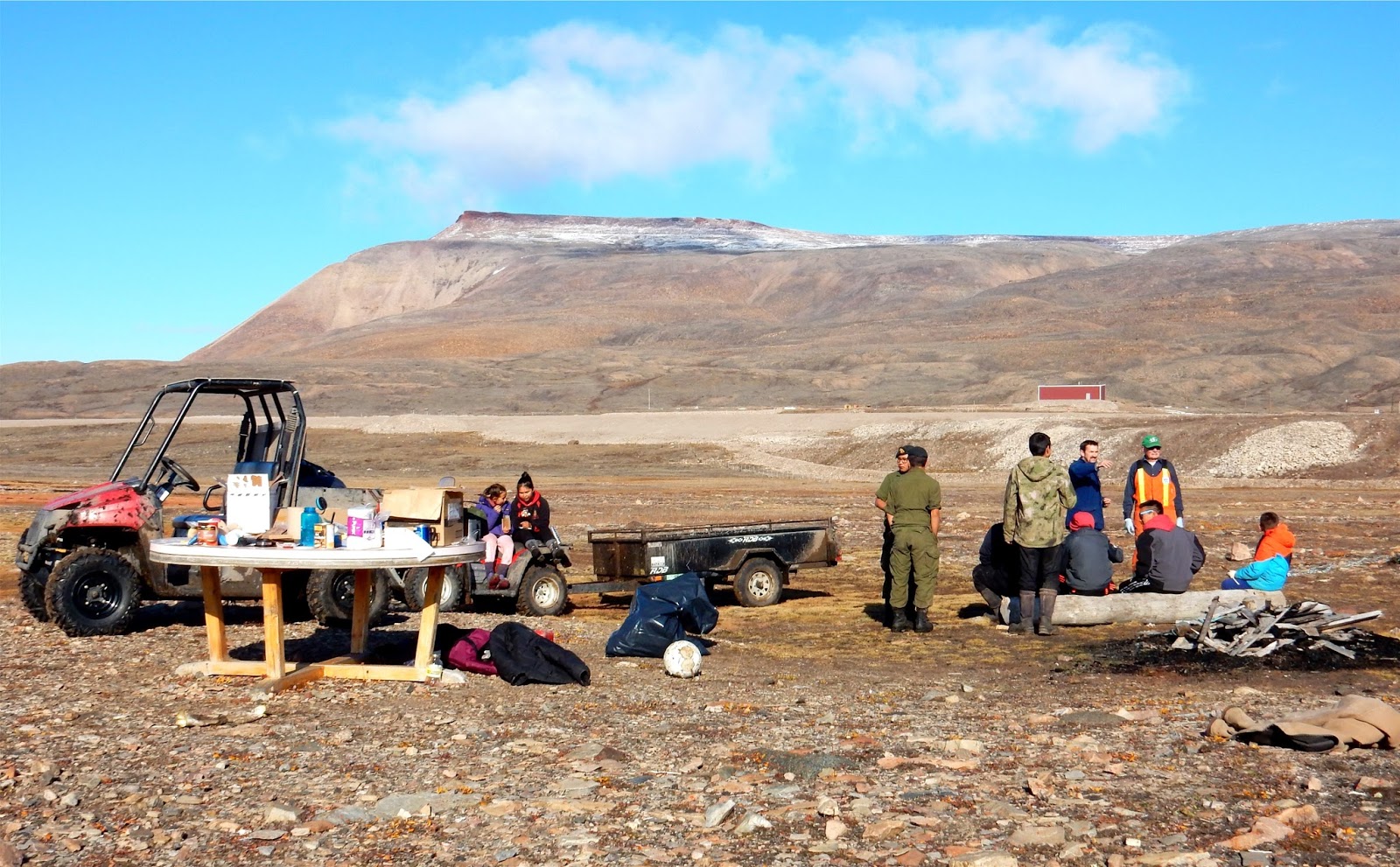
We assembled at the local Anglican church to have breakfast.  We then headed over to the airport in a convoy of pickup trucks and atvs.  The atvs pulled trailers that we would use to haul garbage bags full of trash and any large objects.  Everyone had been instructed to wear warm clothing, gloves, and rubber boots.  Some walked down to the shoreline while others got a lift in the trailers.  I gave the trailer a try.  It was a very bumpy ride down to the shoreline.  Next time, I’m riding on an atv.
           
The large wood pile we started in 2013 was still there.  We collect more wood than we can burn.  The pieces of wood are from discarded sea lift crates and are carried by the currents from the town, across the bay, and finally to this shoreline.  The currents also bring many, many other items over the brief summer months. 
            
The cadets were divided into two groups and given many large black garbage bags.  One group headed south and other headed north.  The senior cadets were in charge of using the atvs and trailers.  Two adult staff set up a white tent and lit two Coleman stoves to boil large pots full of water.  The time was 10:30am.  We would stay until 3pm.
            

The ground was mostly wet and muddy but we still collected all sorts of things.  Pop cans, tires, plastic bags, plastic oil containers, chip bags, gloves, a tricycle, oil drums, and toys.  And that’s just a short list.  I found a large rabbit doll and called it Tummy.  It was our mascot for the day.


The cadets were fed hot chocolate and Meals-Ready-to-Eat (MREs).  I made sure the trash we created was put in garbage bags.  The atv crews brought out a lot of garbage bags, full of trash.  The bags and very large objects were transferred to a pickup truck.  An adult staff member drove the pickup to the local landfill and dumped everything there.  This process was repeated several times.  The wood pile was slightly larger than before.  More wood for us to burn at the annual October bonfire.


A cleaner landscape.
Everyone was tired by 3:00pm but the shoreline looked more pristine.  The cadets were formed up and debriefed about their hard work & accomplishments.  Then they assisted the adult staff in taking down the tent, packing the Coleman stoves, and loading the trailers with the left over MREs and garbage bags.  This time, I walked back to the airport parking lot instead riding in the trailer.  The cadets were driven home.  Another successful beach cleanup in the books.
            
Arctic Bay’s new health centre officially opened on September 11.  At a cost of $23 million & taking 2 years to construct, the new facility is bigger and better than the old one.  There’s more space and more medical equipment.  I was unable to attend the opening ceremony because it was during regular school hours.  One of my drummers performed at the ceremony and had his picture featured in Nunatsiaq News.  A new five-plex residential unit is being built next to the health centre to accommodate medical staff.  The old health centre was built in 1983.  What will it be used for now?  Only time will tell.

           
New tables!
Inuujaq School held a Parent-Teacher Meet & Greet on Tuesday, September 12.  Many parents came to school to speak to the teachers, understand what their children were being taught, and what the routines of the classroom are.  Snacks were available in all the classroom.  The Meet & Greet also gave me an opportunity to show off the new tables I got from the sealift.  I was glad that many parents came to speak to me.  Otherwise I would have been alone and eating all the snacks by myself.