Saturday, May 13, 2023

Spring Camp 2023

Inuujaq School held a weeklong spring camp during the first week of May.  The event was widely anticipated because the last time it was held was in 2019.  The school normally organizes it every year - as my dedicated readers already know - but it had to be postponed three times due to the COVID-19 pandemic.  Everyone was glad & excited to see it return.

Spring Camp is an on-the-land field trip that gives students and staff the opportunity to experience traditional & modern Inuit culture & activities outside the classroom.  Some of these are: seal hunting, ice fishing, igloo building, sewing, story telling, Bannock making, dog sledding, and qamutik (sled) maintenance.

Planning began in March.  The Events Committee met once a week to discuss, plan, organize, and schedule.  School Administration and local District Education Authority (DEA) assist with ordering food and hiring Elders & drivers.  Elders are tasked with putting together the lessons & activities, and drivers chauffeur students, teachers, and supplies to the camp.  Teachers provide student supervision and are also allowed to participate.
Spring camp is spread across a week to prevent camp staff from being overwhelmed.  A predetermined number of students & teachers head out to the camp site each day.  High school students went first, followed by middle school, and then elementary school.  The last day, Friday, May 5, was reserved for just staff.  I was unable to attend the first day because I was in Winnipeg with my cadets attending a marksmanship competition.  But I did go on Friday.

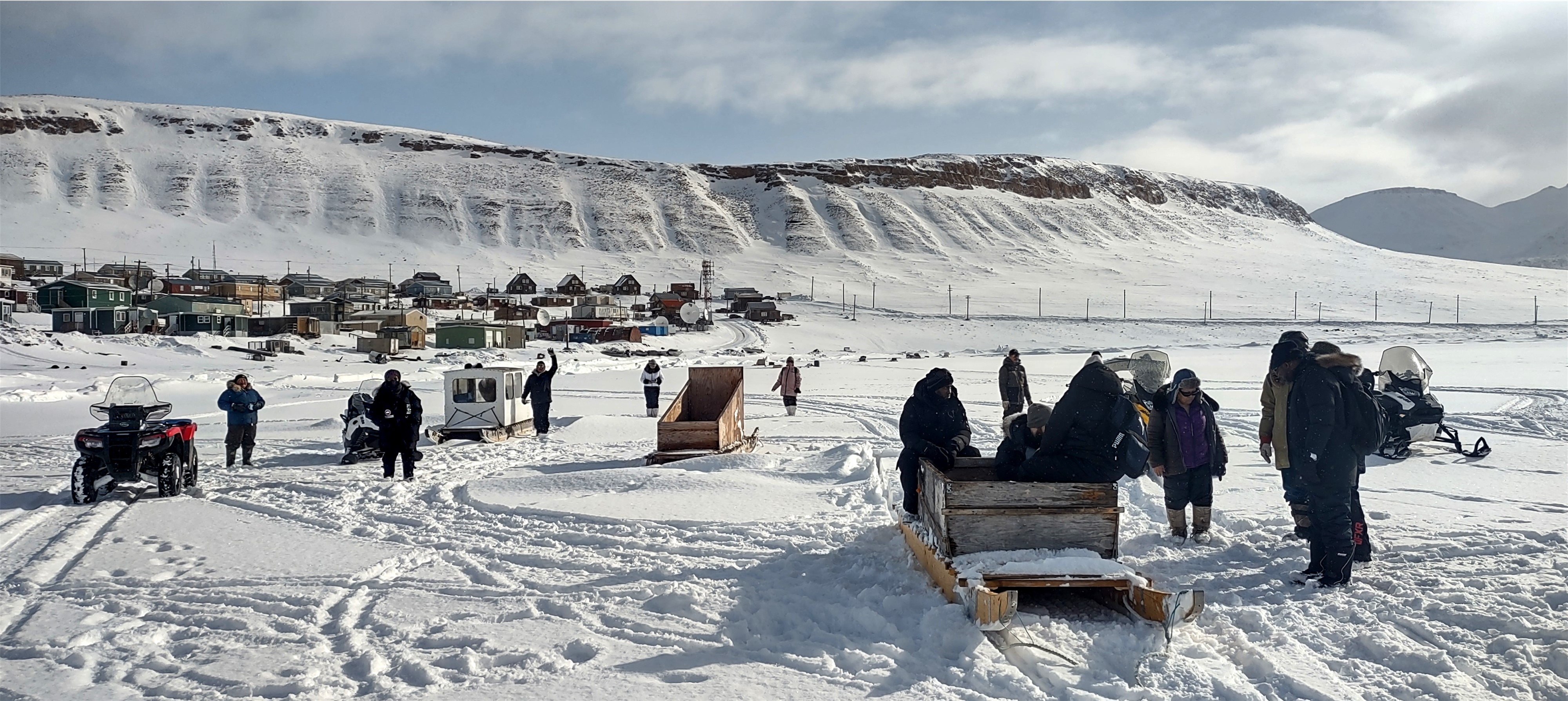
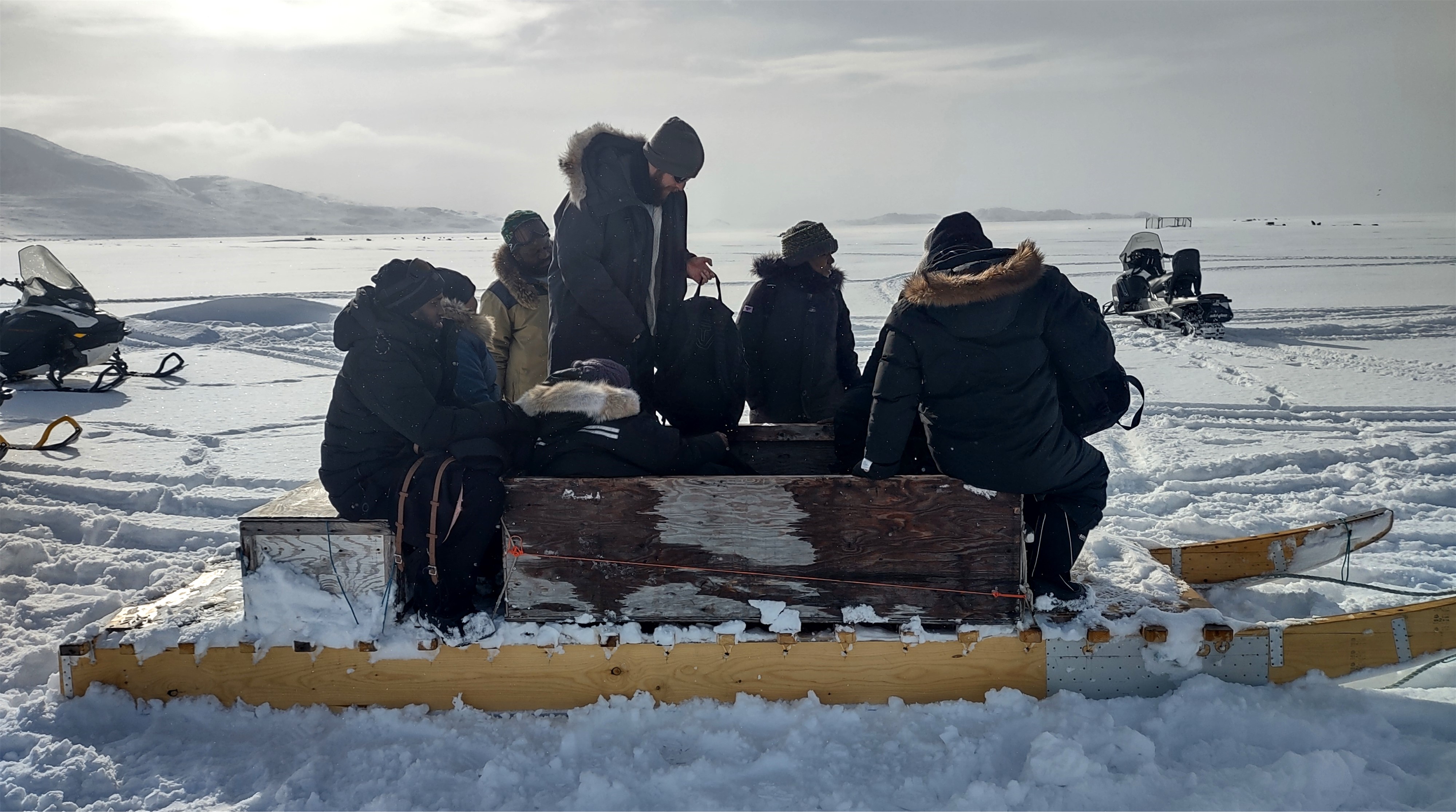
Staff headed down to the ice at 9:30am, bringing everything they would need for the day.  They also carried supplies and loaded them into six qamutiks.  I brought my own skidoo.  We did a quick head count and then the convoy left at 9:45am. 


I followed the convoy but then sped ahead to take pictures of them passing by.  Staff & drivers waved at the camera.  The camp site was Pattaataliarusiq, about 12km southeast of Arctic Bay.  This location has been used for previous spring camps.  It’s far enough to be considered out on the land, but close enough to the community in case there’s a medical emergency. 

Staff helped the drivers unload supplies and put up the white tents.  The tents were already there but lowered to the ground to prevent them from being blown away.  There were supplies underneath, so at first, I thought these supplies were covered by white tarps.  Instead, staff lifted wooden beams and the tents “magically” sprung up from the ground.  Good camouflage on display.

Washroom facilities are always a concern when camping.  In the past, an igloo without a roof was built or a tent with a bucket inside was declared the washroom tent.  This year, the drivers brought a wooden outhouse.  The toilet consisted of a bucket with a garbage bag.

A high school graduate (HSG) was hired to provide dog sled rides for Spring Camp.  He’s been running his own team for a few years now.  Several staff members & I got to experience being pulled by sled dogs before lunch. 

A driver drove a skidoo pulling a qamutik.  The HSG sat on the back of the qamutik coaxing the sled dogs to follow at a slow pace.  If you’re on the sled being pulled, you have to be ready to throw the metal anchor off to the side to signal the dogs to stop running.

I must admit this was my first-time dog sledding and the dogs did very well.  They didn’t run off and I didn’t fall off.  We didn’t go too far from the camp site; “just around the corner.”  When we came back, lunch was being served.

The lunch menu consisted of caribou, hamburgers, hot dogs, granola bars, juice boxes, and whatever snacks people brought on their own.  Two small barbecues and propane tanks were brought to the campsite and the food was prepared by staff with BBQ experience. 

We went ice fishing at a nearby lake after lunch.  Two drivers drilled a few holes using a motorized ice auger.  Watching this is always mesmerizing due to how many extensions are needed to hit water.  The ice can be up to 9 feet thick so drilling through all that can take a couple of minutes.  The most efficient way is to have three people: two manning the ice auger while the third shovels the ice & snow. 


Despite our best efforts, we were unable to catch any fish.  But that’s the way it goes sometimes.  What I would like to do one day is buy/rent an underwater camera designed for finding & tracking fish and film several videos of Arctic char swimming around.  I could also use it to film seals.  I have GoPro cameras, but I’d have to attach them to the end of a long stick.  I’m also hesitant to do that because if the camera(s) detach from the stick, they’re gone forever.

Everyone returned to camp at 2:30pm for a little down time and snacks.  The cleanup / teardown of the camp began at 3pm.  Everything was packed onto qamutiks except for the wooden outhouse.  The leftover food was divided amongst the staff, Elders, and drivers.  I didn’t take any.  We left Pattaataliarusiq at around 3:30pm.  We arrived in Arctic Bay at 3:45pm.

Overall, the day trip was fun and a nice way for staff to enjoy the outdoors without students.  Yes, even teachers need a break.  Hopefully we’ll go seal hunting next year.


Wednesday, May 10, 2023

Stage III Marksmanship (2023) – Part 3

The last day of April began in the early morning at Denny’s.  I was feeling bold and decided to order the steak & eggs meal – the breakfast of champions.  It looked good and tasted good.

The rifle range setup looked a little different than yesterday.  The targets had been raised and the SIUS consoles sat on tables.  Chairs had been placed for cadets.  The many lines of wires stayed the same. 


Cadets got ready and had their air rifles inspected again.  A short morning briefing was held for everyone just to review the schedule for the day.  Cadets would shoot a practice relay and two-timed standing relays.  Shooting in the standing position is challenging because you don’t have a flat surface to rest your rifle, and you can only hold the rifle straight for a few seconds before your arms start shaking. 

Cadets were given 15 minutes for the first standing relay and 30 minutes for the second.  They shot 30 pellets in total.  I followed the same routine as before: standing behind my cadets and monitoring their progress.  You have plenty of time to shoot, so taking short breaks are allowed.  Just don’t shoot after the timer runs out because you’ll be disqualified.  Despite the added challenge, I did observe my team scoring a few high hits.  They were relieved after the end of the second relay. 

I congratulated my cadets for completing all relays.  They put away their rifles and shooting jackets.

The last standing relay finished at 1pm.  Cadets were instructed to help officers clean up and put away the equipment.  I was impressed by the amount of storage containers & Pelican cases needed to protect & transport everything.  The large storage containers came with attached wheels, making them much easier to move.  The cadets did a garbage sweep of the rink once all the equipment was packed.

The competition organizers had the cadets form up for the final debriefing.  The Officer-In-Charge (OIC) thanked the cadets for coming out and congratulated them for seeing the competition until the end.  He then moved on to announcing the results.  The final results weren’t posted to avoid spoilers.  My cadets & I were overjoyed when they announced team Arctic Bay as the winners of the Eastern Arctic Zone.  They achieved first place!  They were only competing against Iqaluit, but the win still counts!

The OIC apologized for no Stage 4 competition being planned this year; circumstances prompted Headquarters to not go ahead with a national competition.  There’s always next year, as the saying goes.  The OIC wished everyone safe travels home and the cadets were dismissed.

The Iqaluit, Arctic Bay, and Thompson cadets returned to the hotel with their coaches.  They transferred their gear from the vans to their rooms.  Dinner was prepared & delivered to the hotel by the Olive Garden.  The food was distributed in an area next to the main lobby.  It was quite good.

May 1 began like the previous two days: breakfast at Denny’s.  I ordered a Classic Benny again.  We still had time in the morning before our afternoon flight, so I took my cadets shopping at the CANEX at CFB Winnipeg.  CANEX is short for Canadian Forces Exchange System and it’s a retail store focused on serving military personnel since 1968.  They sell clothing, badges, footwear, furniture, bags, electronics, boot polish, and snacks, so don’t expect to see firearms on sale.

We checked out at noon and were driven to the airport.  We checked in our luggage and air rifles and went through security.  Lunch was waiting for us near our gate at True Burger Co.  Our flight departed Winnipeg at around 3:45pm.  We landed in Ottawa 7:45pm.  The same escort officers from Connaught arrived shortly thereafter and drove us to the cadet camp for the night.  On the way there, I overheard cadets saying they were glad to be returning home, but already missing their time in Winnipeg.

The last day of the trip began in the very early hours of May 2.  We had to be at the airport for 6am, so we were up and about as early as 4am.  We did get to the airport on time, checked in, went through security, and arrived at the gate with time to spare.  But we were still tired, as anyone who’s taken a red-eye flight will attest.  The flight to Iqaluit departed at 8am.  Most passengers slept the entire way, but not the pilots . . . I hope.  We landed safely in Nunavut’s capital at 11am.

We said our goodbyes to the Iqaluit team after they collected their luggage in the Arrivals Area.  My cadets enjoyed lunch at the Tundra Take-Out & Diner in the terminal’s main lobby and then we headed to our gate to catch the flight to Arctic Bay.  We left in the afternoon, stopped in Pond Inlet, and then landed in Arctic Bay after 5pm.  The cadets were picked up by their parents & guardians.  Frank was there to help me transport the air rifles back to the cadet office and give me a ride home.  The trip had officially come to an end.

Overall, the trip was a success.  I was impressed by the quality of food we were served.  We felt like we were being spoiled.  I’m also very proud of the cadets for winning first place!  They get to enjoy bragging rights for a year.


                                     End of Stage III Marksmanship (2023) mini-series. 

Monday, May 8, 2023

Stage III Marksmanship (2023) – Part 2

The cadets and coaches assembled in the hotel lobby in the early morning of April 29 and proceeded to breakfast.  The organizers made a paid deal with a local Denny’s restaurant to provide breakfast meals to the cadet teams staying in the hotel.  We were allowed to order anything from the menu.  I ordered a Classic Benny meal.  Breakfast lasted an hour.

Everyone loaded their air rifles, shooting jackets, and other necessary equipment into two military vans after breakfast.  The competition was taking place in another part of town so we needed to bring everything for the day because we wouldn’t come back to the hotel until the late afternoon.  I drove one of the vans.  The cadets in my van appeared excited. 

The organizers booked the Charlie Gardiner Arena for the weekend.  The arena is named after the late Charlie Gardiner, “a Scottish-born Canadian professional ice hockey goaltender who played for the Chicago Blackhawks in the [NHL].”  The hockey rink had been drained and turned into a shooting range.  Cadet competitors shoot using the fancy & expensive SIUS targeting systems.  The systems use microphones to triangulate the precise locations of pellets hitting the targets using sound.  The information is sent to consoles for the cadets to see and to laptop computers for the judges to review, record, and score.  In short, there were a lot of wires spread across the floor.

My cadets & I were given one of the change rooms to store our rifles & equipment.  They were instructed to put on their shooting jackets & glasses and bring their air rifles for inspection.  The judges wanted to make sure the rifles were working properly and not illegally modified. 

A welcome briefing was held in the arena after rifle checks.  All the cadets & coaches were present.  Iqaluit & Arctic Bay were the only teams from Nunavut.  The rest were from Winnipeg and other Manitoba towns.  The Officer-In-Charge (OIC) explained the layout of the arena, the rules, schedule, and how the competition was to proceed for today and tomorrow.  Teams were divided into two groups.  When one group is shooting the other is resting.  All relays for the first day would be done in the prone position. 

Teams were given 30 minutes of practice time on the SIUS targets.  Cadets were allowed to shoot as many pellets as they wanted.  They also used the time to familiarize themselves with the SIUS target consoles, zero-in their rifles, practice their breathing, and strengthen their focus.

My cadets had lunch before their first timed relay.  The meals were prepared & delivered by Subway.  The fast-food chain specializes in subway sandwiches.  Five different kinds of sandwich meals were prepared; one of them excluded meat.  We selected a meal and had 45 minutes to consume it.  We were allowed to save leftovers for later.

I held a brief final team meeting with my cadets before their first relay.  I wished them the best, to remain calm & focused, and to have fun. 

All cadets shot three timed relays in the prone position.  Each relay lasted 30 minutes and cadets shot 20 pellets per relay.  A perfect shot (bullseye) is 10.9 points due to the tracking accuracy of SIUS computers.  A perfect relay score would be 218 points.  If we were using paper targets, a perfect shot would only be 10 points.

I stood behind my cadets and monitored their shooting.  I also took photographs and posted them to the corps’ Facebook page to keep everyone in Arctic Bay informed.  Two of my cadets shot a 10.9 each during Relay 2.  They were very proud of that.  My cadets & I sat in the stands and watched the other cadets compete when we weren’t shooting.  The time was 3:45pm when we finished our third relay.

We were allowed to leave our air rifles & shooting jackets at the arena overnight because no one else was using the facility.  The interim results were posted in the main lobby after 4pm.  The cadets crowded around the papers to see their results.  My team appeared to be doing just fine.

The cadets were driven to CF Polo Park Mall and given two hours to shop & hangout.  Unfortunately, the store I wanted to go to had permanently closed.  I walked around the mall, making sure the cadets weren’t getting into trouble.

Dinner was held at The Old Spaghetti Factory restaurant in downtown Winnipeg.  This was a first for the Arctic Bay cadets & me.  I ordered pasta.

We returned to the hotel full, tired, and wanting to rest.  The cadets were dismissed to their rooms for the night, but we did remind them to be down in the lobby at 6:30am tomorrow morning for breakfast.


                                                                  To Be Continued . . . 

Saturday, May 6, 2023

Stage III Marksmanship (2023) – Part 1

Marksmanship plays a large role in the Canadian Cadet Program, teaching & promoting accuracy, dedication, focus, and teamwork.  Tournaments are held every year to promote friendly competition and determine the best shooters in Canada.  Cadets develop and perfect their shooting skills on the Daisy .177 calibre air rifle.  A regional marksmanship competition was held in Winnipeg for the Northwest Region in late April.  Four of my cadets participated and I also attended as coach & escort officer.

Marksmanship competitions are divided into four stages.  Stage 1 happens at the corps level where team tryouts are held.  Stage 2 is where teams compete in their respective zones.  These are done as mail-ins and in person.  Cadet corps in the territories usually do Stage 2 as mail-ins because air travel is very expensive.  Paper targets are mailed to the corps, the cadets shoot them once, and then they’re returned down south to be graded.  Teams with the highest scores advance to Stage 3, the regional competition.  The winners of Stage 3 advance to Stage 4, the national competition.  Unfortunately, there was no Stage 4 this year. 

3045’s Marksmanship Team practiced shooting prone & standing on the weekends.  The cadets selected their shooting jackets & air rifles and labelled them.  Participating corps are required to bring their own rifles, shooting jackets, safety glasses, and any other equipment they may need.  We packed everything the night before our departure.  

We arrived at the airport on the morning of April 27.  We flew down to Iqaluit where we met the Iqaluit team and their coach at the airport.  My cadets enjoyed lunch before going through security.  The flight down to Ottawa lasted three hours.  It was the late evening when we exited the terminal with our luggage and rifle cases.  Two officers escorted the two teams to waiting vehicles and drove us to Connaught Cadet Training Centre for the night.  We were given boxed dinners and then assigned tents with bedding.  I had a tent to myself.

The metal bunk beds and lockers brought back memories of my time spending many summers at cadet camp as a cadet, staff cadet, and civilian instructor.  Although, in the early 2000s, we slept in sleeping bags on cots.  And the tents were green and modular.


Everyone was out of bed and dressed at 6:15am on the morning of April 28.  We headed over to the mess hall for breakfast.  The menu consisted of eggs, bacon, hashbrowns, and various fruits, a standard across cadet camps.  Breakfast lasted an hour.  We returned to our tents for some downtime. 


Our flight wasn’t until the afternoon, so the Iqaluit coach & I decided to take the cadets on a tour of the camp.  I had previously visited the camp on many occasions, so I already knew my way around. 

We started at the shooting ranges, large open flat grasslands with big number signs at one end to show the individual shooting lanes.  None of the ranges were in use.  The cadets were more interested in trying out a set of 4 chin-up bars.  A few managed to get a high number before their arms got tired.


We continued walking along a main road, stopping several times to inspect various military vehicles & a helicopter on display.  The had been turned into outdoor museum displays.  We followed the road for quite some time, passing an M109 Howitzer, and eventually ended up at Shirleys Bay.  We stayed there for 30 minutes, resting, and enjoying the view of the Ottawa River.

We returned to camp following a different road, passing an obstacle course that featured many different, um, obstacles.  Unfortunately, we did not have clearance to try them out.  Maybe another time.

The escort officers drove us to the Ottawa Airport after lunch.  We thanked the escort officers for their help, checked in, and went through security.  We flew direct to Winnipeg, landing in the evening.  Two different officers met us in the Arrivals area and helped us recover our luggage & rifles from the baggage carousel.  We loaded everything into military vans and were driven to the hotel.  We were assigned rooms.  One more team from out of town arrived in the late evening.  The cadets & coaches were instructed to get some much-needed rest.  Tomorrow was going to be a very busy competitive day.      

                                                                    To Be Continued . . .