Tuesday, May 7, 2013

The Later (Many) Days Of April


Kindergarten.
On April 15, the teachers and students of Inuujaq School gathered in the gym to recognize students with perfect attendance for the month of March.  Since coming to the north in 2012, I have learned that one of the greatest challenges for educators is getting students to regularly attend classes.  (I'm pretty sure this problem also exists down south).  Also, there is the argument that awarding perfect attendance is trivial and not fair to other dedicated students.  Medical appointments, illnesses, family events (up here, that includes camping & hunting trips), and being late are all facts of life.  Nevertheless, the recognition alone encourages students to take their education seriously.
            
Grade 2.
The attendance awards were handed out from kindergarten to high school.  Naturally, the entire kindergarten class received certificates.  The remaining recipients are as follows: two for Grade 1, five for Grade 2, three for Grade 3, six for Grade 4, two for Grade 5, four for Grade 6, six for Grades 6, 7, 8, and one for high school.  Each student received a certificate and was photographed with their teacher.  The one high school student had her picture taken with the principal.  In total, forty-one students received perfect attendance certificates out of a student population of 235.
            
Grade 4.
In English, my students watched and studied the feature film Stand & Deliver.  To make sure my students were paying attention, they had to answer four sets of questions.  Judging from their expressions, some liked the movie while others didn't.  Made in 1988, the film is based on the true story of Jaime Escalante, an East Los Angeles high school teacher.  In the 1980s, he successfully prepared his students for the Advanced Placement Calculus Test, which awards students with college credit.  However, problems arise when the test scores are challenged by the Education Testing Service.  What happens next?  Sorry, you'll have to rent/buy the movie to find out.  Jaime Escalante passed away on March 30, 2010, while undergoing treatment for bladder cancer.  He was 79 years old.
            
Flag of NATO.
In Social Studies, we finished the Staking The Claim Unit (looking at Inuit land claims) and moved on to the Security Unit.  The unit looks at the 20th century history of Canada becoming a safe and secure country.  The four condensed chapters look at Canada's role in both world wars, the cold war (NATO), and the defence of North America (NORAD).
            
For the later-half of April, my guitarists had two more performance tests.  The first one was the Canadian national anthem and the other was 'Yankee Doodle'.  For 'O Canada', they could read from the paper that contained both traditional notes and guitar tab, but for 'Yankee Doodle' they could only read traditional notes.  We also looked at several classic rock and pop song melodies.  I also introduced my students to the use of accidentals in music (flats, naturals, sharps) and dotted notes.  For them, the toughest part was understanding that notes with accidentals can share the same sounds.
            
April 30th.
The month of April is when the temperature usually stays above -20ÂșC.  This was true for the remainder of the month.  Even though there was snow on the ground (there still is right now), kids were out riding their bicycles.  Of course, 'brown patches' began to appear, revealing rocks, dirt, and the dark gravel roads.  Night no longer exists, having been replaced by constant dusk.  Pretty soon, the sun will never drop below the mountains and just circle the town.
            
However, the weather wasn't always sunny and clear, with strong cold winds blowing through town and out into the bay.  It made watching the dog races out a little challenging (more on that in a future post).  What surprised me the most was the morning blizzard on April 30th.  I thought blizzard season was over?  I guess not.  It was quite an adventure walking to school, dressed as a 'polar man'.  Afternoon school ended up being cancelled that day.    
            

Going back to the morning of April 17, I stumbled upon a small discarded antler on the side of the road.  I waited ten seconds before picking it up.  After assuming it was a caribou antler, I placed it in my bag and continued walking to school.  Along the way, I pondered on how it got there.  The best reason I could come up with was that a hunter had shot a caribou out on the land and brought it back to be skinned.  He either discarded the antler or the wind blew it away.  I asked several teachers at the school what it could be and they too concluded it was a caribou antler. I have to admit that it is one of the most interesting objects I have seen/found on my way to work.  The first were the white Arctic hares.
            
Speaking of Arctic hares, two (or the same one) ran by as I was walking to school in the morning.  I forget the days but I was surprised to see them again.  The last time I saw a hare was way back in January.  If I stay here longer, maybe I'll catch one and keep it as a pet.
            
On April 22, Inuujaq School received an over sized cheque from the Northern Store to go towards the community cleanup.  Every year, the teachers and students clean up outside the school and other designated areas after the snow melts.  The money will go towards cleaning supplies and an after cleanup barbecue. 
            
During the month of April, I was approached by Iga, the high school Inuktitut teacher, who wanted to know if I wanted to help her with organizing student council.  I agreed, wanting to become more involved with students.  Ironically, I wasn't involved in student council when I was in high school.  When I arrived in Arctic Bay in January, student council had been put on the 'back burner' because there wasn't a teacher who had the time to run it.  Now, there was Iga, myself, and Paulette, the art teacher.  

It was good to see a large turnout of high school students at the first after school meeting in Iga's classroom.  The first order of business was arranging a snap election near the end of the month to choose a president, vice-president, treasurer, and secretary.  Next was deciding when student council should meet (weekly or bi-weekly) and informing middle school students that the council was looking for a student to speak for the middle school grades.  The first and following meetings were very productive and it was good to see students wanting to improve the school's learning environment.  


And finally, the National Arts Centre (NAC) in Ottawa hosted a Northern Scene festival from April 25 to May 5, "featuring more than 250 artists from Yukon, the Northwest Territories, Nunavut, Nunavik, and Nunatsiavut."  Musicians, actors, dancers, writers, filmmakers, storytellers, and chefs from the north came together in the nation's capital to "paint a living portrait" of their lives and cultures.  The festival was the sixth Scene festival organized by the NAC, the previous being: Atlantic (2003), Alberta (2005), Quebec (2007), British Columbia (2009), and Prairie (2011). 
            
Judging from the pictures, videos, and stories on the NAC website, the festival appears to have been a great success.  It would have been nice to attend and experience the festivities but I'm too busy living and teaching in the northern scene.  Even though the core events are over, there still appears to be several ongoing events related to the festival.  If you're in the Ottawa area, set aside some time to check them out.       
         
April 30th.

Thursday, May 2, 2013

3045 ACR


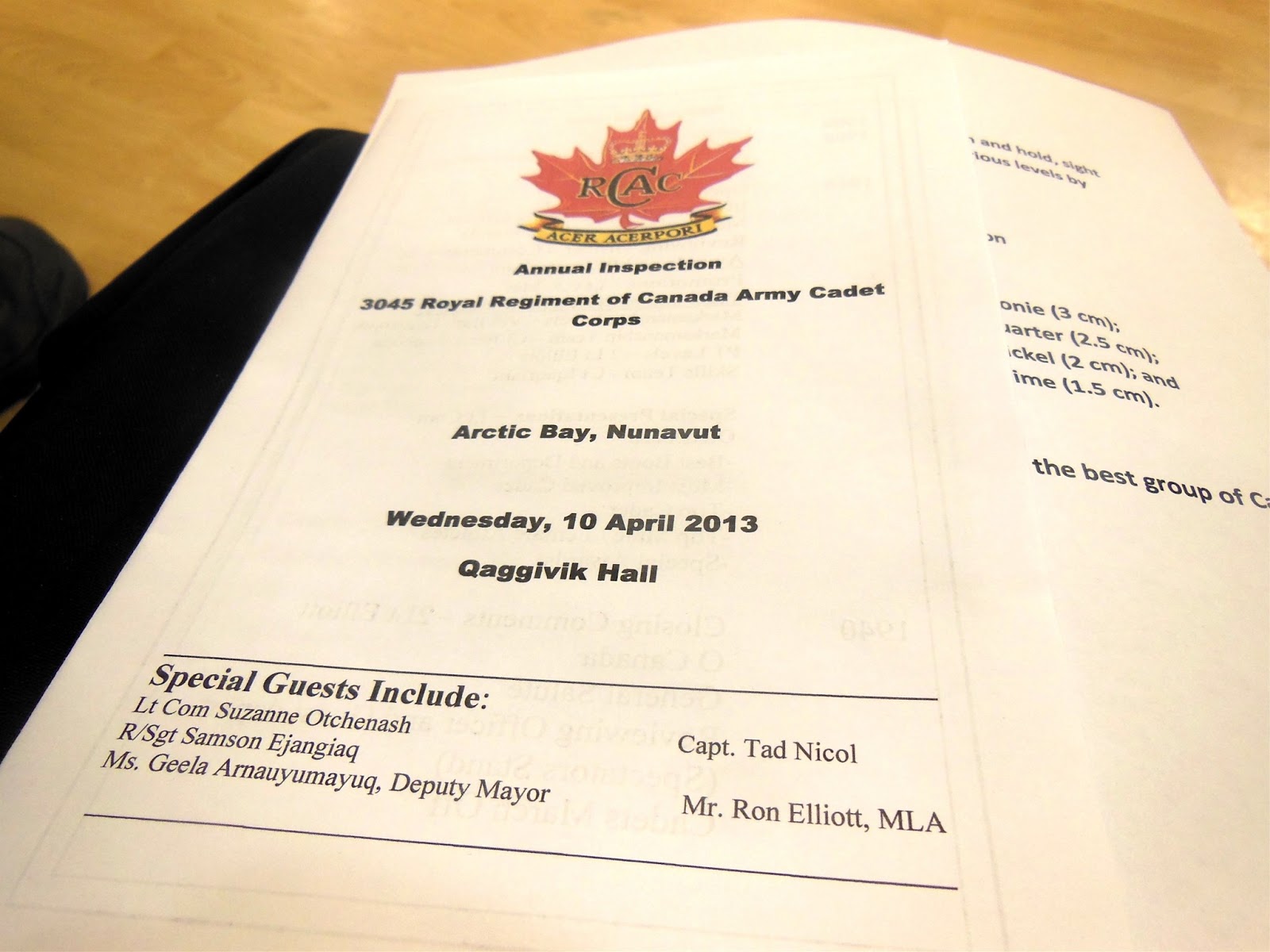
In the cadet program, individual cadet corps across Canada host an Annual Ceremonial Review (ACR), a formal parade at the end of the regular training year.  It is organized to showcase what the cadets of the corps have learned throughout the year, and to present awards & promotions. The parades are attended by parents, friends, and visiting guests.  Informally, an ACR is known as an Annual Inspection. 
            
The ACR of 3045 Army Cadets took place on the evening of April 10 in Qaggivik Hall (Inuujaq School's gym).  The early date was chosen because many Inuit families are out camping, hunting, and travelling between communities in May and June.  Corps are free to choose when to host their ACRs.  When I was residing in Iqaluit last year, 795 Iqaluit Air Squadron's ACR was in late May.  When I was an army cadet at 2332 Major Holland Cadet Corps in Ottawa, our ACRs took place in early June.  Down south, most cadet corps have their year-end ACRs in June.
            
The cadets of 3045 await the order to
march on parade.
The parade was scheduled to begin at 1900 hours (7pm).  Cadets, officers, and civilian instructors began arriving at the gym at 1800 hours (6pm) to get everything ready.  The cadets also worked on polishing their boots and making sure their dress uniforms were spotless.
            

The ACR began with the placement of the Canadian and Army Cadet flags on both sides of the dias.  Sergeant D. Kigutikakjuk and Master Corporal A. Reid were the flag bearers.  With both flags firmly in place, both senior cadets took their positions as right markers.  The entire cadet corps marched on parade and were right-dressed by Warrant Officer L. Oyukuluk.  Everyone in the audience stood as the Guest Reviewing Officer, Lieutenant-Commander (Lt. Com) S. Otchenash, entered the gym.  She was escorted to the Dias by the corps' Commanding Officer, Lieutenant F. May.  Other special guests in attendance included MLA Ron Elliott and Deputy Mayor Geela Arnauyumayuq. 
            
Lt. Com Otchenash inspects cadets on
parade.
Following an Inuktitut prayer, Lt. Com Otchenash inspected the cadets on parade.  She enjoyed speaking to all of them individually.  With the inspection complete, Otchenash took her place at the Dias and observed the March Past.  Parents snapped pictures of their sons and/or daughters marching by the Dias. 
            

With the March Past completed, Otchenash was given the opportunity to address the cadets and the audience.  She spoke in English while Mishak Allurut, a freelance translator, translated in Inuktitut.  Allurut was my Inuktitut instructor during Professional Development week in mid-February.  In her speech, Otchenash congratulated the cadets for their impressive dress, drill, and deportment.  She also thanked the parents and civilian instructors for supporting the cadet movement.  
            
Lt. May continued with the awards and presentations.  First on the list was promotions.  Three cadets were promoted to the rank of Lance Corporal (formerly known as Private), the first rank with a sewn badge - one chevron.  Three cadets were promoted from Lance Corporal to the rank of Corporal - two chevrons.  Three cadets were promoted from Corporal to Master Corporal - two chevrons with a maple leaf.  And finally, one senior cadet was promoted from Master Corporal to the rank of Sergeant - three chevrons with a maple leaf.
            
I'm (left) reading the marksmanship
level requirements. Mishak Allurut
(right) translates in Inuktitut.
Despite being a small corps, 3045 Army maintains three competing teams in marksmanship, biathlon, and skills.  The marksmanship team was led by Civilian Instructor (CI) Irene Swoboda.  Before she presented her awards, I, with the help of Mishak, explained to the audience how cadets earn their marksmanship levels.  There are four levels to attain and grading is determined by how close the cadet is able to hit the target in prone and standing positions.  The rifle of choice is the Daisy Air Rifle.  Five cadets obtained a Level 2, one earned a Level 3, and six were successful in attaining a Level 4. 
            

CI Irene Swoboda presents certificates
to the marksmanship team.
Fitness plays an essential role in the cadet movement by promoting healthy living and remaining physically active.  Three areas are assessed throughout the year: cardiovascular endurance, muscular strength, and muscular flexibility.  There are three fitness badges cadets can earn: bronze, silver, and gold.  This year, four cadets achieved a bronze level and one achieved a gold level.    
            
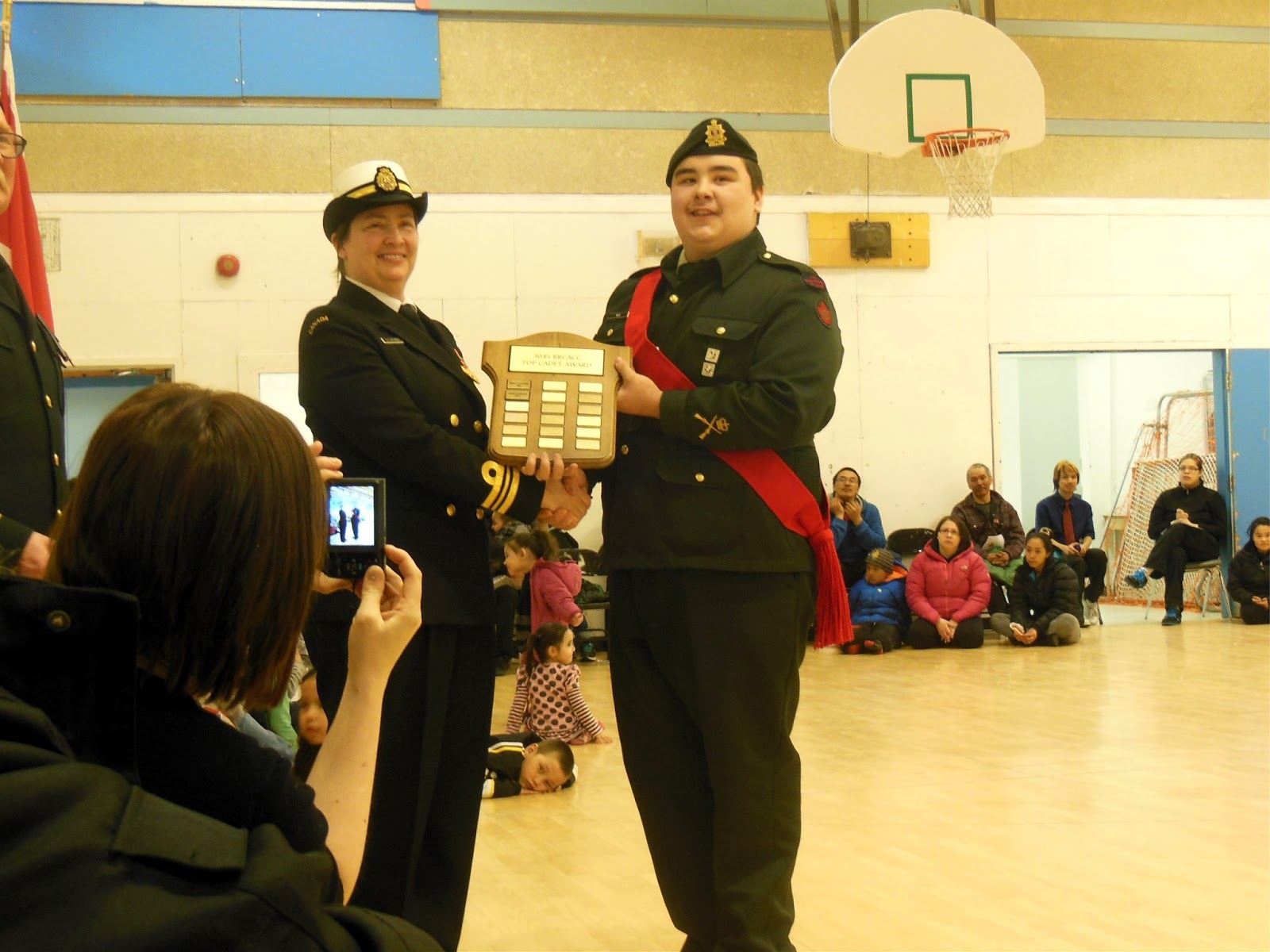
Lt. Com Otchenash presenting the award for Top Cadet to Sgt. A. Reid.
Lt. Com Otchenash was invited to present the last four awards for Best Boots & Deportment, Most Improved Cadet, Top Cadet, and Top Male & Female Athletes.  (Unfortunately, I have forgotten the names of the recipients, but I will find out shortly).
            
For the closing remarks, MLA Ron Elliott thanked everyone for attending the parade and for supporting the cadet movement.  He also congratulated the cadets for putting on a good show.  The parade continued with the playing of the national anthem 'O Canada' followed by the Advance in Review Order and General Salute.  Everyone in the audience remained standing as Lt. Com Otchenash and the reviewing party left the gym.  The cadets marched off to the sounds of the applauding audience. 
            
Retiring cadets WO Oyukuluk, Leslie and WO Attagutsiak, Bruno.
An after-ceremony reception was held just outside the gym with cupcakes, muffins, cookies and coffee being offered.  Most of the delicious sweets were prepared by Irene.  I mingled through the crowd, personally congratulating every cadet for completing the training year (even though there was still one month left).  All in all, it was a great parade.  


Saturday, April 27, 2013

The Mace Of Nunavut


A ceremonial mace is a decorated staff, used to represent a leader's authority and prestige.  That leader could be a monarch, military commander, or civil servant.  The design of the mace is based on the original mace, an ancient blunt weapon with a heavy head to deliver powerful and fatal blows.  In their early history, a ceremonial mace was also a practical weapon, used by a Sergeant-at-Arms to defend the leader it represented.  Today, that is no longer the case.
            
In Canada, every provincial and territorial legislature has a ceremonial mace representing its power and authority.  Nunavut's Legislative Assembly received its mace on April 1, 1999, when the territory officially came into existence.  The mace is crafted from narwhal tusk; the animals on it represent the connection between land, sea, and food.  The crown is made from Nanisivik silver and carved to show four common loons coming together.  The loons come together over a large blue lapis lazuli ball that was taken from Kimmirut.  The cross on top of the crown represents the British Crown.  At the tip of the mace is a 2 ¼ carat diamond from the Jericho Diamond Mine.  The mace was collectively made by six Inuit artists: Inuk Charlie (Cambridge Bay), Paul Malliki (Repulse Bay), Simata Pitsiulak (Kimmirut), Mathew Nunqingaq (Iqaluit), Mariano Aupilardjuk (Rankin Inlet), and Joseph Suqslaq (Gjoa Haven). 
            
When Members of the Legislative Assembly (MLAs) meet in Iqaluit, the Sergeant-at-Arms carries the mace over their right shoulder, leading a procession of Pages, Clerks, and the Speaker.  While the MLAs debate, "the mace rests in the hands of a man and woman carved in granite and labradorite."
            
There actually exist two Nunavut maces: the original and a replica.  While the original remains in Iqaluit, the replica 'visits' northern communities with the aid of the Sergeant-at-Arms and an MLA.  On April 10, the replica and MLA Hunter Tootoo came to Arctic Bay.  Hunter Tootoo has represented the Iqaluit Centre constituency since 1999.  He has also held many ministerial positions such as, Minister of Education, Nunavut Housing Corporation, and Homelessness.  In May of 2011, he was elected to serve as Speaker of the Legislative Assembly.
            
Teachers & students of Inuujaq School filed into the gym after lunch for the presentation of the mace.  Also in attendance were the town's mayor, Frank May, and MLA Ron Elliott.  A large colourful banner with the greeting "Welcome to Arctic Bay" hung at one end of the gym.  Just in front of it were a line of tables where the mace would be displayed.  After the mace was brought in by Hunter Tootoo, the assembly began with introductions in English and Inuktitut, followed by a prayer.  Iga Muckpa's Inuktitut class had prepared a welcome display featuring throat singing, drum dancing, and the singing of a traditional Inuit song.  It was a great display of Inuit culture.
            

The assembly continued with Hunter Tootoo introducing himself and the mace.  He gave a brief autobiography then continued with a more detailed biography of the mace.  He spoke in English and Iga translated in Inuktitut.  At the end of the presentation, he took questions from the audience.  From my observations, his answer to the first question, posed by an elementary student, stunned everyone.  In English, the student asked if he could speak Inuktitut?  He replied that he couldn't.  A short but awkward pause followed.
            
Students & teachers lined up to view the mace after the Q&A session.  No one was allowed to pick it up.  They were all excited to see a piece of Nunavut history.  When it was my turn, I took as many pictures as possible because I had afternoon recess duty.  I ran out of time before I could get a picture of myself standing behind it.  Thankfully, there is always another time.  I found the craftsmanship of the replica mace to be very impressive.  I think this was the third Canadian ceremonial mace I saw up close.  The first two were the maces of the House of Commons and the Senate at Parliament Hill in Ottawa.
            

Several days after the assembly, Iga's Inuit Culture class posted two large, hand-drawn posters of the mace in the high school area.  The posters were in English & Inuktitut, explaining the parts of the mace and the artists who crafted it. 


Tuesday, April 23, 2013

The First (Many) Days Of April


Being the workaholic that I am, the last two days of the long Easter Weekend were spent preparing lessons and correcting school work.  Since I devoted Friday and Saturday to rest & relaxation, I didn't want to fall behind in my work.  The long weekend made the transition from March (maatsi) to April (iipuri) smoother . . . or unnoticeable, depending on the person you ask.
            
With the arrival of April, the days have been getting longer and longer.  People are breaking out their sunglasses to protect their eyes from the shining sun.  Night is turning into constant dusk.  The Inuit teachers & students tell me that by May, it will be the period of the 'midnight sun'.  I'll have to make sure the window in my bedroom is covered by dark curtains, otherwise I won't fall asleep.  I remember experiencing 24-hour daylight in the Yukon back in 1997.  It was tough to fall asleep as well as surprising to see kids playing outside at 1am.  In the land of the midnight sun, the concept of time is lost. 
            
The temperature is still cold but getting more manageable.  I'm surprised by how well my body has acclimatized.  Wearing snow pants is no longer a necessity but an option.  I find it humourous to hear my southern friends complaining about the negative temperatures in the single digits.  Up here, that's summer weather!  As long as there's no wind, the cold is more than bearable.
            
The Science Fair was still in the minds of students as school continued on April 2.  In English, my students reviewed characterization, flashback, and foreshadowing.  I also included some grammar lessons in sentence writing.  The main challenge my students find is remembering to add prepositions to their sentences.     
            
In Social Studies, we were nearing the end of the Staking The Claim Module.  My students watched the third (also last) documentary that explained the federal government's settlement of the four major land claims agreements for Nunavik (1975), Inuvialuit (1984), Nunavut (1993), and Nunatsiavut (2005).  Focusing on the Nunavut Land Claims Agreement, I used a PowerPoint presentation to summarize the nine major guaranteed rights.  It would have taken too long to go through the entire agreement because it's over two hundred pages broken into 41 articles.  Plus, the legal wording of the document would be too difficult for my students to understand.
            
During the first two weeks of April, my guitar students had two performance tests.  The first was a review of basic open chords and the second was playing 'Ode To Joy' while reading traditional notation.  Both tests were challenging so I made sure they had enough time to ask for help and to practice.  They all did very well.  My students also looked at two pieces they requested: 'Joy to the World' and 'Jingle Bells'.  I guess Christmas will be coming early this year.
            
The week of April 8 - 12 was my second time on morning & afternoon recess duty.  Just like the first time a month ago, I was the only qallunaaq teacher on duty.  Nothing really serious happened.  The elementary kids still played on the play structures and slid down a hill using pieces of cardboard, and the high school kids still smoked.  However, the sun was much brighter.
            
Arctic Bay is home to many skilled artists and carvers.  The students of Inuujaq School are no exception.  With the arrival of spring, the windows in the high school wing have been decorated with sun catchers, all painted by Paulette's art students.  They all look really nice.
            

Speaking of creativity, two young Inuit boys decided to impress me in the late afternoon of April 9 while I was walking home after a hard day's work.  Using their arms & heads, they stood against the sun and created two eye silhouettes.  


Friday, April 19, 2013

Out For A Walk


Since coming to Arctic Bay I had always wanted to explore the surrounding area.  However, time and transportation kept getting in the way.  There was work to be done and I didn't have a snowmobile to get around.  Finally, after two months, the long Easter weekend gave me a chance to go out for a walk.  On the morning of March 30, I decided to walk over to Victor Bay, directly behind the town.  Many locals have fishing & hunting cabins there.  I dressed warmly and armed myself with a camera, binoculars, and a compass.  The Arctic sun shined brightly as I stepped out of my home.  There wasn't a cloud in the sky.      
            
What's over that hill?
A winding dirt road grants vehicular access to Victor Bay.  I followed this road, imagining the Arctic landscape I was going to see for the first time.  About halfway up the road, I stopped and faced the town.  The view was great.  There wasn't any activity in town, prompting me to assume that everyone was sleeping in.  The road peaks at the top of a small hill.  Crossing the peak, I walked past a long wooden qamutik.  In the distance, there were snow covered ridges.
            
I continued walking along the road, the tough snow crunching beneath my boots.  When I stopped several minutes later to take a photo of frozen plants, my ears were overwhelmed by the sounds of silence.  Complete.  Deafening.  Silence.  It was everywhere.  I had to snap my fingers several times to convince myself that I still had my hearing.  I also checked my ears to make sure I wasn't wearing earplugs. The silence added to the reality that I was in the far north where human activity is restricted to very small pockets.  For someone who grew up a city boy, (where there is always a sound of some kind), I found the silence to be relaxing.  And as a musician, the silence was 'music to my ears.'  (In music, silence is just as important as sound).  I like the sound of silence. 
            
I continued my walk, the silence being replaced with the sounds of crunching snow.  Several minutes later, my foot crunching was drowned out by a skidoo approaching from behind.  The Inuk driver raced passed me, dragging a small qamutik.  It was a safe bet that he was heading to his cabin.  As he passed me, I stopped walking, wanting to know how long it would take for the sounds of his roaring skidoo to disappear.  It took less than a minute.                        
            
A young hunter walks home empty-handed.
Victor Bay slowly came into view with every step I took.  In the far distance, I could see the frozen bay, an iceberg, and many mountaintops.  Walking in the opposite direction was a young Inuk hunter (between 9 - 12 years old) with a rifle slung on his back.  His hands were empty; he hadn't shot anything.  We exchanged greetings as we passed.  He was all smiles.  I guess he was staying positive and feeling certain that he would catch an animal on his next trip out on the land.  I envied him; I never got to fire a rifle when I was a kid.
            
When Victor Bay came into full view, I stopped to take several pictures.  Naturally, the silence returned.  The only sounds I heard were the clicks of my digital camera.  What I immediately noticed about the bay area was its similar layout to Arctic Bay.  One could build an entire replica of the town facing to the north.  At the moment, there are around six cabins in Victor Bay.  I spotted the snowmobile that passed me by earlier, parked next to a large wooden cabin.  
            

Out in the frozen bay stood a tall pinnacle shaped iceberg.  To the left of it stood a more tabular shaped iceberg.  I photographed both.  Looking through my binoculars, it looked like each iceberg had to be at least five stories tall.  I estimated that it would take me around an hour to get to them on foot.  However, doing such a thing is risky due to dangerous wildlife (polar bears).  Best to get there by skidoo.
            
I moved off the dirt road, walking eastward, creating my own path through the untouched snow.  I snapped a few more pictures of Victor Bay before heading back towards Arctic Bay.  I followed Arctic Hare tracks so that I wouldn't get stuck in deep snow.  If the snow is good enough for the local wildlife to walk on, then it's good enough for me. 
            
Industrial Area, aka 'Gas Station'.
The jagged hills that split the two bays are populated by many small inukshuks.  I emerged on top of a hill located somewhere close to the centre of town.  I was able to see the entire town and frozen bay.  I moved over to a taller hill to my right to get a clearer view.  Instead of an inukshuk, the summit is marked by a tall wooden post surrounded by rocks.  (There were two small inukshuks sitting on the right edge of the hill).  From here, I snapped pictures of the town, airport, industrial area, and the bay.  I also observed these places through my binoculars.  By this time, there was activity happening in town.  The silence had been replaced with the sounds of trucks, skidoos, and barking dogs.  There was also a cold wind, prompting me to pull up the hoodie on my Canada Goose parka.
            
Arctic Bay Airport
After enjoying the breathtaking views for some time, I slowly began my descent to the dirt road I used to get to Victor Bay.  I took my time, making sure I didn't slip and fall.  I wanted to take more pictures but the battery on my camera was drained.  When I arrived at my place, I transferred all the pictures I took to my laptop, and charged my camera.  While my camera was recharging, I prepared Arctic char for lunch.
            
The lone qamutik I passed by earlier.
Overall, I enjoyed my walk to Victor Bay and the surrounding area.  The excursion took about 3 & a half hours.  If I had more time (and possibly a skidoo), I could have explored more.  But that will have to wait for next time.  I'm not sure when that will be or where it will take place.  Perhaps the summit of King George V Mountain?