Monday, January 5, 2015

A Tour of Nanisivik - Part 2

(The tour occurred on August 31, 2014).

Former Nanisivik town site.
The Nanisivik town site was large enough to accommodate 50 dwellings, a large building complex, a small church, and a metal-domed teepee.  The complex contained a 10-room school, library, gymnasium, pool, bar, two stores, fire hall, daycare, a shop to fix things, the RCMP, a two-cell jail, a government liaison office, and a health centre with residence for (a) nurse(s).  The domed teepee is the same as the ones that are used down south to store highway salt & sand.  In Nanisivik, the teepee was used as a kitchen and cafeteria.  It was known as "The Dome". 
            
Garage owned by the GN. Please
excuse the blurriness.
After the mine closed in 2002, the town site was slowly taken apart.  The complex, dome, and most of the dwellings were dismantled, but a few houses and the church were moved to Arctic Bay.  All that remains at the town site is a garage owned by the Government of NunavutGoogle Earth has yet to update its satellite photographs of the area, so until they do, you can go there and look at the former town from space.
            

We headed down towards the dock, passing a flat piece of land where the mill was located.  The former mill crushed the separated ore into lead & zinc, and waste rock.  Frank stopped his truck about halfway down so that I could take pictures of the surrounding landscape.  The rocky hills had impressive crowns and a small stream ran down a deep rocky cavern towards the docking area.  From where we were standing, we could see snow on one side of "Mount Fuji".
            

Nanisivik Dock
The Nanisivik deep sea dock is quite small compared to other deep sea ports.  Three large circular piers filled with concrete and rocks were built to enable large ships to come closer to shore without running aground.  There were many shipping containers around the dock when we arrived.  What I learned from Frank is that since the mine's closure, the dock has been used by shipping companies & the Coast Guard for the annual sealift every summer. 
            

There are certain places in the north, such as Kugaruuk & Eureka, where sea container ships cannot deliver supplies because of thick ice and/or shallow water.  Those supplies are unloaded at Nanisivik and then transported to those places by the Canadian Coast Guard.  Unfortunately, many of the cargo containers destined for Kugaruuk this year ended up in Churchill, Manitoba because of the icy conditions in Pelly Bay.  The Kugaruuk Co-op had to pay to get those supplies airlifted to the community.
            
There were many large white containers sitting next to the sea containers and wooden boxes near the dock.  They were the living quarters for workers who would be building the tank farm and other infrastructure for the Nanisivik Naval Facility.  I think the tank farm is now complete and construction of the NNF will begin in 2015.
            

The Nanisivik Naval Facility was announced by the federal government in 2007 and much has changed since then, but not for the better.  The original plans called for the construction of a new docking & refuelling facility but the plans were scaled down because the costs proved to be too expensive for the government.  Instead, Nanisivik will be used as a refuelling station for Arctic patrol boats.  If the Canadian government wants to maintain an Arctic presence, they need to stop doing it on-the-cheap and make serious investments in infrastructure and defence.            

Me standing on one of the concrete piers.  Graveyard Point is the tall mountain behind me on the left.
Me sitting in front of the Interim Site
Office.
I walked around the docking area, photographing the circular piers, Admiralty Inlet, the sea containers, and the steep drop looking over the dock.  I also got Frank to take several pictures of me as proof that I did visit the docks.  I also had him take a picture of me sitting in front of National Defence's Interim Site Office.  The long red and white trailer building was built, by order of Defence Minister Peter MacKay, to assert Canadian sovereignty in the north.  The office was locked and not in use during our visit.  How exactly does this assert Canadian sovereignty?, I wondered.
            
T-Intersection.
Nanisivik Airport
Frank drove back the way we came.  When we reached the t-intersection, he continued onward towards the Nanisivik Airport (YSR).  As mentioned in my previous post, the airport was built in the 1970s on top of a plateau that is higher than King George V Mountain (KGVM)!  KGVM stands at a height of 1,642 feet, but according to Google Earth, the airport sits at an altitude of 2,069 feet!  Flights had to be frequently cancelled or delayed due to clouds.  Passengers from Arctic Bay had to drive between 30 - 40 minutes to the airport and a taxi ride cost $40 per person one way.  Those passengers who relied on the taxi service always hoped that their flights would never be delayed and/or cancelled.     
            

Runway.
The 5,000-foot runway enabled jet planes to land as long as they had a gravel kit - a reinforced underbelly so that the fuselage isn't destroyed by all the rocks being kicked up on landing and takeoff.  The runway is built on a pool of muskeg which soaks up water.  It's almost like a liquid and its always moving during the summer time.  If the runway is not maintained, the muskeg will eventually break it up.  The runway had to be placed there because there was no other place with 5,000 feet of level ground and no mountains close by.
            

Maintenance Garage.
In 2010, the airport ceased operations and all flights were transferred to the Arctic Bay Airport (YAB).  YAB only has a 3,000 foot runway and is serviced by turboprops.  It has been 4 years since the closure and yet all the buildings are still there.  The federal government and the Government of Nunavut are arguing over whose responsibility it is to dismantle everything.  Meanwhile there are oil drums and bags of calcium chloride sitting around, as well as the ground is contaminated with oil.  The airport is also in the watershed for Arctic Bay's water lake.  Therefore, any contaminates that can be dissolved in water will end up in the town's water supply.  The federal & territorial governments better come to an agreement really soon.
            

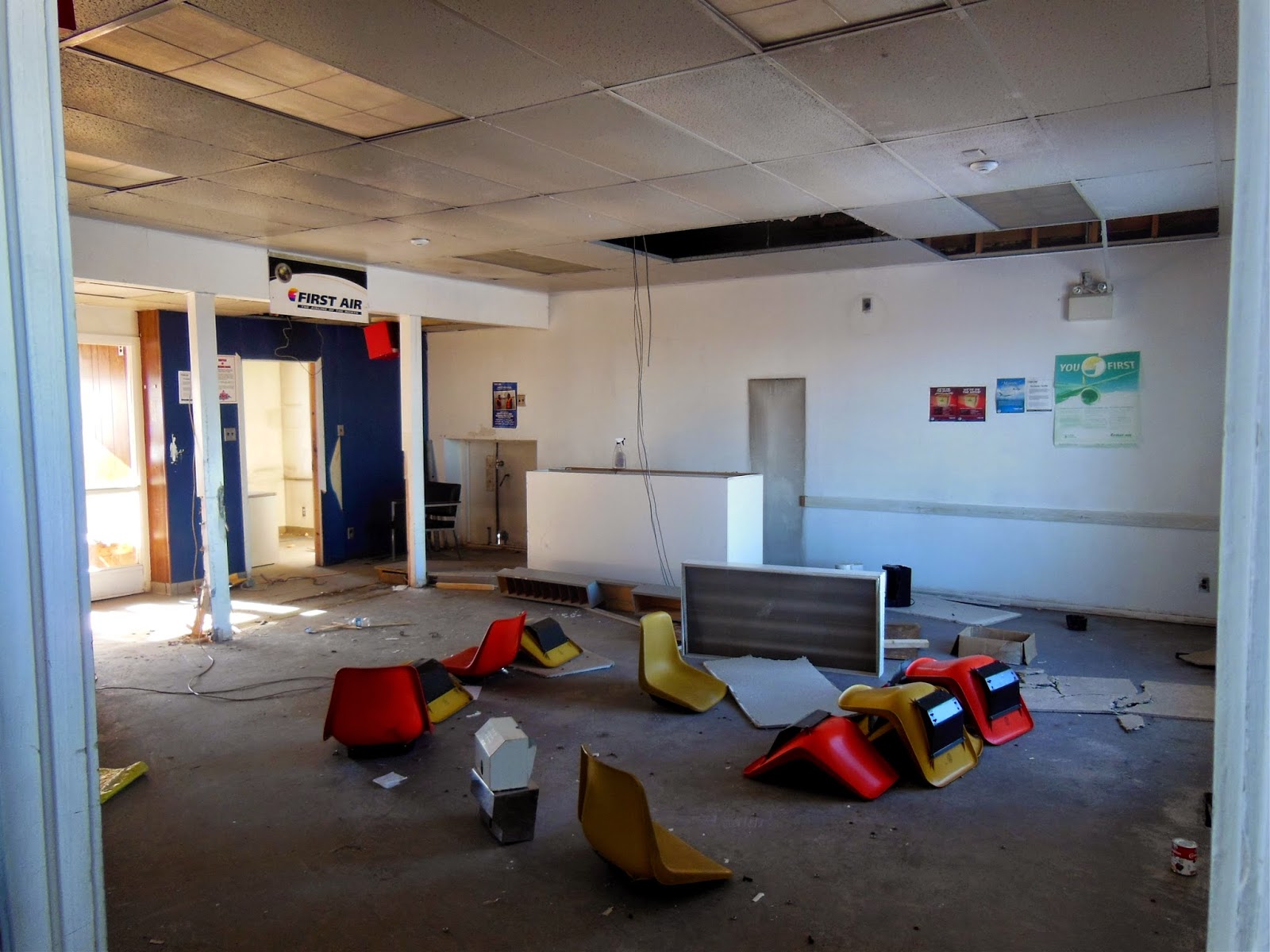
The airport was deserted.  Frank drove onto the tarmac and stopped in front of a small black building that once served as the airport's terminal.  I ventured inside to investigate.  The interior was a mess.  The floor was littered with overturned chairs, tables, wires, and garbage.  Since the closure, people come in, take whatever they want, and leave everything else behind.  I just walked around and took pictures of the departure area, the corridor that leads to the old maintenance garage, and the old weather office. 
           
The old weather office.
Frank told me an interesting story about an Inuit child being born in the old weather office sometime in 1994.  The doctor who performed the delivery adopted the child.
            
To finish off the tour, we drove from one end of the runway to the other.  Frank couldn't drive too fast because large puddles of water dotted the runway.  The landing lights were still in place.  When Frank drove off the runway, I made plans to come back in the new year with my new skidoo and drive back & forth on the runway a couple of times. 
           
Runway landing lights at one end of the runway.
I thanked Frank for the tour as he dropped me off at my place.  The entire excursion lasted 3 hours.


End of Tour of Nanisivik mini-series.

*All in-depth background information was happily provided by long time Arctic Bay resident Frank May.  Thank you.

Friday, January 2, 2015

A Tour of Nanisivik - Part 1


Happy New Year!

Here it is. The long awaited Tour of Nanisivik mini-series.  A perfect way to start off the new year of 2015!
            
Let's rewind the clocks to August 2014.
            
I visited the Nanisivik mine, town site, and airport on August 31, during the Labour Day Weekend.  My tour guide was long time Arctic Bay resident, Frank May.  These places have been on my list of places-to-go ever since I arrived in town two years ago.
            
Nanisivik, meaning the place where people find things in Inuktitut, was a mining town built in 1975 about 20km to the east of Arctic Bay.  It housed & supported, the workers who laboured in the Nanisivik Mine, their families, and local Inuit.  The Nanisivik Mine began operating in 1976, producing lead-zinc ore that was shipped and sold to European smelters.  A deep sea dock was constructed to enable large ships to collect the ore and transport it to Europe.  An airport with a 5,000-foot runway was also constructed to ferry supplies and workers from all over Canada.
            
The mine was managed by Strathcona Minerals Services Limited, the same company that was hired by the TSX to look into the 1996 Bre-X Scandal.  The mine closed in 2002 and the town was abandoned not long after.  The Nanisivik Airport continued to operate until 2010 when all flights were transferred to the newly expanded Arctic Bay Airport.
            
Frank drove his pickup truck along the Road to Nanisivik, the 32km gravel road that links Arctic Bay, the former Nanisivik town site & dock, and the Nanisivik Airport.  At the moment, it's still Nunavut's longest highway.  The first leg of the tour was driving past familiar landmarks: the First Bridge, Liquor Restricted Area Signs, and the Second Bridge.  The Second Bridge was the location of Operation Hill Top 13, 3045 Army's Field Training eXercise (FTX) in September 2013.  The bridge would also be the location for Operation Hill Top 14 the following September. 
            
The Long Stretch
When we passed the Second Bridge, I was venturing into unexplored lands.  For Frank, who has travelled back & forth on this road for more than two decades, this was just another every day road trip.  Frank stopped his truck so that I could get out and take a picture of the Long Stretch, a 5km portion of the road that runs straight.  About halfway down the stretch, we stopped at a former gravel crusher site just to left of the road.  All that remained were the tracks where surface rock was pushed down, scooped up, and put into the crusher.
            
Former rock crushing site.
In 1985, a large crusher was brought up on sealift and placed here with the sole task of taking big rocks and crushing them into sand & gravel.  The sand & gravel would be used to pave the Nanisivik Airport runway.  Even though the crusher was removed in 1986, the machine had crushed enough rock to service the airport until it closed in 2010.
            

Frank's inukshuk
During the 1980s, a snow fence had been built along The Long Stretch to prevent snow from burying the road to Nanisivik.  Frank was one of the workers who laboured on this fence.  What's impressive is the inukshuk he built in 1986 still stands after nearly thirty years. 


"Mount Fuji"
As we came to the end of the Long Stretch, a tall cone-shaped mountain came into view.  The mountain is locally known as "Mount Fuji" because it looks like the real Mount Fuji in Japan.  Frank explained that diamond drilling was done around the mountain until 1990.  A temporary road had to be laid down to make this possible.  He also said that a few people have skied down "Mount Fuji" during the winter months.  After studying the mountain from a distance, I could imagine myself doing the same thing.  I would just need someone with a skidoo to drive me back up to the top.
            
Terry Fox Pass Monument
The next significant monument we visited was Terry Fox Pass (TFP), named after Canadian athlete & cancer research activist, Terry Fox.  TFP was established in the early 1980s by the Polar Pacers and the Midnight Sun Marathoners.  At TFP stands a rock monument with three flag poles (Canada, NWT, Nanisivik Mine), and a tall sign post that gives directions to various cities.  At the base of the monument lays a commemoration plaque.  Betty Fox, Terry Fox's mother, attended the monument's dedication ceremony in 1981.  Terry Fox's younger brother worked as a summer student at the Nanisivik Mine for a time and participated in the marathon. 
            

Frank fixes the directions sign.
One of the main organizers of TFP and the Midnight Sun Marathon was Joe Wormsley, aka Arctic Joe.  Originally from PEI, Wormsley is a former D-Day paratrooper and was once the fittest man in the British Empire.  For twenty-five years, he would travel up north to participate in the Midnight Sun Marathon - Arctic Bay to Nanisivik Dock, and back up to the Nanisivik town site.  Two of these marathons would be held every year during the July 1st weekend.  A 100km marathon was held every 5 years.  About 125 runners from all over the world participated in the marathons and the winners received medals.  Frank was a frequent participant.                      
            

Personally, I don't think I could ever be ready for a marathon.  Sure, I could walk or drive the entire distance but jogging & running?  I don't think so.
            
We got back into the pickup truck and drove onwards.  Frank turned left at the T-intersection towards the mining town and dock area.  (Turning right would have led us to the airport).  We would come back and visit the airport.  Frank calls the T-intersection, "The world's most northerly highway interchange."
            
Naturally occurring iron oxide.
Tailings Pond.
We passed a large red hill covered by naturally occurring iron oxide before arriving at the tailings pond.  Tailings are the waste rock of the mining process, usually high in arsenic and other toxic materials.  The waste rock needs to be disposed and in most cases, mining companies will build a tailings pond.  The pond is the biggest problem of any mining operation because of the toxic substances; you can't let them out into the environment.  Usually, a mining company's water license specifies that all tailings have to be underwater so that they don't get blown away by wind.
            
Tailings Pond.
When the mine closed in 2002, the mining company let the water from the pond drain into the ocean.  The ocean was not damaged because the toxicity is in the sediments at the bottom of the pond.  The company trucked in shale and covered the whole pond 2 metres thick.  This will let the permafrost freeze everything and hopefully hold those tailings until the "end of the time" as Frank put it.  Pipes were later inserted into the pond with thermometers to monitor the permafrost.
            
A rocky hill overlooking the tailings pond. Pipes with thermometers can be seen to the left of centre.
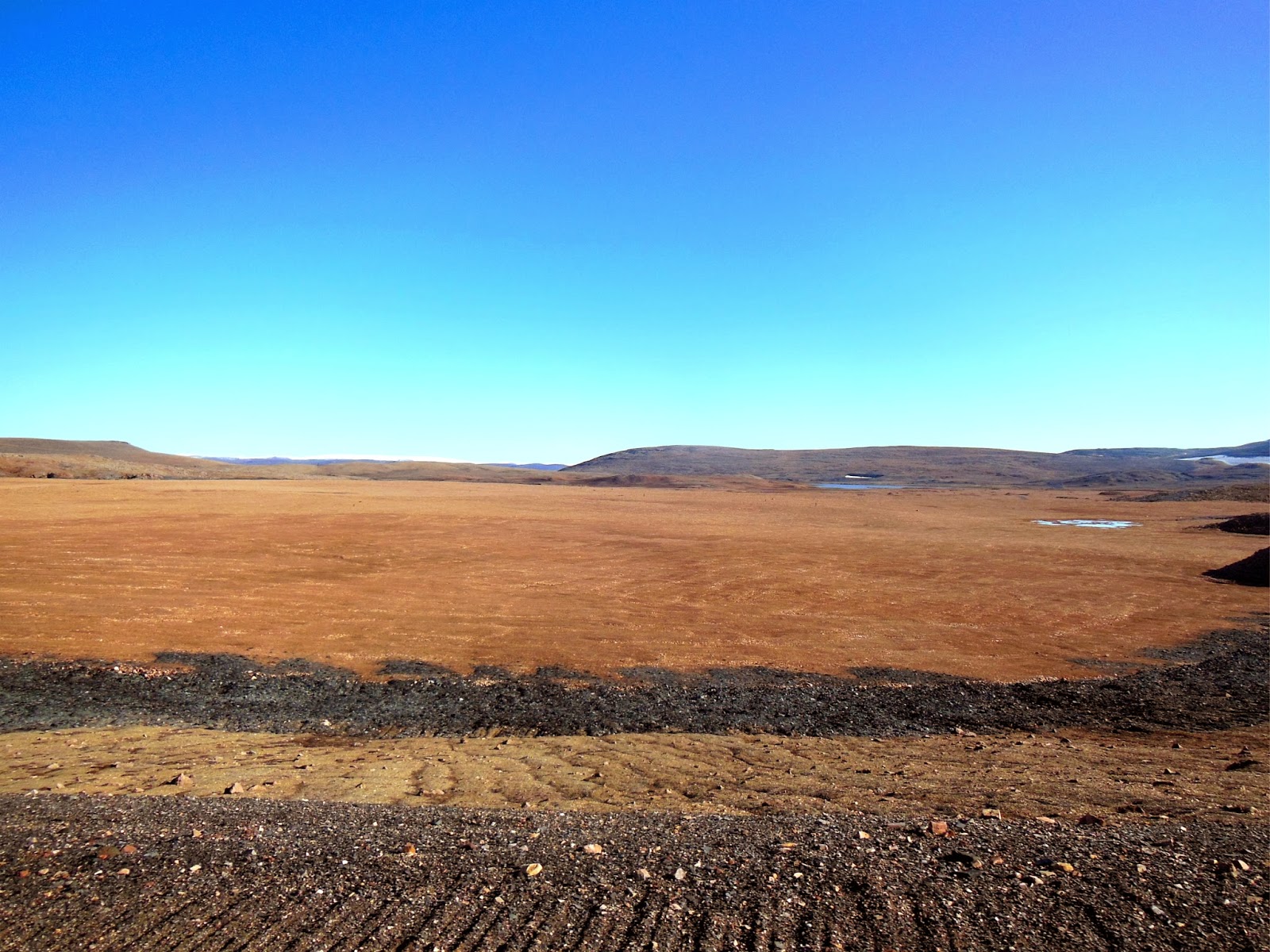
I was surprised by how much land the tailings pond covers.  The Nanisivik Mine produced a lot of waste rock during its twenty-six year operation.  You could build an entire town on top of the flat surface, or stage a large music concert, but I wouldn't recommend it.  Frank drove onto the pond so that we could get a better look at all the pipes.  For several minutes, it was difficult for me to believe that there was water beneath all the shale. 
            
After snapping several more pictures of the pond and "Mount Fuji", Frank drove back onto the main road and proceeded towards the town site.      


To Be Continued . . .
*All in-depth background information was happily provided by long time Arctic Bay resident Frank May.  Thank you.

Saturday, December 20, 2014

Christmas Festivities


The school's Christmas concert was set for the evening of December 17 at the Community Hall.  Preschool to grade 9 classes, as well as the staff, were tasked with organizing and presenting  Christmas-themed skits.  My drumline was the high school's contribution.  Teachers set aside several blocks of time each day to brainstorm and rehearse the skits with their students.  Some classes rehearsed behind closed-doors, keeping their performances top-secret until the 17th.  It was impossible for my drummers & I to keep our repertoire secret because the drums could be heard throughout the school. 
            
Grades 7-12 students spent the morning of Dec 17 decorating the Community Hall under the careful supervision of their teachers.  The elementary and middle school classes had prepared a variety of Christmas decorations and they needed to be plastered all over the hall.  My drummers & I used this time to bring over the drums, music/instrument stands, sheet music, sticks, and anything else we would need for the dress rehearsal and concert.  Everything was transported by truck.  Students & teachers scurried around the hall, setting up rows of chairs, and taping & hanging decorations, while Christmas music played over sound speakers.  All the chairs and decorations were in place by lunchtime. 
            

The entire student body went to the Community Hall after lunch for the dress rehearsal.  Each class went up on stage and presented their skit so that the students would know their spots, where to go, and conquer any feelings of stage-fright.  The "curtains were lifted" for those classes who kept their skits secret during the previous weeks.  The rehearsal also gave the concert planners a better picture of how the entire program would look like "for real".    
            
The program is kept simple, starting from preschool and ending with the teachers.  The drumline is the second last act.  As I expected, many students crowded around the front of the stage as my drummers & I marched on for our dress rehearsal.  This year, I would stand in the centre and play snare drum with my drummers.  We played our five selected pieces while teachers & students cheered us on.  I noticed a few people were filming our practice with iPods.  My drummers did very well on the dress rehearsal; now they had to repeat the same performance for the concert.  They all told me they were nervous.
            
"So am I," I confessed.  "The trick is to not think about it.  Don't look at the audience.  Look past them.  And the time will go by very fast.  Our gig will be done before you have a chance to blink."       
            
The dress rehearsal was finished at 3:30pm.  Everyone went home for the rest of the afternoon, had dinner, changed into formal clothing, and returned to the community hall at 6:30.  The place was filled with parents, elders, children, teachers, and community members.  The concert began at 7.
            

Aga & Kataisie, the high school art & Inuktitut teachers, presided over the concert as English & Inuktitut emcees.  Ryan, the school's media teacher, filmed the concert using one of his HD camcorders.  I stood at the back of the hall and filmed secondary raw footage.  The pace of the Christmas concert felt slower for me because I attended the dress rehearsal.  I already knew what to expect.  Everyone who was present at the dress rehearsal probably felt the same way.  Regardless, it was a concert worth seeing twice. 
            
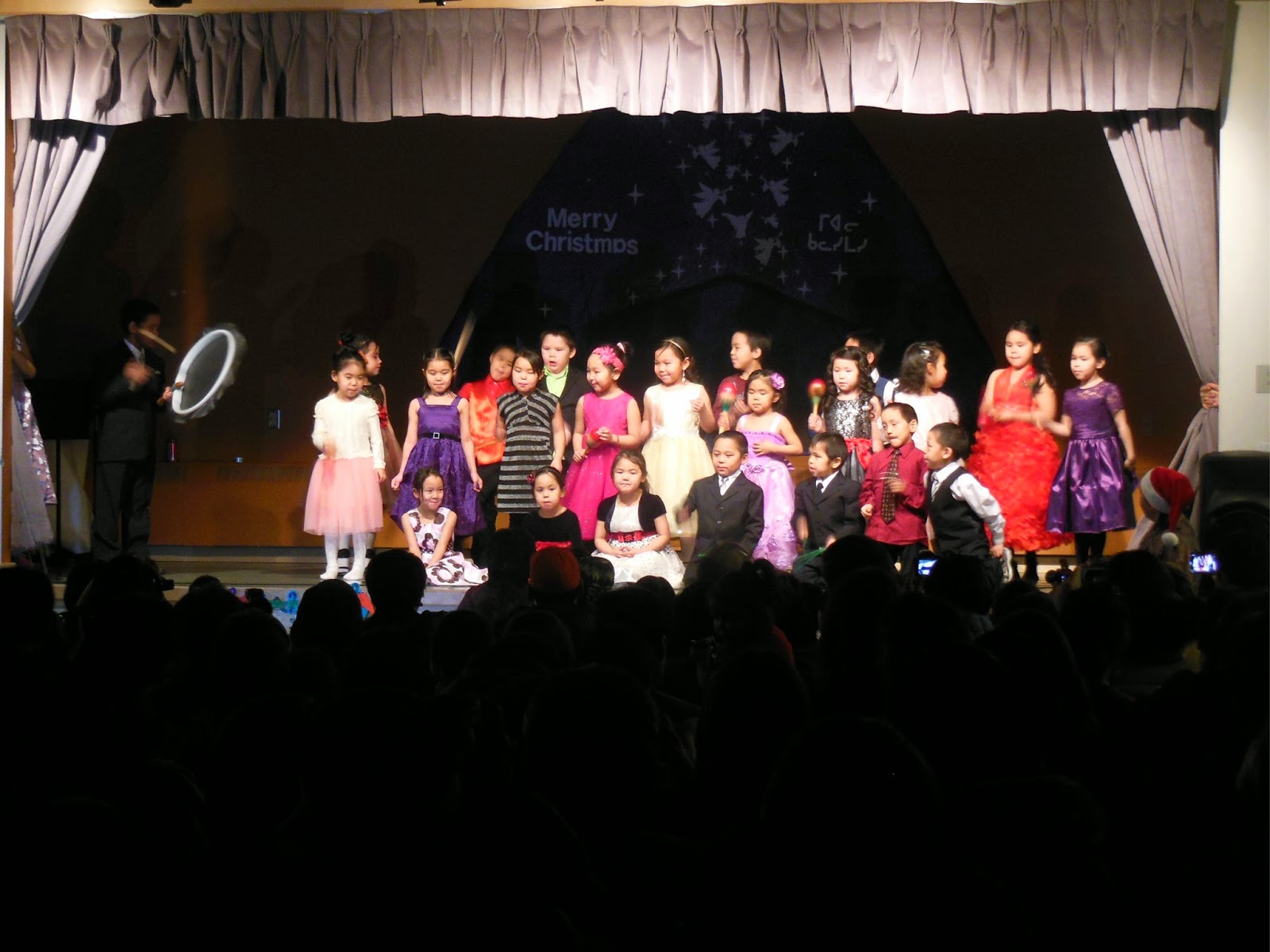
There was something for everyone.  There was singing, acting, dancing, rapping, Inuit drumming, and marching percussion.  Even though some acts weren't Christmas-themed, they were still entertaining & fun.  I could spend an entire blog post or two accurately describing each act but I'll just the mention the acts that stood out the most for me.
            
The Grade 1 class sang a few Christmas tunes, accompanied by an Inuit drum.  The Grade 3 class did a square dance and a student played on one of my snare drums along with the recording.  The Grade 4 class played charades by putting on animal masks and acted out specific animals with the help of prerecorded sounds.  They revealed the names of the animals they were playing before closing their act by throwing candy to the audience.  The Grade 6s danced to "Feliz Navidad" while the Grade 7s played Nunavut's Got Talent, a spinoff parody of the popular tv show America's Got Talent
            
The Grade 9 class presented a short play about saving Santa, who got into a serious accident, by performing open surgery and removing all foreign objects.  What impressed the audience was that the play was done using the silhouettes.  A large white piece of paper covered the front of the stage and two projectors shined light on it.  The students' silhouettes appeared clearly on the white paper and the audience laughed at all the right moments.
            
The moment had finally arrived; it was the high school drumline's turn to perform on stage.  "Alright, it's time," I announced to my drummers.  I could see that they were nervous.  I was also nervous but a leader must never show it.  "Let's do this."
           
We marched on stage and quickly set up our drums, music stands, and sheet music behind the closed curtains.  The emcees kept the audience busy while my drummers & I did our final checks.  When everything and everyone was in place, I individually asked each drummer if they were ready.  When they all nodded, I signaled the stage crew to draw open the curtains.  Looking past the audience, I raised my drum sticks and clicked them four times.  Our performance began.
            
For me, our gig went fairly quickly.  Since I have been performing with various bands for many years, the routine is very familiar: play a song; audience applauds; switch music; repeat until out of selected music; leave the stage.  The pieces we played as a drumline were: Run Out! (UMass), Run On (UCLA Pregame Sequence), X1 (by Cassidy Byars), and Raven (by Cassidy Byars) as an encore from the Halloween concert.  One of my bass drummers & I played the fifth piece, Triplet Cadence, as a duet.  I wrote the cadence in 2006 when I was teaching marching percussion at a summer cadet camp in CFB Borden.  When the curtains closed, I shook my drummers' hands and congratulated them on a job well done.               
            
The teaching staff closed the concert by performing three hand clapping rhythms in groups, and a fourth as a massed group.  The first one was "Cups (When I'm Gone)" from the movie Pitch Perfect without the use of cups, the second was a rhythm created by an Inuit elder, and the third was patty-cake.  The fourth rhythm was from the popular song "We Will Rock You" by Queen.
            

December 18th was the last day of school before the Christmas holidays.  With the success of the Christmas concert still fresh in everyone's minds, the festivities continued with caroling in the school's gym after morning recess.  Eunice, the Grade 7 teacher, led students, teachers, elders, and parents in singing Christmas carols in English & Inuktitut.  Mary's husband provided guitar accompaniment.  Mary is the school counselor.  We sang "Deck The Halls", "O Christmas Tree", "Joy To The World", "O Come All Ye Faithful", "Rudolph The Red Nosed Reindeer", "Jingle Bells" and many more.            


Santa came to school after lunch to hand out gifts to students (preschool - Grade 9).  I walked behind Santa and his helpers, photographing him with the students and their gifts.  (Between you & me, Santa was played by the nephew of one of the school's student support assistants).  Many children were shy to sit on Santa's lap and pose for pictures, but after much prodding from parents, they mustered up the courage and got through it.  Once the children received their presents, they were free to leave the school.  High school students received gift certificates from the Co-op store.    
            

Teachers could leave early too, provided that they had completed their attendance and report cards.  When I was done, I quickly cleaned up my classroom and headed out the door.  I wished the Inuit teachers & my students a Merry Christmas and a Happy New Year before firing up my skidoo.  I immediately began packing my suitcase when I arrived home because I was flying down south the next morning.  I took out the garbage and handed over my skidoo keys to my next door neighbours.  They had decided to stay in Arctic Bay for the holidays and agreed to look after my skidoo.
            
I woke up on the morning of December 19th and had a quick shower.  I finished packing my suitcase after a small breakfast.  When my ride to the airport arrived, I switched off all the lights and locked my apartment.  I met the other teachers that were flying down south for the at the airport.  We would arrive in Ottawa six hours later and go our separate ways.  We would meet up at the Ottawa Airport in two weeks. 
            
It's hard to believe how fast 2014 has come and gone.  I'm glad I have plenty of pictures and memories to remember the last 365 days.  The new year is less than two weeks away.  I wonder what new challenges await me?    

See you all in 2015!