Sunday, February 17, 2019

Biathlon Competition – Part 2


I was up and about in the early morning of Saturday, February 9.  I was a little anxious but excited to see how these cadet biathlon competitions work.  The collected pictures & videos will be used for training purposes back at the corps.  I got dressed in my military gear and walked over to the mess hall for breakfast.  A few of my cadets were already there.  Breakfast consisted of: pancakes, hash browns, ham, scrambled eggs, fruits, and muffins.  My cadets were feeling fine & ready.  I instructed my senior cadets to check our equipment after breakfast. 
            
My cadets playing foosball.
The participating teams are from all three territories.  The teams are divided into two groups: the first-time cadets stay at Boyle Barracks and learn how to ski and compete at a biathlon competition.  The more experienced cadets go to Grey Mountain and do the actual competition.  Four of my cadets would be staying behind while I went with my seniors to Grey Mountain.  (Boyle Barracks has plenty of adult supervision).  Three school buses came to pick up the Grey Mountain cadets and their equipment.  We left the camp at 9am.
            
The school bus drove past the SS Klondike National Historic Site.  The historic site contains the second SS Klondike, a sternwheeler, built in 1937 to transport freight between Whitehorse & Dawson City along the Yukon River.  The second ship was decommissioned in 1950 and now functions as a museum.  I vaguely remember visiting the large ship in 1997.  Driving by it 22 years later, I could see that it hadn’t moved and looked the same.


A very large skidoo for grooming.
We arrived at Grey Mountain at 9:30am.  The place is owned by Biathlon Yukon but is also home to the Whitehorse Archery Club.  The site hosted the biathlon portion of the 2012 Arctic Winter Games.  Everyone disembarked and walked towards the main buildings.  The venue slowly came into view.  The venue boasts 24 outdoor shooting lanes and buildings for admin, competitors, volunteers, and equipment.  A military ground crew was sent ahead of us to set everything up.  A team of senior cadets would be assisting the officers with judging. 
            
Senior cadets being briefed on judging protocols.
Boxes of .22 bullets.
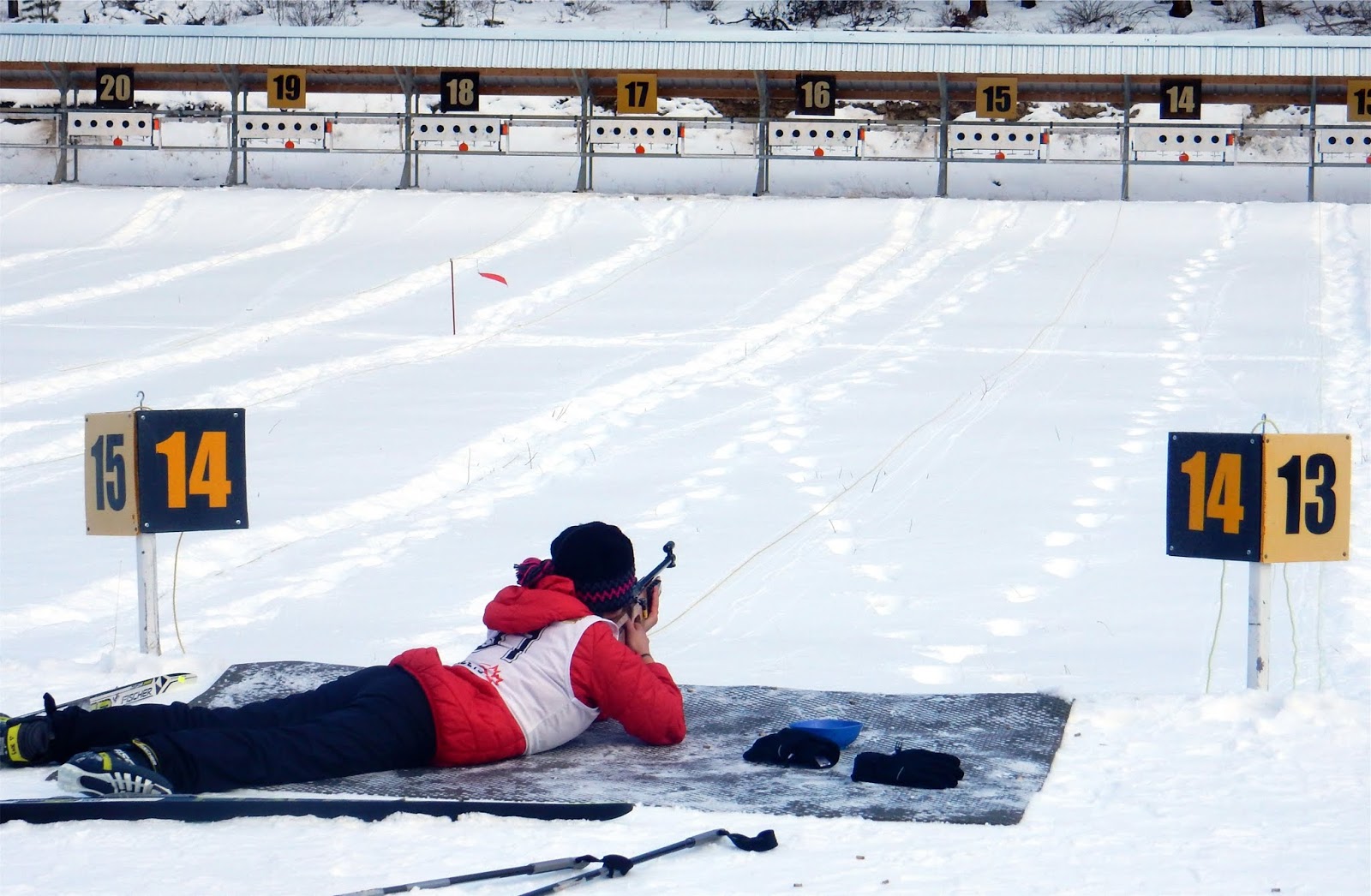
The morning consisted of all Grey Mountain cadets getting used to the skiing equipment and the .22 rifles.  They were allowed to practice shooting at their assigned lanes and “zero-in” their rifles before the start of the competition.  My cadets were assigned Lanes 13, 14, & 15.  I supervised my cadets, watching them shoot and ski.  I even acted as a spotter and told them where their bullets were hitting.  I thought I would need earplugs but the .22 rifles aren’t loud.
            

Lunch was catered by Home Sweet Home Baking, a local Whitehorse business.  The lunches came in brown paper bags.
Bagged lunches.
The timed competition officially began with the junior male cadets.  I stood on the sidelines, watched, and took some pictures.  I didn’t have any junior male cadets competing this year.

Junior cadets.

3045 Junior Female Cadet at Grey Mountain.
3045 Junior Female Cadet crossing
the Finish line.
Next up were the junior female cadets.  I did have one junior female cadet competing this year.  She was given a number 31 scrimmage vest to wear over her clothing.  The number just meant she would be the 31st cadet in line.  The other three cadets & I stood by the Start line to cheer for her.  Right after she left, I walked over to the Lane 14 and waited for her to appear.  Competitors have to ski a loop and then shoot before repeating the two more times.  All I can do as coach is place the rifle on the mat and make sure there are five bullets in the bowl.  My junior cadet looked tired but relieved when she crossed the Finish line. 

#40 from Arctic Bay begins his relay.

#50 from Arctic Bay begins his relay.
The senior cadets, male & female, would compete in a combined race.  The separate male & female races would be held on Sunday.  Since I had three senior cadets, I had to be ready to look after them all at the same time, should the moment arise.  That didn’t seem likely since they would be starting at different times, but anything can happen in a race.  My cadets came and went at random intervals.  The most I had was two at a time.  They all looked tired at the end of the race.


3045 First-Time cadets at Boyle Barracks.
The competition was done for the day.  There would be more races on Sunday.  We all packed up our gear and boarded the school buses back to Boyle Barracks.  I checked on my four first-time cadets after disembarking from the school bus.  They had just finished their training for the day.  They told me they had their own mini skiing competition.  I was glad to see them in good spirits. 

The temperature at Grey Mountain.
February 9, 2019.
Cadets who travel from a small town to a big city centre like Whitehorse always hope for a chance to go shopping.  There are just so many more things to buy and usually the cadets are given a shopping list from their parents, relatives, and friends on what to buy.  After dinner, the cadets were taken to a large WalMart store.  (I can’t recall if Whitehorse had a WalMart in 1997.  Probably not.)  The cadets were given 90 minutes to buy what they wanted and to be back on the bus.  WalMart may not sound like much but to these cadets, it’s a treat.         
              
We returned to Boyle Barracks and went to bed an hour later. 

Me at Grey Mountain.
To Be Continued . . .

Friday, February 15, 2019

Biathlon Competition – Part 1


I only taught for a half a day on February 8 because I had a plane to catch in the afternoon.  My superiors in Pond Inlet granted me leave to escort 8 cadets to the Stage III Biathlon Competition in Whitehorse.  This would be my first time attending the competition in the capacities of escort officer and coach.  I was quite excited because I hadn’t been to Whitehorse since 1997.
            
The cadets were allowed to wear their civilian clothing while travelling.  I had to wear my military CADPAT uniform.  The cadets were instructed to wear their 3045 hoodies to make it easier for them to be identified.  They also had to wear their white issued mukluks.  We were all at the airport by 12:45pm.  I was glad I packed several days in advance.
            
Me & the Biathlon Team.  Inuk Slender Man stayed behind.
We took a group photo for Facebook before the plane arrived.  We posed in front of an Arctic Bay banner and a mannequin dressed in sealskin.  We call him “Inuk Slender Man.”
            
The Perimeter charter plane landed at 1:20pm.  The plane began its journey from Winnipeg, stopping in Naujaat to pick up cadets.  Arctic Bay was the second stop.  The military was able to book a charter because there were a lot of cadets from Naujaat 3055 corps attending the competition.  Everyone watched the plane come to a stop and turn off its engines.  The back door opened and cadets began disembarking from the plane.  The plane needed to be refueled and passengers need to be inside the terminal while this is being done.  Safety first.  The Naujaat cadets were being supervised by two civilian instructors and a CIC officer.
            

The CIC officer in charge of the Naujaat cadet corps is one of my bosses on the military side.  She’s looking after the corps until someone in the community is available to take over.  We exchanged greetings.  She came to Arctic Bay bearing gifts from Naujaat.  She set down a large box containing bags of raw caribou meat.  She was given instructions to hand out the meat for free.  The meat quickly disappeared when she announced, “Free caribou meat!”  Everyone waited until the announcement was made to board the plane.
            
My cadets & I were last to board the plane.  The charter plane is large enough to accommodate around 46 passengers.  The propellers began to spin once everyone was onboard and the doors were sealed shut.  Several minutes later, we were flying high in the sky.
            

The pilot came over the intercom and announced that he was going to fly all the way to Whitehorse without having to stop in Kugluktuk as originally intended.  He assured everyone that he had checked his calculations and concluded that the plane could make it to the city.  Regardless, he was going to fly to Kugluktuk just in case.  The flight crew served everyone a snack consisting of fruit, muffin, and croissant. 
            

The flight to Whitehorse took about five hours.  I was surprised that the plane had enough fuel to go the entire distance.  The landscape slowly changed beneath us.  At first, all we saw were ice, snow, and mountains.  Then we saw snow, mountains, and trees.  It’s been too long, I thought when the plane entered Yukon airspace.
            

We drove by the Yukon Transportation
Museum.
The plane touched down at 7:30pm.  Looking at Whitehorse Airport Terminal, I concluded that several changes were made to the structure since my last visit.  In 1997, the airport had one jet bridge.  Twenty-two years later, the terminal now boasts two jet bridges.  I also think the exterior has been refurbished.  Our plane parked on the right side of the terminal where a school bus was waiting for us.  We disembarked and boarded the school bus.  Our luggage and skiis would be loaded onto another school bus and delivered to the cadet camp.  We would get there first.
            
I had never been to the Whitehorse cadet camp before this trip.  The camp is called Boyle Barracks, named after Canadian adventurer, miner, and businessman Joseph Whiteside Boyle (1867 – 1923).  I have heard of this camp before because many northern cadets are sent here for summer training.
            
Everyone got out of the bus and assembled around a captain.  She welcomed everyone to Boyle Barracks and instructed the cadets to go into the mess hall and wait with the other cadets.  Adult coaches were instructed to go to the officers’ mess, register their teams, and receive their instructions packages.  Everyone was dismissed.
            

A different captain handed me a large folder containing documents & schedules related to the competition.  She also told me the cabins where my cadets would be sleeping for the weekend.  I was lucky enough to be assigned a room all to myself.  When the second bus arrived, I found my cadets and told them to unload all our stuff and move into their assigned cabins.  Our skiing equipment would go into the playroom next to the mess hall.
            
An officers briefing was held about an hour before lights out.  We went over the schedules, rules of the competition, selected judges, and the layout of the course.  Once all questions & concerns were answered, we were dismissed for the night.  Morning reveille was at 0600 hours (6am). 
            
The last thing I did before drifting off to sleep was plug my camera into an outlet so that the battery would be fully charged the following morning.

To Be Continued . . .

Thursday, February 7, 2019

Early February (2019)


The local cadet corps held tryouts for the marksmanship team in late January.  We couldn’t decide on attendance & attitude alone.  The tryouts were a shooting competition.  Cadets interested in making the team had to shoot the most accurate grouping targets.  To make the competition fair, I assigned each cadet a number and they were to write that number on their paper targets.  The numbers would guarantee anonymity while being corrected by Frank.  The problem of bias would also be eliminated.  Frank & I looked over the results and selected the five the best shooters to represent 3045 Army Cadets.
            
The first challenge of the newly formed 3045 Marksmanship Team was the Stage II Postal Shoot.  This competition would determine which teams would advance to the territorial championships in April.  As the name suggests, the competition is done by shooting targets at the corps and then mailing the targets down to Winnipeg to be marked.  Airfare is too expensive in the north to fly everyone to one location.
            
We held the Postal Shoot on February 3.  The cadets were given their own shooting lane and would shoot grouping targets.  The cadets “zeroed in” their air rifles before shooting the competition targets that were mailed to us from Winnipeg. 

For the readers out there thinking that having a postal shoot gives way to frequent cheating: in my personal experience, it’s really difficult to cheat.  The pellets make holes in the papers a certain way, much different then, let’s say, using a pen.  Plus, we all play by the rules up here.  Frank & I made sure the grouping targets were immediately placed in sealed envelopes right after they were used.  The corps runs a very busy shooting program every weekend, so our cadets don’t need, nor think about cheating.

At the end of February 3, the cadets & I felt pretty good about our chances on advancing to the territorial championships.  The results of the Postal Shoot would be made public in 3 weeks.

Since the introduction of the school’s new security camera system in March 2018, a large tv screen in the main office has been getting a lot of attention from students & teachers.  The screen displays the camera feeds on 10-second rotations.  Everyone stops to look at who’s on closed-circuit television!  The new cameras are in high-definition, much better than the old camera system.  I mentioned the new camera system in my Grade 12 Social Studies class when we were learning & discussing authoritarianism.  The texts mentioned George Orwell’s 1984 and the infamous quote, “Big Brother is watching”.  I explained to my students that our new security system is a form of Big Brother, watching our every move in & around the school. 


The sun came back to Arctic Bay on February 5.  I paused from teaching and took a photo of the sun peaking out from behind the mountains.  Dark Season was officially over.  The sun would stay up for 30 minutes and then sink behind the mountains.  The sun would stay up for an extra 20 minutes with each passing day.

My four classes are going alright.  I’m pretty much teaching the same topics in Grades 10 & 11 Social Studies and Grade 10 English.  The only differences are in Grade 12 Social Studies.  I’m teaching the students about various political systems (democratic, authoritarian, etc).  I also introduced the students to the Social Studies Project, the large assignment at the end of the semester that replaces the final exam.  So far, I’ve only gone over the basics & expectations.  I’ll have them working on the project in March.

Thursday, January 24, 2019

A New Year & Career Fair


Source: 123RF.com
Happy New Year everyone!  I can’t believe it’s 2019!  The decade is almost over!  Time certainly flies when you’re not looking.  Sorry about the long wait but a lot of things were happening that prevented me from publishing a new post until now.
            
My Christmas vacation was brief but I did get to see family & friends.  I also shopped at various stores, buying supplies for the next six months.  I always look like I’m travelling heavy on the way down because I bring large suitcases.  However, I pack light when flying south for Christmas, but heavy when flying north.  I save money on cargo & postage fees.
            
Iqaluit.
Iqaluit.
My frequent travels in and out of Nunavut has led me to notice that Iqaluit is becoming more structurally colourful.  The buildings are painted in a variety of bright colours, most likely so that you can see them during a blizzard.  From the sky, the large town looks like it’s being built with large Lego blocks, or someone sprinkled Skittles on white snow. 
            
I followed through with my promise to my Grade 10 English students and uploaded our short film, “Mr. Putugu’s Classroom” to the school’s Facebook page.  It didn’t take long for the video to gain an audience.  The reception was positive and the film was shared several times by the viewers.  I was glad that all our hard work had paid off.  When I came back to Arctic Bay after the break, several of my students told me about the local popularity of the video.  I also wondered if the video would become known to CBC News North in the near future?  If so, maybe they will want to do a news story about our efforts?  Only time will tell.
            
A new year means a new semester, classes, and roster of students to teach.  I will be teaching four classes this semester: Grades 10 – 12 Social Studies, and Grade 10 English.  Unfortunately, I won’t be teaching beginner guitar.  Maybe my English students this semester will also want to make a short film?  I’ll ask them when we are close to starting the media literacy unit. 

It’s been several years since I taught Grade 12 Social Studies but I’m not too concerned.  I am familiar with the required history topics and can always use the internet for research.  The only area of concern is the final project.  The final project replaces the final exam and demands a lot of effort from the students.  I’ll be introducing the project early in the semester so that the students can start thinking about what topic they want to investigate.   


A career fair was held at Inuujaq School on January 21.  Several organizations took over the gym for the day to talk to students and members of the public about job opportunities in Nunavut.  It’s been quite a long time since a career fair was held in Arctic Bay.  When I asked my students about it, the only one they could remember was in 2007!  I bet the ridiculously expensive airfare prevents companies from travelling to the remote communities.  The organizations at this year’s fair were: Baffinland, Fisheries & Oceans Canada, Parks Canada, Government of Nunavut, Service Canada, Skills Canada, Polar Knowledge Canada, Qikiqtani Inuit Association, and the Inuit Mentorship Program.  That’s not as many as there were in 2007 but it’s better than one.

Free stuff giveaway.
Tables, chairs, and banners lined the gym walls.  Information documents, pamphlets, and giveaway items sat organized on the tables.  There were also two tables with snacks and bottled water.  In the middle of the gym laid a very large circumpolar map of the north.  The map belongs to Polar Knowledge Canada.  The organization also had smaller circumpolar maps of the north & south poles to hand out to people.  To maintain student interest, the organizers of the career fair created a scavenger hunt.  Students would receive a pamphlet containing questions.  Finding the correct answers required visiting all the tables and talking to the presenters.  Students who collected all the correct answers would get a prize of some sort.


The high school students went down to the gym in the afternoon.  The presenters were there waiting for them.  The students received their question pamphlets & pencils at the door.  They fanned out, searching for answers.  I casually walked around the gym, taking pictures of the displays.  I was mostly drawn to the large map on the floor.  I always had an interest in maps & geography.  Quite a few students were also drawn to the large map.  At least eight of them spent a good 20 minutes looking it over, especially the areas around Arctic Bay.  I think they were discussing their past, present, and future hunting/camping trips. 


I did stop and listen to some of the presenters.  There was a lot of information to take in.  I did ask the Polar Knowledge people if there’s been an update on the opening of the new research facility in Cambridge Bay?  The official opening ceremony has been delayed numerous times.  They said even they don’t know when the ceremony will happen because of the upcoming federal election in October.  They are hoping it will happen soon.  For the amount of money the government has spent on constructing that research facility, the opening ceremony better happen soon.  Otherwise, the state-of-the-art building will become a white elephant.

I briefly returned to the gym after school to take a few more pictures and video clips.  From what I observed, the fair was quite popular.  I’m glad such an event occurred because living in an isolated community subtly tells its residents that they’re not many career choices available.  That is not true. 


I was also glad the organizers prepared a scavenger hunt for students.  Without that incentive, the students would have been in and out in minutes.  The only things I brought back to my classroom were the two circumpolar maps.  They will be displayed in my classroom.