Wednesday, May 20, 2020

Onward To Elwin Inlet – Part 1


Everyone was glad the annual Fishing Derby competition was not cancelled in the wake of the ongoing COVID-19 pandemic.  There were no confirmed cases in the community so the organizers felt that the “show should go on”.  Of course, participants were still encouraged to practice social distancing when fishing.  The fishing locations were: Arctic Bay, a lake near Victor Bay, Ikpikituarjuk, and a far away lake to the south, past Ikpikituarjuk.  The derby started on Saturday, May 16, but some participants left as early as Thursday because they needed the extra time to get to Ikpiki & the far away lake.  The bays & inlets are still frozen in May, but cracks do form in certain places.

I decided to do some travelling on May 16 but not because of the fishing derby.  I’m more interested in exploring the land than fishing.  I’ll have to devote at least a day or two in the future to develop basic fishing/hunting skills just in case my skidoo breaks down far away from the community. 

My destination was Elwin Inlet, around 61km to the northeast of Arctic Bay.  I had never been there before and I would have to drive a distance of 70km to get there.  I was aiming to just get to the entrance because I wasn’t sure if I had enough gas to explore the inlet itself.  Even though my skidoo was working again, the dashboard was still out of commission.  I would have to guess how much gas my machine was consuming.  I already had a good idea of the rate of consumption based on my trip to Baillarge Bay in 2019.  I normally travel with a full tank and two 20L gas jugs.


My backpack was full of supplies.  I packed: snacks, toilet paper, small first aid kit, binoculars, Kleenex, spark plugs, batteries, extra ammunition, earplugs, Ziploc bags, GPS, SPOT, map, and matches.  For lethal protection I had my 12-gauge shotgun, machete, and niksik.  I left a copy of my travel map at home and let my coworkers know where I was going for the day.  It took me an hour to get ready. 

The trip began at 10:30am.  I followed the Road to Victor Bay.  In true stereotypical Canadian fashion, I found myself apologizing to my skidoo while I drove on the road that zigzagged up a hill.  There was no snow; only gravel and small rocks.  Skidoo drivers usually drive on the snow next to the road but by mid-May much of it had melted away.  There was now a steep incline on the trail near the top of the hill and I feared my machine would tip over if I tried to drive over it.  When I got to the top of the hill, I drove off the road and onto a small frozen lake I had traversed on foot when I was exploring the Cliffs in April.  I stopped and checked the runners on my skis to make sure they weren’t damaged.  They were not.

I followed a skidoo trail over the land, across another frozen lake, and down to Victor Bay.  The trail does not follow the road.  I was surprised there wasn’t much snow.  There were a few places where I was driving over exposed soft grass.  Thank you, global warming.  As long as it wasn’t rocks.  The trail led me to several cabins along the western shoreline of Victor Bay.  I was expecting to see people outside but saw no one.  I continued down to the shoreline and found a spot to drive onto the ice. 


There were a few qamutiks (wooden sleds) lying on the ice.  To my right, I spotted a large object that looked like a large seal.  I used my binoculars and my camera to confirm that it was in fact a large foam mattress.  Hopefully, the wind wouldn’t blow it away. 

Victor Bay.
When I revisited the St. Georges Society Cliffs in April, one of the last pictures I took was a long skidoo trail snaking its way across Victor Bay.  I easily found this trail and followed it all the way to other side of the bay.  I reached the top eastern tip of the bay, also known as Graveyard Point.  It was here I spotted and drove over a small ice crack.

Graveyard Point.

I continued across Strathcona Sound and past Cape Strathcona.  My earplugs & helmet dampened the continuous, monotonous drone of the two-stroke engine.  I left the right plastic panel that covers the exhaust at home.  The cold weather would keep the exhaust cool.  I stopped a few times to take pictures of the jagged cliffs & mountains to my right.  I already have pictures of them from past trips, but their awe-inspiring presence makes it difficult not to take photographs.

Ship Point.

Facing towards Elwin Inlet.
I was surprised when I reached Ship Point because it felt like not a lot of time had gone by.  I checked my GPS to make sure I wasn’t hallucinating.  I left the engine running, stepped off the skidoo, and stretched my legs.  There were no signs of life in the area except for me.  The gas cans were still attached to the skidoo.  I looked towards Baillarge Bay, briefly remembering the day I explored that area in 2019.  I then set my sights to the north.  I could already make out the entrance to Elwin Inlet in the distance.  It appeared close, but I knew the inlet was 20km away.  I pondered on filling up on gas but decided to wait.  I got back onto the skidoo and took a deep breath.  I was about to enter an area for the first time.  I exhaled and squeezed the throttle.  I continued following the skidoo trail.


I was expecting a certain level of fear to surface as I passed Baillarge Bay.  Even though I was following a frequently travelled route to the floe edge, there are still things that could go wrong.  I was alone, my skidoo could break down, and at worst, the ice beneath me could break, or I would become a polar bear’s next meal.  I did have enough supplies to last another day or two.  My point is never lure yourself into a false sense of security.  Always be on guard.  Surprisingly, those feelings of concern were blocked by the majestic jagged mountains & cliffs I passed.  Being awe struck by their grandeur made me feel relaxed.  I stopped a few times to take pictures.


Reality decided to test my resolve when I neared Elwin Inlet.  The skidoo tracks I was following suddenly turned right at 90 degrees.  I slowed down to make sense of what I was seeing and then my mind shouted “Ice crack!” a split-second later.  I turned right just in time.  The crack looked at least a metre wide.  I drove alongside it and looked for a narrow spot to cross over.  When I found a spot, I got off the skidoo and photographed the crack.  Turns out there was still thick ice underneath the exposed water.  I drove back a few metres, turned around, squeeze the throttle, picked up speed, and drove over the crack.  I made a mental note of the crack’s location.  I would have to cross it again on my way back.


I spotted a small valley to my right just before the inlet.  It looks like a nice place to camp.  Unfortunately, I couldn’t see a way to get there because there was a lot of built up ice along the shoreline.  Exploring that area would have to wait until another time.


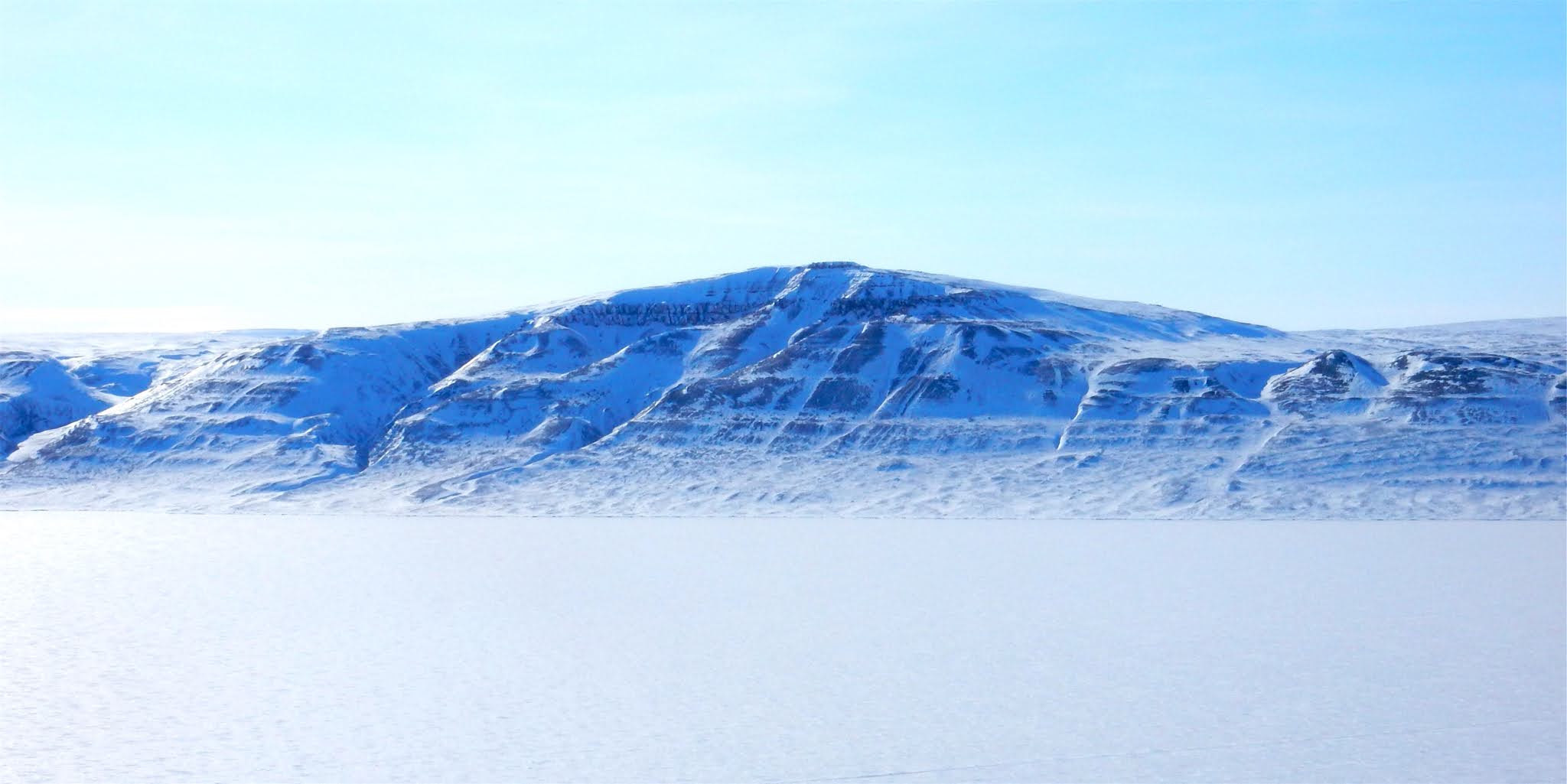
A very tall slanted mountain sat next to the valley.  It doesn’t have a name, at least, not on the map I looked at.  I quickly realized that it sits on the southern edge of Elwin Inlet.  I drove onward, crossed a small ice crack, and found a spot where I could clearly see the entrance to the inlet.  I turned the skidoo around just in case I needed to make a quick escape.  I had finally arrived.

Elwin Inlet.
                                                                         To Be Continued . . . 

Sunday, May 10, 2020

New Working Arrangements

Sorry about the three-week absence but there wasn’t much to write about.  I finally have enough material to write a post.

The atmosphere at school felt a little strange on April 21.  Everyone greeted each other with elbow bumps and/or waving hands.  We were required to follow a new set of rules laid out by the Nunavut Government and Qikiqtani School Operations.  We had to stay at least 6ft apart from each other, use the photocopiers at prearranged times, and eat by ourselves at lunchtime – (unless you went home).  The principal held a welcome-back-meeting over the school’s intercom.  He explained the above rules and what was expected of us from the higher ups.

Our first priority was to prepare learning packages (LPs) for the week of May 4 – 15.  Once these were completed and ready to go, we could focus our attention on other educational projects.  The LPs are take-home assignments that cover the topics that we taught from the beginning of the semester to the shutdown of schools in March.  Students can complete and return them for extra credit.  The LPs were given out from the school’s main entrance because students are not allowed to enter the school.  The LPs were packaged in large envelopes.

The teachers were required to do something related to their occupation when not working on LPs.  The Nunavut Government did not want to pay teachers to just sit in their classrooms.  I reorganized & re-labelled several learning materials, but the largest project I undertook was adding English subtitles to five educational videos for my Grade 10 Socials Studies class.  These videos are attached to the Residential Schools & Inuit Land Claims modules. 

I wanted all spoken dialogue to be subtitled so that students wouldn’t miss any important information.  Having subtitles also helps when the audio isn’t clear.  We’ve all watched videos where people don’t speak clearly, mumble their words, and/or speak too fast.  To be honest, I personally think all educational videos need to be fully subtitled.  You just have to decide which languages to use.

Adding subtitles is very time consuming.  I find the rate varies between 30 minutes to 1 hour of work to add subtitles to 1 minute of footage.  There were many times when I had to listen to several sections over and over to make out what was being said.  I also had to get help from a co-worker to translate Inuktitut dialogue that hadn’t already been translated into English.  I thanked them for their help.  I was granted permission to work on these videos at home.

I also transcribed two audio recorded interviews from the Residential Schools module.  I’m not sure why these recordings came without written transcripts.  Several other recordings in the resource included transcripts.  The rate of transcription was the same as adding subtitles to the videos.  Having a transcript to go along with an audio recording gives students something to read instead of having to sit in their chairs and just listen.

My skidoo has been running well for the last several weeks.  It finally came out of the repair shop, the engine working at full capacity.  Turns out the problems were a broken piston and a very old oil pump.  A co-worker replaced the broken piston with one of my spares and the oil pump was replaced with a brand new one I ordered off of the Skidoo website.  Unfortunately, getting the lights & dashboard to work still remains a mystery.  We think it may be a wire because the lights are new, the voltage regulator is new, and the battery still works.  If only Bombardier offered skidoo engine repair course to us common folk!  Regardless, I can still use my machine by pull starting it and making sure it’s always topped with gas & oil.


I noticed more & more families were travelling out on the land since the closure of schools.  It’s very easy to social distance out on the land because the land is immense!  The community’s frozen coastline becomes a long parking lot for skidoos & qamutiks.  Most people leave them out there during the spring because there are rarely any blizzards.  Seeing all the vehicles out on the ice got me thinking about doing a day trip somewhere in the near future.  All I needed was a location and a date.

Sled Dogs on ice.

And finally, in the world of COVID-19, the United States has passed a million cases!  The USA always wants to be #1 in everything but why have the most active COVID-19 cases?  I don’t see the pride in it.  I just hope a vaccine is found soon.     

Monday, April 20, 2020

Mid-April 2020


Uluksan Point was the focus of my walk on the morning of April 13.  I wanted to walk there on March 30, but instead, I hiked up a rocky hill to take pictures of Arctic Bay.  There would be no detours this time.  Many people go to the point to camp, picnic, and have bonfires.  I was going there to take pictures and see if my sealskin parka would keep me warm.  I already knew the answer was ‘yes’ but I wanted to be sure. 


Uluksan Point is on the side.
I’ve only worn my parka within the community because it’s not designed for out-on-the-land excursions.
  Even though the outer layer is sealskin, the inner material is not super thick, so wearing it in extreme cold temperatures wouldn’t be good.  The parka was made for spring weather.  I suppose I could take it with me on a land trip but I would wear it at my destination. 


I picked April 13 for my trek because the skies were clear and the sun was shining brightly.  Arctic Bay gets a lot of sunny weather in the spring.  However, the temperature remains cold.  I kept the spare camera batteries warm by placing them in the inside pocket of my parka.  My body heat would keep them from freezing. 


The distance to Uluksan Point is roughly 2.40km from my place.
  I started walking at around 11:25am.  I left my guns at home and carried a machete in case I needed to swing & stab my way out of a deadly encounter with aggressive wildlife.  There was no traffic along the road to Uluksan Point.  I was expecting to see at least one person driving by on an atv but that didn’t happen.


I reached Uluksan at noon.
  I had to pull up the hood on my parka because there was a strong wind blowing.  There was no one at the point except me.  There were two large boats and two qamutiks sitting near the shoreline.  I took several pictures of the surrounding area, and a few selfies.  My parka did a good job keeping me warm.  I stayed for about 15 minutes.  I walked home, occasionally looking behind me to make sure I wasn’t being followed by a polar bear.  I made it home.

The Canadian Cadet Program received a big announcement from its Commander-in-Chief, Brigadier General D. Cochrane, & his Adjutant, Chief Warrant Officer W. Crawford.  Their announcement was delivered on April 15 through a pre-recorded 6-minute video uploaded to a few video sites.  I watched it on the Cadets Canada Facebook page.  To make a long story short, the leaders announced the cancellation of all in-person cadet training activities until August 31, 2020.  The ongoing COVID-19 pandemic was the primary reason.  All cadet corps in Canada will remain closed and no cadets will attend summer camps.   

I shared the video & written transcripts on the corps Facebook page.  I also added a message, stating that all local cadet activities are cancelled until the end of summer.  No parades, weekend marksmanship & sports, and field training exercises.  Naturally, the cadets were greatly disappointed that it had come to this, but the health & safety of everyone takes precedence.

Speaking of closures & cancellations, Nunavut’s Education Minister, David Joanasie, announced the closure of all schools for the remainder of the school year on April 17.  He based his decision on the advice of the territory’s Chief Public Health Officer.  I also think his decision was influenced by the Northwest Territories & Yukon governments, who closed their schools for the rest of the school year in late March & early April respectively.  A cancellation/closure of this scale is a first for me.  I know I’m still relatively new in my profession but this is a moment in my teaching career I will never forget.

Joanasie continued his press conference by ordering all Nunavut teachers back to work for April 21.  We will be preparing & sending home learning packages for students to complete at home.  Think of them as homework or take-home assignments.  They’re to be based on the units we taught before the school closures.  There will be no high school final exams; final report cards will be based on course work.

The cancellation also means I won’t be making a short film with my Grade 10 English students this semester.  I’ll have to wait until the fall or the new year.

I’ll be honest, I am looking forward to getting back to work after a 3-week hiatus.  I was starting to get bored of being stuck at home all the time.  We’re allowed to work on other things while the learning packages are being completed.  I already have a few ideas in mind.

Continuing the theme of cancellations, the annual Nunavut Quest dog sledding competition & Qamutik Cup hockey tournament have been cancelled because of the COVID-19 pandemic.  Nunavut Quest’s cancellation was announced at the end of March and the Qamutik Cup organizers made their announcement early this month.  This is the second time Nunavut Quest has been cancelled.  I’m not sure if the Qamutik Cup has been cancelled in previous years. 

The many cancellations of public events have forced people to find their own means of entertainment.  One huge benefit of living in Nunavut is that you have access to a very large backyard.  Many people in Arctic Bay have spent a lot of time out on the land.  It’s very easy to practice social distancing because the land is far and wide.  Although, I should point out that not everyone in town has the transportation means of travelling far distances.  Those who don’t own skidoos and/or vehicles can still go hiking but not far from the community.  However, there are many cabins in Victor Bay and if you own or know people who own them, you can visit, and stay there for a day or two.

I saw a group of Inuit preparing to go on a hunting/camping trip while I was walking to the Northern Store on April 18.  The convoy contained three skidoos and two qamutiks packed with supplies.  I noticed a 45-gallon gas barrel on each qamutik.  These made me assume the group was going out for an extended period of time.  They could also be travelling to another community.  I didn’t ask.

There was a line outside the Northern Store when I arrived.  I snapped a picture for this blog and as a future memory of the era of social distancing.  I stood in line and chatted with a few people, waiting to be let into the store.  We all find it weird to be practicing social distancing when COVID-19 is not present in the community.  The Northern Store is making everyone do it because of instructions sent from headquarters down in Winnipeg.  I was finally let inside after some time and bought a few things.  The store is really quiet because only 10 customers are allowed inside at a time.

I wonder how long these rules will be in place?

Thursday, April 9, 2020

St. Georges Society Cliffs – Revisited


Taking pictures of the community on March 30 made me think of another place I hadn’t been to in many years: St. Georges Society Cliffs.  The last time I walked along the top of these cliffs was in 2013.  They’re commonly known as ‘The Cliffs’, most likely because saying the official title all the time is exhausting.  Similarly, we just say ‘King George’ instead of King George V Mountain.  I decided to hike to The Cliffs on April 5.  My skidoo was in the shop being fixed so I didn’t have a choice.

Arctic Bay Airport

I packed for a day trip.  My essentials were: GPS, SPOT, batteries, gun, ammunition, machete, binoculars, toilet paper, snacks, juice boxes, Ziploc bags, matches, mirror, and a spare pair of gloves.  I doubted I would encounter aggressive wildlife, but you can never be sure.


I stepped outside, wearing my heavy Canada Goose clothing.  My backpack was full and my .22 rifle was slung across my chest.  The trigger & bolt locks would be removed when I reached the outskirts of town.  There were some clouds in the sky but for the most part, the weather was all sun & clear blue skies.  I was wearing my heavy clothing because I didn’t want to get stuck at The Cliffs, cold, and underdressed.  Even though it’s early spring, the weather can still suddenly change, especially at higher altitudes.

I began my hike at 10:30am.  The community was relatively quiet.  I followed the road to Victor Bay, listening to my boots crunching the snow on the ground.  A pickup truck drove by while I was near the top of the hill where the road crests and can no longer be seen from Arctic Bay.  I wondered if the driver saw my rifle and assumed I was going hunting?  I stopped at the wooden iglutaq I previously photographed and removed the two locks on my rifle.  I loaded a magazine and checked to make sure the safety was still on.  Now I was “packing heat”.   

I walked across a frozen pond, passed the spot where I slid down a hill, and ascended a snow-covered slope.  I’m not sure how much weight I was carrying, but it felt like a lot.  I thought I would be a few pounds lighter by the end of the day.  I continued walking south, looking at all the rocks littering the snowy landscape.  I returned to the place where I photographed Arctic Bay on March 30.  I took several more pictures.


I stopped next to a big rock to catch my breath.  I marked the large boulder on my GPS as a future point of reference.  The GPS was also tracking my every move and displaying the path I was in the process of creating.  I continued walking towards The Cliffs, the crunching sounds of snow being my only companion.  The second big rock I marked on my GPS was on top of another hill.  I hiked up this hill by moving from one small rock to another so that I wouldn’t slip.


I knew I reached The Cliffs when I saw an inuksuk sitting on top of a rock.  However, there was only one.  There were three inuksuks in 2013.  I was certain I was in the right place.  The natural elements must have knocked over the other two.  I took a picture of the remaining inuksuk and then began inspecting The Cliffs.


The Cliffs haven’t changed much in the last 7 years.  In fact, I don’t think they have changed at all.  The land changes very, very slowly.  The Cliffs are still rocky and jagged.  I walked carefully and snapped as many pictures as I could.  I also aimed my camera at the large pyramid shaped mountain on the other side of Adams Sound.  The Sound was completely frozen. 

There were two visible skidoo trails in Adams Sound.  Both began at Arctic Bay on my left but split into two different directions.  The first one extended diagonally across the Sound towards Cape Cunningham while the second lay parallel to The Cliffs.  I spotted two skidoos driving along the first trail.  The second skidoo was pulling a qamutik.  The first skidoo was way ahead of the second one.  I assumed the people down there were going camping / hunting.  They were taking social distancing to the extreme.  I could still hear the engines roaring along even though I was far away.


I sat down and rested for some time.
  The sun was still shining and the sky was mostly blue.  The views of Adams Sound & Admiralty Inlet were great.  There was a very light breeze in the air.  Silence was omnipresent.  It was just me & my thoughts.  My Canada Goose clothing kept me quite warm.  If I had stayed in that spot for a little while longer, I probably would have dozed off.


I continued walking along the edge of The Cliffs and took more pictures.  Suddenly, I spotted a large rock with a giant crack down its centre.  This was my first time seeing this rock.  I was perplexed as to how this giant boulder could have broken into two pieces?  Was it gravity or years & years of slow erosion?  I took a closer look at this giant boulder before returning to photographing The Cliffs.  Satisfied with the many pictures I collected, I turned north, heading inland, towards the hill I ascended at the beginning of the hike.


Victor Bay.
The return walk took me across two small frozen lakes and two rocky hills.  I used my GPS to guide me back to where I started.  The trail I created somewhat resembled an oval.  Victor Bay came into view after an hour of walking.  I photographed the bay, noting a long skidoo trail extending across the entire bay and beyond.  The trail leads to the floe edge.

Victor Bay.

I was able to find the same spot where I slid down a hill (last month) to get to the road to Victor Bay.
  I walked across the same frozen pond but in the opposite direction.  When Arctic Bay came into view I stopped, unloaded my rifle, and placed locks on the trigger & bolt.  I followed the road down to the community.


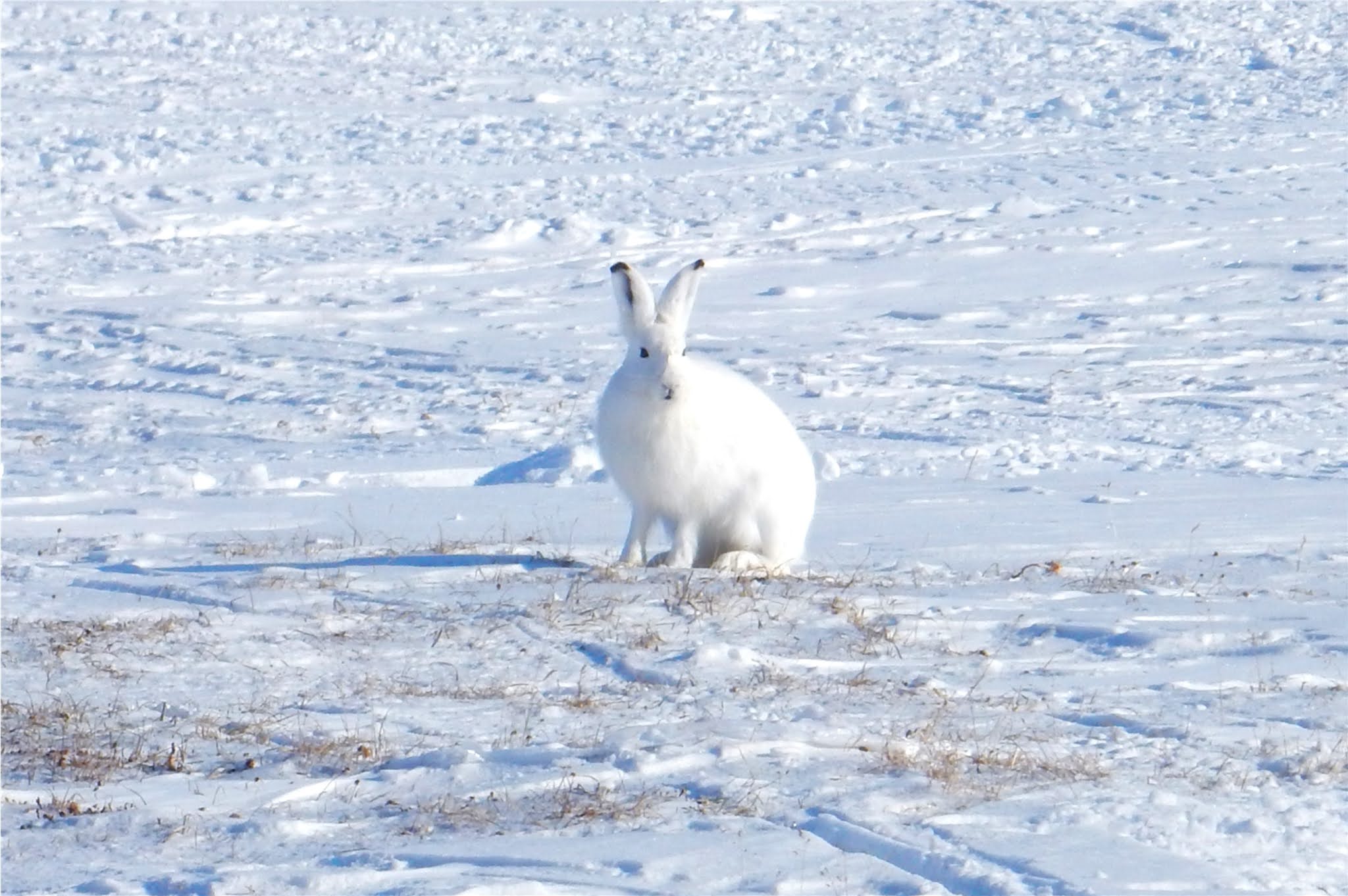
A large white hare ran across the snow when I entered the community.  It stopped several times to eat and look around.  I used these precious moments to photograph the animal.  The last time I saw it was next to an orange loader.

Overall, I enjoyed my hike to The Cliffs.  I came, I saw, I photographed.  The activity gave me the perfect excuse to go outside & get some exercise for a couple of hours.  I didn’t have to worry about social distancing because I was alone.