Friday, February 21, 2020

Cadets & Rangers


I photographed a full moon on the afternoon February 8.  (No, it’s not what you’re thinking).  The time was close to 3pm and dusk had arrived.  Even though the sun returned on February 5, prolonged periods of darkness were to last another month. The days feel equally balanced between day & night in March.  The scale tips in daylight’s favour in April.  Anyway, on this particular day, I was walking home and noticed the moon rising behind the tall rocky hills that surround the community.  I stopped, aimed my camera, and waited for the perfect moment to take a series of pictures.  I wanted the moon to be in the “right spot”.  I took five photographs and reviewed them when I got home.  I got one good photograph but you can’t see the details on the moon’s face.  Unfortunately, I don’t have a DSLR camera with expensive lens.
            

3045’s Marksmanship Team of 2020 completed the Stage II Postal Shoot on February 9.  The Postal Shoot is a mail-in competition where the northern teams shoot target papers sent from Winnipeg and then mail them back to be marked by officials.  Each cadet shoots three target papers.  One target paper has twelve target circles on them: ten for scoring & two for practice.  Cadets are given 15 minutes per target paper.  The best teams advance to Stage III.  It took two hours for the Marksmanship Team to shoot all their targets.  I had the honour of placing all the targets in a sealed envelope and mailing it to Winnipeg.  The team and I hope they will advance to the next stage.
            
The cadet corps received a large gift of toques from one its sponsors: NEAS.  The sealift shipping company had blue toques made with the RCAC logo on one side and their company logo on the other.  The toques were distributed to the cadets and I took a photograph of them on February 12.  I wrote a thank you email to NEAS and attached the picture to the message.
            
On the morning of February 15, I spotted a convoy of skidoos & qamutiks assembling on the ice in front of the Northern Store.  Upon closer inspection, it was the local Canadian Rangers preparing to go out on patrol.  The patrol lasts for several days.  Canadian & Ranger flags were attached to two qamutiks.  The Gas Station must have made quite a bit of money filling all the red plastic gas cans the day before.  I didn’t ask where they were heading.  From what I’ve been told, camping in the middle of February is a challenge because temperatures can sink to very low levels, like in the -50˚C range.  Dress warmly, and bring Coleman stoves that work & enough naphtha to keep them going to warm the tents.  Of course, make sure they’re some air openings to avoid carbon monoxide poisoning.
            
The cadet corps held its first Parents Night Parade of 2020 on February 19.  (This parade was also the third for the 2019-2020 Training Year).  I managed to recruit Inuujaq School’s vice principal to be the Guest Reviewing Officer (GRO).  Following standard procedure, the cadets & I arrived at the school’s gym an hour early to set up.  I made the preparations less stressful for myself by preparing all the awards the day before.  The cadets were formed up and sized by the Cadet Platoon Commander (CPC).  There were 24 cadets on parade.
            

The parade began at 6:35pm.  I escorted the GRO to the front of the parade square while the cadets stood at attention.  The music for General Salute & O Canada were played.  The CPC escorted the GRO through the ranks, inspecting & speaking to the cadets.  I kept the audience distracted by saying a short welcome speech.  I didn’t have to speak loudly because I borrowed the school’s portable Phonak speaker.  The cadets did a March Past after the inspection.  The GRO & I stood at attention while the cadets marched and gave us an eyes right. 


GRO addressing the cadets.
The GRO was given a chance to address the cadets & audience.  He thanked the corps for giving him the opportunity to be the GRO for the first time and commended the cadets for their dress, drill, and deportment.  He also said the school continues to support the cadet corps, and wishes it to continue for many more years.


Level 2 Marksman Cadet.
Gold Level Fitness Cadets.
I began the Awards Section with marksmanship & physical training (PT) badges.  These are the two most common badges awarded to cadets.  We take marksmanship & PT very seriously up here.  One cadet achieved a Level 2 marksmanship badge.  (Level 4 is the highest).  For PT: One cadet achieved Bronze, one cadet achieved Silver, and two cadets achieved Gold.  (Excellence is the highest level).


Me & the Biathlon Cadets.
The two biathlon cadets were called to the front to receive recognition for their efforts at the recent competition in Canmore, Alberta.  I officially announced their results from the Junior Female Sprint Race, and their advancement to the National Competition in Valcartier, Quebec.  The competition will take place at the beginning of March.  The audience applauded their efforts.


The Marksmanship Team was called up next to be formally introduced.  I also informed everyone that they recently completed the Stage II Postal Shoot and we’re currently waiting for the results.


Senior Cadet selected for Alpine Tour.
I called a senior cadet to come to the front to be recognized for being selected for the upcoming Alpine Tour Expedition in Banff National Park in Alberta.  He is the 4th cadet from 3045 to be selected for this expedition.  The expedition also occurs in March and is a week long camping trip where cadets hike, snowshoe, ice climb, and receive avalanche training.  I never attended when I was a cadet but I’ve been told that it’s a very exciting & memorable trip.

Cadets promoted to Lance Corporal.
CPC is promoted to the rank of MWO.
Promotions were saved for last.  I originally thought there would be a few promotions, but after reviewing cadet files on the computer database, turns out there would be many.  The GRO assisted me.  The first to be promoted were 8 cadets to the rank of Lance Corporal.  One Lance Corporal was promoted to the rank of Corporal and one Corporal was promoted to the rank of Master Corporal.  The corps’ three sergeants were promoted to the rank of Warrant Officer (WO).  Since the corps now had too many WOs, the CPC, who happened to be a WO, was promoted to the rank of Master Warrant Officer (MWO), the second highest rank a cadet can achieve.  I informed the cadets they had three choices to address her in the future: Master Warrant Officer, Sergeant Major, or Ma’am.
           
Frank.
Frank did the Closing Remarks, thanking all the sponsors, the people who brought snacks, the parents, and the community for supporting the cadet corps.  The Advanced In Review Order (AIRO) and playing of God Save the Queen followed.  The GRO & I marched out of the gym and the newly promoted MWO dismissed the cadets.  The parade was over.
            

The cadets moved to the back of the gym for a group photo, then dismissed to reception.  Separate photographs were taken of the newly promoted WOs & MWO.  Reception lasted for 20 minutes.  The cadets & I cleaned the gym after reception.  I formed up the cadets one last time for a quick debriefing.  I congratulated the cadets for participating and for receiving a badge and/or promotion.  The cadets dismissed for the remainder of the night.  The next Parents Night Parade will be in April, except it’s known as the Annual Ceremonial Review.   
3045's newly promoted WOs.

Tuesday, February 11, 2020

Return of the Sun (2020)


The sun was back and it was time to celebrate.  The first sun celebration of the new decade!
            
The sun disappears from view on November 11 and doesn’t reappear until February 5 or 6th.  The days in between do get some sunlight, but it diminishes first, then increases after December 21.  The sun’s disappearance is not celebrated.  Arctic Bay only experiences 24-hour daylight during the spring & summer.  The community is not north enough to experience 24-hour darkness during the fall & winter. 
            
Planning for the school’s assembly began in late January.  The biggest addition to the program was a feast (more on that coming up).  There would be a ceremonial qulliq lighting, speeches, songs, dances, attendance awards, and announcements.  The food was ordered from the local Co-op.  The assembly was set for February 6th in the afternoon.
           

High school students & teachers headed down to the gym at 1:30pm to set up chairs, tables, and the portable sound system.  Several teachers stayed at school over the lunch hour to prepare the food.  Bannock was also prepared.  The bowls & trays of food, covered in plastic wrap, was brought into the gym and placed on a line of tables.  This was followed by juice boxes, paper plates & cups, napkins, and a coffee machine.
           

Elder Qapik Attagutsiak was invited to light the ceremonial qulliq.  A comfortable chair and small cloth-draped table were set aside for her.  She gave an impromptu lesson to the high school students on properly lighting the qulliq.  Elder Tommy Tatatuapik was invited to speak to the student body later in the ceremony.  He gave an impromptu lesson on properly playing the Inuit drum after Qapik was finished with her lesson.
           
Principal & Morty beginning the ceremony.
The ceremony began at 1:45pm.  The gym was full of students, teachers, Elders, community members, and visiting guests.  Many people were wearing traditional Inuit clothing.  The principal welcomed everyone to the assembly.  The gym lights were turned off and Qapik officially began the ceremony with the lighting of the qulliq.  She briefly explained the history, importance, and cultural significance of the qulliq.  Student Support Assistant Morty provided the English translation.  The lights were turned on when Morty said she was finished her presentation.  Qapik received an applause from the audience.
           
Elder Tommy.
Superintendent Eliyah speaking.
Tommy continued the assembly by talking about his experiences living out on the land during the dark winter days and what was done when the sun returned.  Morty translated his words into English.  The next person to speak was Superintendent Eliyah, visiting from Pond Inlet.  He was visiting/inspecting his assigned schools and his schedule made it possible for him to be present for our assembly.  He talked about how nice the community is, the wonderful students & teachers, and how he appreciates Inuit language & culture being kept alive.  Tommy & Eliyah were applauded for their speeches.
            
There were three performances.  The first one was done by a high school student and Elder Leah K.  The student played the Inuit drum and Leah sang a song in Inuktitut about the sun coming back.  The next performance was a square dance by the Grade 4 class.  The third performance was the Grade 3 class singing “You Are My Sunshine” in Inuktitut & English.  Their teacher played the tune on an accordion.  Plates of food were being prepared during the performances by several teachers & staff.  It’s easier to hand out food instead of having lines.  Lines take too long.  There can be lines for second helpings.
            
The superintendent assisted the principal in handing out best attendance awards for the month of January.  Students received certificates, handshakes, and had their pictures taken.  Some were shy, but all were smiling when receiving their certificates.  The last thing on the program before the feast was the announcement of the recently formed student council.  It’s been a while since Inuujaq School has had a student council so it’s good to see it again.  Members were called to the front and formally introduced to the school and community.
           

The feast began with the blessing of the food by an Elder.  Then the teachers & student support assistants distributed the many plates of food and juice boxes.  The feast lasted 20 minutes.  High school students & teachers stayed behind to clean up the gym while the elementary & middle school teachers escorted their students back to their classrooms.  Community members also made their exit.  The custodians brought in the brooms & mops once the gym was empty.  The gym was cleaned in 15 minutes.  The dismissal bell rang shortly thereafter.


Tuesday, February 4, 2020

Biathlon 2020 – Part 4

Due to unexplained reasons, we only received the provisional results of the relay races.  All the times were posted but they weren’t organized.  Maybe the Canmore Nordic Centre needed the Judges Building earlier than expected and requested the military to vacate right away?  Whatever the reasons, we were assured the selections for the National Biathlon Competition would be made in a few days.  I’m sure we could have figured them out ourselves, but that would have required a lot of time.  And the bus arrived to take us back to Edmonton.
            
The coach bus was spacious and came with a washroom.  The bus was filled with teams from Edmonton and the Territories.  The drive took about four hours.  We were all thankful the bus driver let us stop at a roadside Tim Hortons halfway.  My four cadets & I were the first ones to get off the bus.  The military had reserved rooms for us at a hotel near the Edmonton Airport.  We said our goodbyes and thanked the driver for giving us a lift.  We checked in for the night.  I celebrated the end of the competition and the beginning of the journey home with a steak dinner at the hotel’s restaurant. 
            
January 27 was a long travel day.  The day began in the early morning, checking out of the hotel and taking a taxi to the airport.  The terminal was surprisingly busy.  Thankfully, the line through security was short when we got there.  We made it to the gate on time and boarded our flight.
            
Flight to Rankin Inlet.
We landed in Yellowknife at 9:50am, 10 minutes later than scheduled.  We only had 20 minutes to make it to our next flight.  What happened next was slightly humourous in my opinion.  We exited the plane, stepped onto the tarmac, and were directed to the terminal.  On the way, we walked by the Summit First Air plane that was going to take us to Rankin Inlet.  Why not just let us board the plane now instead of making us go through the terminal, I wondered?  We entered the building and quickly found the gate for the Rankin Inlet flight.  Boarding commenced just as we arrived.  We exited the terminal and boarded the flight.  Our time inside the terminal was less than 10 minutes.
            
Somewhere between Yellowknife & Rankin Inlet.
Snow in Rankin Inlet.
The flight to Rankin Inlet was uneventful.  I was a little worried about this travel route because Rankin Inlet is prone to blizzards and high winds.  If the plane were to land and then become stranded, we would have to overnight.  Of course, the flight could also be forced to stay in Rankin Inlet if a blizzard were to strike Iqaluit.  Blizzards are a common occurrence in Iqaluit at this time of year.  I would just have to hope for the best.  The plane landed in Rankin Inlet.  Sure enough, wind was present, confirmed by the snow being blown across the paved runway.  We waited in the terminal for two hours.  The plane was refueled and restocked with food.  The terminal was built in 1996 and is finally getting an upgrade & expansion.  Two new wings will be added, increasing capacity by four.  The expansion was well underway when we were there.
            

Rankin Inlet from the air.
We boarded the same plane again and flew to Iqaluit.  We arrived in the late afternoon.  The Iqaluit air cadets were met by their parents in the Arrivals Area.  They picked up their luggage and said their goodbyes to us.  My remaining two cadets & I picked up our stuff and took a cab to the Frobisher Inn.  Iqaluit’s shortage of hotel rooms was on display.  There was a very long line at the front desk.  A large portion of people in line were attached to the military in a civilian capacity.  I think they were on their way to Resolute Bay but their flight got cancelled and the military was trying to find hotel rooms for the night.  (Don’t quote me on this).  In the end, the officer-in-charge split the group in half.  Half stayed at the Frobisher while the other half went to a different hotel.  Our rooms were reserved weeks in advance. 
            
Me & Qapik.
I was back the airport with the two cadets the next day.  Our flight was scheduled for the afternoon.  We met Qapik Attagutsiak in the Elders Lounge.  She was also returning to Arctic Bay. She & her daughter, Kataisee, were in Ottawa for a special ceremony.  Qapik was honoured for her contributions during the Second World War at the Canadian Museum of History, located in Hull, Quebec.  (The French speaking city is located just across the river from Ottawa).  The ceremony coincided with the 75th anniversary of the end of the war and was part of Parks Canada’s Hometown Heroes initiative.  The community-based initiative began in 2015 and “honours [the] men and women who defended Canadian values, and contributed to the cause of freedom during the world wars.” 

The ceremony was attended by Johnathan Wilkinson, Minister of Environment & Climate Change, David Akeeagok, Deputy Premier of Nunavut, Lieutenant-General Wayne Eyre, and hundreds of people.  The ceremony was blessed “by Elder Simon Brascoupé from Kitigan Zibi Anishinabeg First Nation,” and featured “traditional throat singing[,] drum dancing[, and] military music.” 

Qapik “is the last known surviving Inuk ‘bone collector’.”  During the war, Inuit were “encouraged to salvage animal fat [and the bones of] walrus[es], seal[s], and dog[s.]  These were shipped to processing plants in the south where the were transformed into glycerin, munitions, aircraft glue, and fertilizer.”  For her efforts, she was presented a large “inunnguat (and inuksuk-like figure in the shape of a human) covered with drawings made by local school children”.  I wish I was there.  You can read more in-depth coverage of the event in the following links:

APTN National News – ‘A living human treasure’ . . .
Wikipedia – Qapik Attagutsiak
(Extra) - Virtual Museum.ca – Qapik Attagutsiak, Arctic Bay, 1984.

I asked Qapik if I could have my picture taken with her, to which she replied “Yes,” in Inuktitut.  Kataisee translated my request and took the picture.  I was glad she said yes because I missed the opportunity in 2015 when I brought her freshly chiseled ice.

Blizzard at the Iqaluit Airport.
Somewhere in this picture there is a snowplow.
A blizzard suddenly appeared, enveloping the entire airport in a whiteout.  Several departure delay announcements were made, followed by the cancellation of all flights.  We were all stranded in the big city until the following day.  We all returned to the Arrivals Area to collect our baggage.  I quickly informed my military superiors in Winnipeg & my principal in Arctic Bay.  The principal said he would find a supply teacher to cover my classes.  The sudden cancellations created a mad dash to reserve the few remaining hotel rooms in the city.  Winnipeg was unable to reserve any for us, but thankfully, the cadets had relatives in town.  They were able to contact them and make arrangements for an overnight stay.  I had keys to my brother’s apartment.  Winnipeg approved Plan B.  The cadets & I agreed to meet back at the airport at noon the next day.  (Qapik & Kataisee were able to reserve a room at the Frobisher Inn).

The blizzard was gone the next day (January 29).  The sky was clear and the sun was shining above Iqaluit.  The cadets & I checked in our luggage and went to the same gate.  The same people were there, waiting to board the flight to Arctic Bay.  The flight was guaranteed to leave Iqaluit but landing in Arctic Bay was subject to weather.  If the plane couldn’t land, it would continue to Resolute Bay and we would have to overnight.  Winter flying in Nunavut, I said to myself while shaking my head.  We all boarded the plane hoping for the best.  (Qapik & Kataisee boarded first).
           
Luck was on our side.  Despite several low hanging clouds around the airport, the pilots were able to land the plane.  The Arctic Bay passengers breathed sighs of relief, glad to finally be home.  The luggage and skiing equipment were brought out to the front of the terminal by the ground crew.  I took possession of the skiing equipment and paid the local taxi to drive me to the school’s gym.  It was a Wednesday and cadets had just begun.  The cadets were surprised to see me.  They thought I would go home and sleep.  Unbeknownst to them, I secretly wanted to, but I changed my mind because leaders are supposed to lead by example.  The two biathlon cadets arrived later and briefly talked about their experiences.  Near the end of the training night, I showed the corps a few pictures & vids of the trip.
            
We covered a lot of ground in our travels.
Overall, the trip was fantastic despite the travel delays.  We travelled across the entire country.  Almost.  I revisited the West Edmonton Mall & Canmore after a long period of absence, and saw how Alberta runs a biathlon competition.  Three days later, I was informed the four cadets I coached/escorted were selected to represent the Territories at the National Biathlon Competition in Valcartier, Quebec.

End of Biathlon 2020 Mini-Series.

Friday, January 31, 2020

Biathlon 2020 – Part 3


The Canmore Nordic Centre (CNC) was built in 1988 for the Winter Olympics.  The venue hosted biathlon, cross-country skiing, and the cross-country skiing part of the Nordic combined events.  This year it hosted the 2020 Alberta / Territories Cadet Biathlon Championship.  Everyone involved must have felt privileged & excited to be present and/or competing at a former Olympic venue.  I know I was.  The CNC is one of three Biathlon High Performance Training Centres used by Biathlon Canada.  The other two are located in Whistler, BC, and Valcartier, QC.
            

Stepping off the bus on the afternoon of January 24, I noticed many parked cars and cross-country skiers.  The CNC has withstood the test of time and managed to keep going after the Olympics.  Too often we hear stories of former Olympic venues remaining empty, abandoned, and in permanent state of disrepair.  Countries are beginning to realize that hosting the Olympics may not be worthwhile if the newly built venues can’t find people to use them after the games.  Speaking of countries, flags of the countries that participated in the 1988 Olympics still stand near the main lodge and parking lot. 


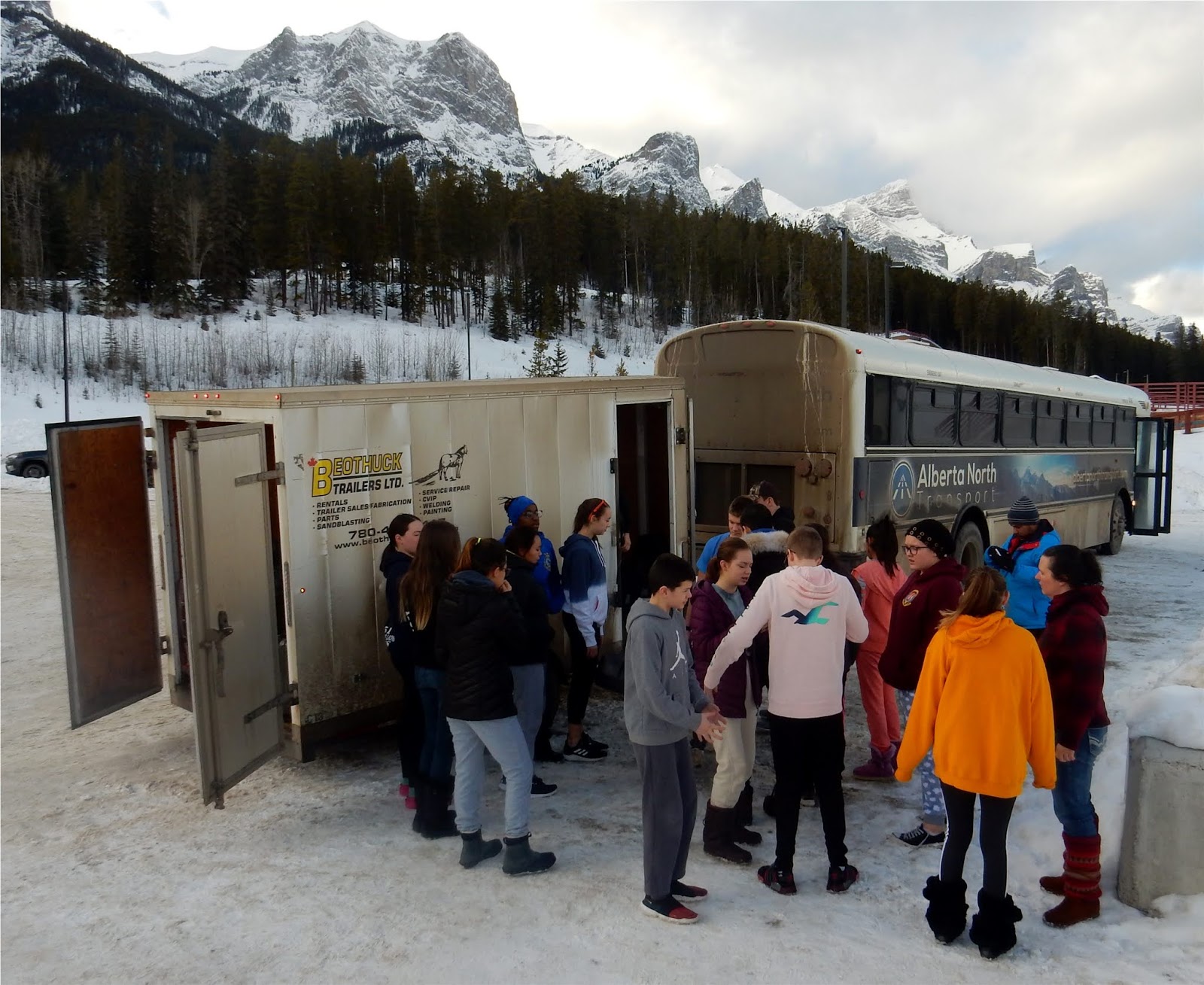
The cadets unloaded the trailer and moved all their equipment to the Wax Room Building (WRB).  While this was being done, I photographed the majestic Rocky Mountains that surround the venue and the town of Canmore.  The scenery provides the perfect picturesque background to a biathlon competition.  The planners had reserved the entire WRB for the weekend.  Like I mentioned in the first paragraph, cadets from Alberta & the Territories were competing at the same time, thus they all need rooms to store & wax their skis.  The WRB has many individual rooms equipped with tables, chairs, and electrical outlets.  I was surprised to see my name on one of the wax room doors.


Underground Tunnel.
The cadets were given two hours to ski the racetrack so they could become familiar with the route.  I told my cadets not to waste this opportunity.  While the cadets were out skiing, I investigated & photographed the outdoor shooting range.  The range looks professionally built.  Behind the range were: part of the race track, Judges Building, and the wooden bleachers for spectators.  We had been explicitly told to use the underground tunnel to access the shooting range.  Walking across the racetrack was forbidden to prevent collisions with racers.  The area in front of the Judges Building was the location of the Start & Finish Lines. 

Wax Room Building.
The cadets returned to the WRB at 4pm and put away their skiing equipment.  We then boarded the bus to be driven to a local high school where we would rest, relax, eat, and sleep at the end of the day.  The military was able to rent the school for the weekend because one of the officers in charge happens to be a teacher at the school.  Everyone went through registration.  The cadets would sleep in the gym and the officers/coaches would sleep in classrooms.  The people from the territories were provided with sleeping bags & air mattresses.

A Welcome Address & Briefing was held in the school’s auditorium after dinner.  The Officers-In-Charge introduced themselves & the judges, and went over the rules of the school & the competition.  The cadets were dismissed for the night, but the officers & coaches remained for the competition briefing.  We were given documents containing: the schedules, competition rules, and layout of the racetrack. 
           

Judges Building.
January 25 was the first day of the competition.  Reveille was at 6am, followed by breakfast at 6:30am.  School buses transported everyone to the CNC at 7:45am.  The competition staff were already at the venue getting everything ready.  Loud music was playing from speakers on the roof of the Judges Building.  The first race of the day would be the Junior Female Sprint Race.  The four cadets from Arctic Bay & Iqaluit would be competing in this race.  All competitors were given time to practice shooting & skiing.
           
Penalty Loop.
My tasks for the races were to signal my cadets which shooting lanes to use and refill the ammunition bowls with .22LR bullets.  Another officer would handle the rifles.  He made sure each cadet had a designated rifle.  Just before the commencement of the race, cadets were given numbered bibs & instructed where to line up.  Competitors would start one after the other.  I reminded my cadets that the shooting range is a Silent Zone, meaning I couldn’t give them any shooting advice or assistance.  They would be on their own.  I also told them not to forget to do their penalty laps.  One missed target equals one penalty lap.   
           
Arctic Bay cadet.
Arctic Bay cadet.
The Junior Female Sprint Race began at 10am.  The Junior Male Sprint Race began at 10:20am.  There were enough shooting lanes to run both races simultaneously.  My female cadets began their relays at different times.  The only time I was busy was when they were shooting at the same time.  Aside from that, I was free to take pictures & video clips of the race.  The parents & cadets back home wanted to see how Arctic Bay performed.  I would also use some pics & vids for training purposes at the corps. 

Iqaluit cadets.
Spectators.
The were people in the bleachers cheering on the competitors.  My cadets were relieved but very tired when they crossed the Finish Line.  The racetrack isn’t flat.  There are several hills to ascend & descend.  Two tables containing hot chocolate & bottled water sat just past the Finish Line for the cadet competitors.


Senior Female & Male Competitors.
The next four sprint races after lunch followed the same routine, except they began 15 minutes apart.  The races were structured as: Senior Female, Senior Male, Youth Female, and Youth Male.  The Senior Female race began at 1pm.  I wasn’t needed on the shooting range because I didn’t have any participating cadets.  I watched these races from the bleachers.


Random Wedding Photo Op.
The races were done by 3pm.  We spent the next hour cleaning the range, moving our skiing equipment to our assigned wax rooms, waxing our skis, and keeping the rooms organized.  During the cleanup I noticed a professional photographer directing a large wedding party on a nearby hill.  I don’t know who was getting married but I assumed the bride & groom wanted to have a series of photographs taken with the mountains in the background.  Hopefully the pictures turned out great.

Medals.
2nd Place - Junior Female Sprint Race.
3045 RCACC.
The medal ceremony for the sprint races was held at the high school in the evening after dinner.  The high school students in the woodshop class made the medals.  Alberta & the Territories competed separately.  Competitors who placed 3rd, 2nd, & 1st in their categories received medals and a group picture.  A lot of medals were given out.  My two Arctic Bay cadets placed 2nd & 5th in the Junior Female Sprint Race.  The two Iqaluit air cadets placed 6th & 8th in the same race.  Congratulations!  I announced the results on the corps Facebook page after the ceremony.

Early Arrival.
Fast forward to January 26; the last day of the competition.  The morning was busy because we had to eat breakfast, pack all our belongings, clean the school, and be out of the school by 7:45am.  The teachers needed their classrooms to get their final exams ready for the upcoming week.  We were able to achieve this goal. 

The second & final day of the competition was all about the relay races.  Competitors race in teams of two.  The first teammate completes their relay, crosses the Finish Line, and then tags their second teammate to do the same.  Once they’re done, both finishing times are added together.  The shooting range was going to be very busy & hectic because the organizers wanted all competitors to be done by 12:30pm.  Teams needed the afternoon to travel home. 

The relay races began at 10:30am with the Junior Males.  The males were given a 30-second warning followed by a loud whistle sound.  The first group rushed forward while the people in the bleachers cheered.  The race was on. 


My four Junior Female cadets began their race at 10:45am.  The starting process was the same.  The first two pushed off with the rest of the group, trying to get an early lead.  I did the same things: signal my cadets and refill the bowls.  I also noted when they completed their last shooting relay so that I could warn their teammates to get ready at the Start Line.  The first two cadets finished their relays at different times, but made sure they touched the shoulders of their teammates.  We were told a time penalty would be added if there wasn’t a point of contact.


The hill that everyone hated.
The second two cadets continued, while the first two breathed sighs of relief.  According to them, the relay race was more exhausting than the sprint race.  I think it’s because of that mad dash at the beginning.  The second two cadets performed well and completed their relays.  They too were exhausted.  They all agreed they hated that one hill where you have to frequently push up because it drains a lot of energy.


Northern Cadets.
Once the races were declared finished, a massive cleanup effort followed.  The judges went over the results while everything was being put away.  A group meeting was held with all the cadets & coaches from the Territories and two Alberta based officers.  The one who teaches at the local high school has travelled to Whitehorse many times to organize & host the cadet biathlon competitions.  We gave him a Thank You card for arranging us to be flown down to Alberta and for booking the Camrose Ski Club on the 23rd.  We gave a second Thank You card to the other officer who helped us with the rifles and waxing.  We finished the meeting by taking several group photos.

We waited for the final results to be posted.  We all wanted to know who was going to represent the Territories at the National Biathlon Competition in early March?  

             
To Be Continued . . .