Saturday, May 18, 2013

Out For A Walk . . . Again

Road to Victor Bay

In the days after Nunavut Quest, I prepared the country foods I acquired at the community feasts.  I did find some ideas on the Internet but in the end, it was a series of culinary experiments.  I started with the walrus meat, just boiling it in water for thirty minutes.  With a little added salt, the meat didn't taste that bad.  For the next experiment, I boiled one of the caribou pieces but added sliced onions, carrots, and celery to the mix.  I think the vegetables added flavour to the meat but I couldn't tell until I got rid of the strong gamey odor.  I probably should have cleaned out the frozen blood before putting the meat into the pot.  Lesson learned.  The third time was the charm because I wrapped the last caribou piece in bacon, sprinkled salt & pepper and then roasted it in the oven.  It tasted like bacon-wrapped steak.
            
What's over that hill . . . again?
On the morning of Saturday, May 4 (aka Star Wars Day), I woke up with a wanting to go somewhere.  It had been a month since I hiked to Victor Bay and I didn't want to pass the opportunity to enjoy the clear sunny weather.  I decided to hike up the hills behind my house and photograph the town below.  Just like my previous walk, I dressed warmly and brought along my camera, binoculars, and compass.  I left my place at around 10:15am. 
            
Rather than hike directly up the hills behind my place, I decided to approach them from the side.  This meant walking up the road to Victor Bay.  The snow on the road had completely melted, revealing a dark rocky path.  The long qamutiq I photographed a month earlier was no longer near the point where the road peaks at the top of a small hill.  Someone must have removed it a long time ago.
            

After walking several more metres, I turned around to take a photo of the sun.  Just like the first time, I was enveloped by complete silence.  I thought I could hear the sound of my clicking camera echoing off the snow-covered hills.  I moved off the dirt road, photographing a point marked by a tall stick.  A minute later, an Inuit man on a skidoo raced by, on his way to a cabin in Victor Bay.  When he was gone, I filmed a 360 degree panorama view of the surrounding landscape.  I was hoping to record the silence but when I reviewed the footage, the silence was drowned out by the soft sounds of light wind and the camera's background noise.
            
I continued moving to my left (west) trying to find the right slope that would lead me to a view overlooking Arctic Bay.  After a few minutes, I assumed I had found the right slope, and began a slow ascent to the top.  I stopped frequently to take pictures of the rocky hills.  There was still plenty of snow on the ground but with more patches of brown earth and black rocks.  The pinnacle iceberg I photographed back in late March was still out in Victor Bay.  Peering through my binoculars, it looked exactly the same as before. 
            
King George V Mountain - center left.
It didn't take long for me to realize that I had gone up the wrong hill.  When I reached the top, I came to a wide plateau littered with rocks.  I could see the top of King George V Mountain (KGVM) to my left and more hills straight ahead and to my right.  I sat down on a rock to rest for a few minutes.  I filmed another 360 degree panorama view of the surrounding landscape.  This time, I was able to record a few seconds of silence.  I thought about where I could go next.  I could walk towards KGVM, thus taking me back to town, or I could choose a new path.  I decided to choose a new 'uncharted' path by walking south west.  
            

After trekking up and down several slopes for some time, I spotted a very tall mountain in the distance.  I hadn't seen it before and it looked like a pyramid with a very wide base.  When I moved closer, I saw the frozen strait that connects Arctic Bay to the Northwest Passage by boat.  What surprised me was the land up ahead had suddenly stopped.  Taking several more steps revealed that I had arrived at a line of cliffs.  To my far left, I noticed three tall figures standing at the edge of the cliffs, appearing to be looking out over the strait.  Through my binoculars I could see that they were three inukshuks.  To my right, I noticed an inward 'v' formation in the cliffs.  I headed towards the formation to see how steep the cliffs were.
            
The cliffs are steep and jagged.  If you go over the edge, you're not coming back.  The rock formations in the 'v' opening reminded me of The Three Sisters, a famous rock formation in the Blue Mountains region.  I visited this part of Southern Australia back in 2010 with my family.  (You can read about it here).  Daring myself, I lay down on the ground at certain points and peered over the edges.  I'm not sure how high I was, but the drop had to be at least 200 feet.  As I stood up, I could hear and see several ravens flying around.  They were most likely wanting me to drop food on the ground but I hadn't brought any.                              
            

I walked along the edge of the cliffs towards the three inukshuks.  I gazed at the frozen strait below, amazed by its sheer size and flatness.  An entire city could be built on the frozen ice.  Upon reaching the inukshuks I photographed them from different angles.  Their design and structure were impressive.  Leaving them behind, I continued walking east, making sure not to slip and fall.  I looked back a few times to see how far the cliffs went.  They appeared to go on for several kilometres.  Now I knew where the photos for Nunavut Tourism were taken.   
            

Aside from snow, the other endless feature of the north is rocks.  The majestic landscape is just littered with rocks in many different shapes, sizes, and colours.  The Nunavut Government could make a lot of money exporting rocks for landscaping projects down south.  The very large rocks that stand out can be used as points of reference.
            

Upon reaching the end of the cliffs, I could see all of Arctic Bay: the airport, KGVM, the Industrial Area (aka Gas Station), the road to Nanisivik, and of course, the town.  After photographing each area, I took a closer look through my binoculars.  I spotted a water truck heading towards the airport.  I followed it, wanting to see if its destination was the airport or the refilling point.  The water truck passed the turnoff to the airport and continued driving for another kilometre before stopping at a small shed near a secluded lake.  So this is where the town gets its water, I thought to myself.  After enjoying the breathtaking views, I began my walk back to town.  I was able to get some pictures of the entire town before I exhausted the battery in my camera.
            
Road to the landfill.

A lone pair on a skidoo.
The hill I was walking on had two slopes.  I descended the first slope which brought me halfway down the hill.  I passed the town's cemetery, which is a collection of crosses and inukshuks.  The cemetery is marked by a tall white cross but I was unable to see it from where I was standing.  Rather than walk all the way back to the road to Victor Bay, I decided to walk down to the cemetery road.  The second slope was a little steeper and slippery.  To maintain my balance and grip on the snow, I moved from rock to rock while I made my descent.  Once safely on the cemetery road, I walked back to my house.  The time was 2:30pm when I closed the front door behind me. 
            

My four-hour hike was scenic and fun even though I never reached my original destination.  Instead, I discovered the western cliffs and plateaus of Arctic Bay and documented them with my camera.  And yet, there is still so much more to discover. 


Saturday, May 11, 2013

Nunavut Quest


Before the arrival of modern vehicles, aircraft, and sea vessels, the traditional methods of getting around the Arctic were walking, dog teams, and canoes.  Instead of gravel and paved roads, there were trails and paths.  Travelling between communities by dog team still took days due to the sheer size of the land.  Today, the trails and paths are still used by the Inuit, but the sounds of barking dogs have been replaced by the roar of skidoos. 
            
When people who haven't been to the Arctic look at a map of northern Canada, they immediately assume that the only way to get anywhere is by air and sea.  However, this is not true.  Travelling between communities across the land happens on a daily basis.  It's the same as taking a road trip down south.  You just have to be prepared to spend a night, or several nights, on the land. 
            
Source: Wikipedia
Dog sled races have been around for a very long time, being the most popular winter sport in the Arctic regions of Canada, the United States, Russia, and Europe.  Similar to rally car racing, the event is a timed competition where participants have to complete a marked course in the least amount of time.  Generally, there are three types of races: sprint, mid-distance, and long-distance.  There are resting points along the course so that the dogs have a chance to rest and eat. 
            
Despite its popularity, dog sled racing has yet to be given official event status in the Winter Olympics.  It was only a demonstration sport during the Winter Olympics in Lake Placid, New York (1932), and Oslo, Norway (1952).
            
Nunavut Quest is the annual six-day dog sledding race between Igloolik and Arctic Bay.  The 445-600km mid-distance race takes place in the spring.  The race was created in 1999 to celebrate the creation of Nunavut.  Fifteen mushers and 180 sled dogs participated in the first race on April 13.  The prizes were and still are: $10,000 for first place, $5000 for second, and $2500 for third.  The start and finish lines alternate between the two communities every year.  This year, the race would start from Arctic Bay on April 24.
            
Just like in Formula One and NASCAR, a dog sled racer (aka musher) cannot survive without a dedicated support crew.  They travel ahead of the team by skidoo, setting up camp at the designated rest points.  With them they drag qamutiqs loaded with food, water, tents, clothes, fuel, medical supplies, and camping equipment. 
            
Arctic Bay received a steady influx of visitors in the days leading up to the race.  Mushers, support teams, Inuit sled dogs, friends, and families arrived from other northern communities by plane and skidoo.  For many, it would also be a big family reunion.  To welcome all the competitors and visitors, two community feasts were held at the Community Hall on April 19 & 22.  Naturally, I attended both. 
            

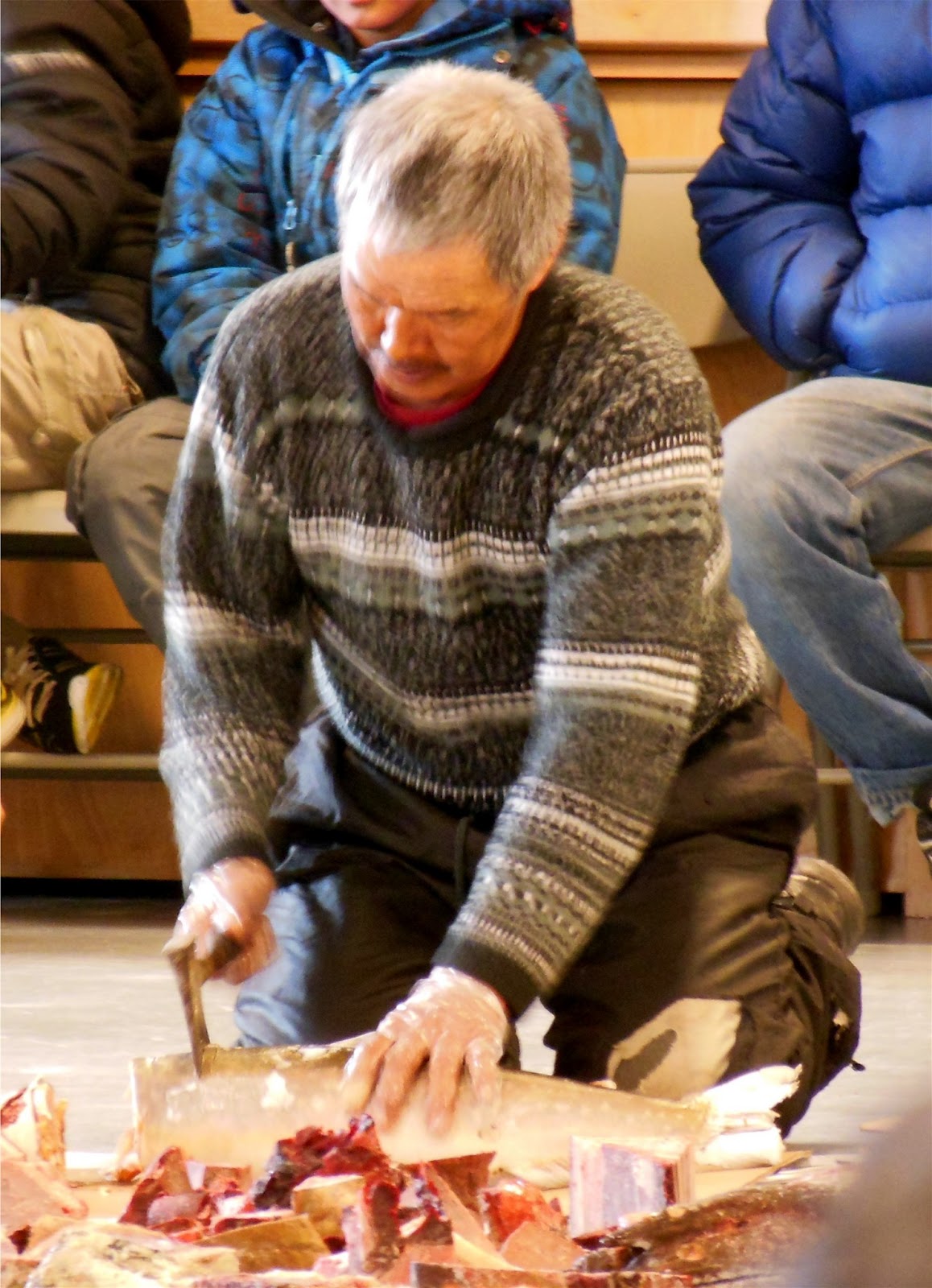
Cutting Arctic char.
The first feast was organized by the health centre staff who arranged the hall to look more like a buffet.  On a line of tables at the front of the hall sat boxes of raw Arctic char & caribou, and trays of various fruit.  The community hall was packed when the feast began at 7pm.  After the opening prayer, Elders lined up first followed by everyone else.  Everyone used large pieces of cardboard boxes as plates.  I picked two chunks of caribou and many pieces of fruit before returning to my seat.  Without hesitation, I flipped out a small knife and started cutting small pieces of caribou and placing them in my mouth.  Several kids watched me eat the raw meat for several minutes before returning to their game.  I think I also caught a few Inuit adults glancing in my direction.  I only ate a little bit of the raw caribou but the amount was much more than the first time.  I was glad to see that my stomach was getting used to the taste of raw meat.  I saved the two pieces of caribou for a later date.
            
Raw frozen walrus meat.
Traditional Inuit games were played at the Community Hall over the weekend of April 20 & 21.  Unfortunately, I was unable to attend because of school work.  Thankfully, plenty of pictures were taken and posted on Facebook. 


Around the country food they swarm.
The second evening feast followed a more traditional approach with the meats being laid out on a ground sheet in the middle of the Community Hall.  This time, there was caribou, char, aged walrus, and non-aged walrus.  Just like the first feast I attended in February, the adults sat around the food while children ran around and played.  They made sure not to touch the meats.  Just before the feast began, the hunters and several volunteers mixed the meats around so that everyone had a fair chance of getting each type of meat.  Armed with plastic bags and bare hands, everyone pounced on the ground sheet after the conclusion of the opening prayer.  Since I already had two pieces of caribou from the previous feast, I chose to just get a piece of non-aged walrus.  The piece I picked was the ribs.  Trying raw walrus for the first time wasn't as bad as I thought.  It tasted a lot like raw caribou.  I ate quite a bit before saving the rest.
            

The qualifying race took place on April 22 at 2pm.  Many people headed over to the frozen bay to watch.  Inuujaq School students were escorted down to the ice by their teachers.  Despite my best efforts, I got there just as the final dog team left.  The teams would return in an hour and their recorded times would determine their starting positions.  Several teachers including myself thought the qualifying event would be longer than 15 minutes.  Deciding not to waste the trip, I snapped pictures of the surrounding landscape, Inuit dogs, and people heading back to town.  The teachers & students walked back to school to finish the last period of the day.
            
Northern Store.
I made sure I would not miss the actual race on April 24.  Thankfully, the event is treated like a holiday and afternoon school was cancelled.  As I quickly ate my lunch, I could see streams of vehicles, skidoos, and people make their way to the starting lines.  Low overcast clouds hung above the bay.  Throwing on my winter outerwear, I walked down to the ice armed with my digital camera.  I got there just before 1pm. 
            

The weather was much different out in the bay with strong cold winds blowing through.  Despite this, there was plenty of activity.  The eleven competitors were looking after their dogs, support teams were checking their supplies and skidoos, and spectators were walking around snapping pictures and talking to each other.  The support teams were the first to leave, forming a long convoy of skidoos and qamutiqs.  Many waved them goodbye.  The support teams needed at least an hour's head start to get to the first checkpoint and have it prepared.  When they were out of sight, some people went back to town because the race wouldn't start until 2pm.  I chose to stay and snap more photos.
            
Support Teams leaving for the first checkpoint.
Picture taken by Ryan.
As time marched on, I realized that I should have gone home for lunch so that I could change into warmer clothes.  I was still wearing my work clothes underneath my winter parka and snow pants.  Thankfully, Ryan, the media teacher, showed me what many do to warm up: they sit in a heated vehicle.  You don't even have to know the owner.  It is a generally accepted rule that if you bring a vehicle out on the ice for a special event, you should leave it unlocked and running so that anyone who is cold can sit inside and warm up for a few minutes.  When 2pm neared, I got out of the land rover and positioned myself to catch all the action on my camera.  My battery was running low so I couldn't film any videos.
            
Mushers still use long whips to keep control of the dogs.  This is necessary because fights can still break out and if a dog gets seriously injured, it has to be put down.  The striking motions were flowing, not forceful. 


When the clock struck 2pm, an announcer with a bullhorn walked out in front of the dog teams and announced in Inuktitut that it was time to start the race.  He started his stop watch when he ordered the first competitor to go.  While his dogs sprinted forward, the first competitor waved goodbye.  The spectators returned the gesture.  The same cycle was repeated every minute.       

There were two exciting and scary moments.  The first happened to musher #5; he fell off his qamutiq but his dogs kept running.  He hopped onto the back of a skidoo which raced off to catch up to the runaway dog team.  When the skidoo driver got side-by-side, musher #5 jumped back onto his qamutiq.  The infraction added five minutes to his overall time.  The second mishap happened to musher #9; one of his dogs refused to run with the rest of the pack.  The dog kept running to the far left, causing him to fall and to be dragged.  What was worse was that this happened repeatedly causing musher #9 to stop every few metres.  I could only hope that that rebellious dog would eventually fall in line.  When all the dog teams were gone, the crowds dispersed for the day.            
            

All teams arrived in Igloolik on May 3.  The final results were:
            
First Place: Andy Attagutalukutuk with a time of 38 hours and 34 minutes.
Second Place: Peter Siakuluk with a time of 39 hours.
Third Place: Bob Olayuk with a time of 40 hours.

Dog Team Mural created by Iga's Aulajaaqtut (Wellness) class.


Tuesday, May 7, 2013

The Later (Many) Days Of April


Kindergarten.
On April 15, the teachers and students of Inuujaq School gathered in the gym to recognize students with perfect attendance for the month of March.  Since coming to the north in 2012, I have learned that one of the greatest challenges for educators is getting students to regularly attend classes.  (I'm pretty sure this problem also exists down south).  Also, there is the argument that awarding perfect attendance is trivial and not fair to other dedicated students.  Medical appointments, illnesses, family events (up here, that includes camping & hunting trips), and being late are all facts of life.  Nevertheless, the recognition alone encourages students to take their education seriously.
            
Grade 2.
The attendance awards were handed out from kindergarten to high school.  Naturally, the entire kindergarten class received certificates.  The remaining recipients are as follows: two for Grade 1, five for Grade 2, three for Grade 3, six for Grade 4, two for Grade 5, four for Grade 6, six for Grades 6, 7, 8, and one for high school.  Each student received a certificate and was photographed with their teacher.  The one high school student had her picture taken with the principal.  In total, forty-one students received perfect attendance certificates out of a student population of 235.
            
Grade 4.
In English, my students watched and studied the feature film Stand & Deliver.  To make sure my students were paying attention, they had to answer four sets of questions.  Judging from their expressions, some liked the movie while others didn't.  Made in 1988, the film is based on the true story of Jaime Escalante, an East Los Angeles high school teacher.  In the 1980s, he successfully prepared his students for the Advanced Placement Calculus Test, which awards students with college credit.  However, problems arise when the test scores are challenged by the Education Testing Service.  What happens next?  Sorry, you'll have to rent/buy the movie to find out.  Jaime Escalante passed away on March 30, 2010, while undergoing treatment for bladder cancer.  He was 79 years old.
            
Flag of NATO.
In Social Studies, we finished the Staking The Claim Unit (looking at Inuit land claims) and moved on to the Security Unit.  The unit looks at the 20th century history of Canada becoming a safe and secure country.  The four condensed chapters look at Canada's role in both world wars, the cold war (NATO), and the defence of North America (NORAD).
            
For the later-half of April, my guitarists had two more performance tests.  The first one was the Canadian national anthem and the other was 'Yankee Doodle'.  For 'O Canada', they could read from the paper that contained both traditional notes and guitar tab, but for 'Yankee Doodle' they could only read traditional notes.  We also looked at several classic rock and pop song melodies.  I also introduced my students to the use of accidentals in music (flats, naturals, sharps) and dotted notes.  For them, the toughest part was understanding that notes with accidentals can share the same sounds.
            
April 30th.
The month of April is when the temperature usually stays above -20ºC.  This was true for the remainder of the month.  Even though there was snow on the ground (there still is right now), kids were out riding their bicycles.  Of course, 'brown patches' began to appear, revealing rocks, dirt, and the dark gravel roads.  Night no longer exists, having been replaced by constant dusk.  Pretty soon, the sun will never drop below the mountains and just circle the town.
            
However, the weather wasn't always sunny and clear, with strong cold winds blowing through town and out into the bay.  It made watching the dog races out a little challenging (more on that in a future post).  What surprised me the most was the morning blizzard on April 30th.  I thought blizzard season was over?  I guess not.  It was quite an adventure walking to school, dressed as a 'polar man'.  Afternoon school ended up being cancelled that day.    
            

Going back to the morning of April 17, I stumbled upon a small discarded antler on the side of the road.  I waited ten seconds before picking it up.  After assuming it was a caribou antler, I placed it in my bag and continued walking to school.  Along the way, I pondered on how it got there.  The best reason I could come up with was that a hunter had shot a caribou out on the land and brought it back to be skinned.  He either discarded the antler or the wind blew it away.  I asked several teachers at the school what it could be and they too concluded it was a caribou antler. I have to admit that it is one of the most interesting objects I have seen/found on my way to work.  The first were the white Arctic hares.
            
Speaking of Arctic hares, two (or the same one) ran by as I was walking to school in the morning.  I forget the days but I was surprised to see them again.  The last time I saw a hare was way back in January.  If I stay here longer, maybe I'll catch one and keep it as a pet.
            
On April 22, Inuujaq School received an over sized cheque from the Northern Store to go towards the community cleanup.  Every year, the teachers and students clean up outside the school and other designated areas after the snow melts.  The money will go towards cleaning supplies and an after cleanup barbecue. 
            
During the month of April, I was approached by Iga, the high school Inuktitut teacher, who wanted to know if I wanted to help her with organizing student council.  I agreed, wanting to become more involved with students.  Ironically, I wasn't involved in student council when I was in high school.  When I arrived in Arctic Bay in January, student council had been put on the 'back burner' because there wasn't a teacher who had the time to run it.  Now, there was Iga, myself, and Paulette, the art teacher.  

It was good to see a large turnout of high school students at the first after school meeting in Iga's classroom.  The first order of business was arranging a snap election near the end of the month to choose a president, vice-president, treasurer, and secretary.  Next was deciding when student council should meet (weekly or bi-weekly) and informing middle school students that the council was looking for a student to speak for the middle school grades.  The first and following meetings were very productive and it was good to see students wanting to improve the school's learning environment.  


And finally, the National Arts Centre (NAC) in Ottawa hosted a Northern Scene festival from April 25 to May 5, "featuring more than 250 artists from Yukon, the Northwest Territories, Nunavut, Nunavik, and Nunatsiavut."  Musicians, actors, dancers, writers, filmmakers, storytellers, and chefs from the north came together in the nation's capital to "paint a living portrait" of their lives and cultures.  The festival was the sixth Scene festival organized by the NAC, the previous being: Atlantic (2003), Alberta (2005), Quebec (2007), British Columbia (2009), and Prairie (2011). 
            
Judging from the pictures, videos, and stories on the NAC website, the festival appears to have been a great success.  It would have been nice to attend and experience the festivities but I'm too busy living and teaching in the northern scene.  Even though the core events are over, there still appears to be several ongoing events related to the festival.  If you're in the Ottawa area, set aside some time to check them out.       
         
April 30th.

Thursday, May 2, 2013

3045 ACR


In the cadet program, individual cadet corps across Canada host an Annual Ceremonial Review (ACR), a formal parade at the end of the regular training year.  It is organized to showcase what the cadets of the corps have learned throughout the year, and to present awards & promotions. The parades are attended by parents, friends, and visiting guests.  Informally, an ACR is known as an Annual Inspection. 
            
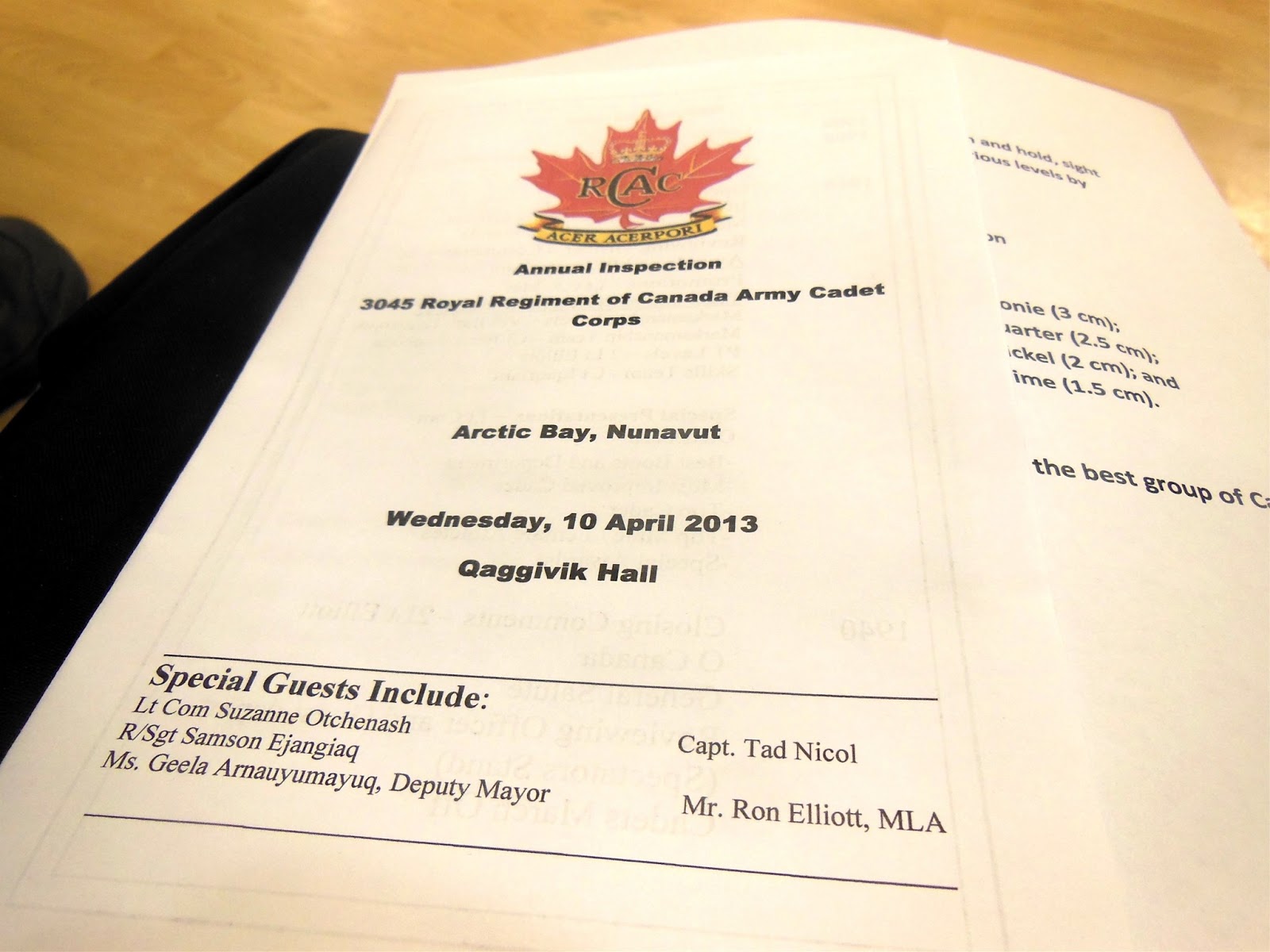
The ACR of 3045 Army Cadets took place on the evening of April 10 in Qaggivik Hall (Inuujaq School's gym).  The early date was chosen because many Inuit families are out camping, hunting, and travelling between communities in May and June.  Corps are free to choose when to host their ACRs.  When I was residing in Iqaluit last year, 795 Iqaluit Air Squadron's ACR was in late May.  When I was an army cadet at 2332 Major Holland Cadet Corps in Ottawa, our ACRs took place in early June.  Down south, most cadet corps have their year-end ACRs in June.
            
The cadets of 3045 await the order to
march on parade.
The parade was scheduled to begin at 1900 hours (7pm).  Cadets, officers, and civilian instructors began arriving at the gym at 1800 hours (6pm) to get everything ready.  The cadets also worked on polishing their boots and making sure their dress uniforms were spotless.
            

The ACR began with the placement of the Canadian and Army Cadet flags on both sides of the dias.  Sergeant D. Kigutikakjuk and Master Corporal A. Reid were the flag bearers.  With both flags firmly in place, both senior cadets took their positions as right markers.  The entire cadet corps marched on parade and were right-dressed by Warrant Officer L. Oyukuluk.  Everyone in the audience stood as the Guest Reviewing Officer, Lieutenant-Commander (Lt. Com) S. Otchenash, entered the gym.  She was escorted to the Dias by the corps' Commanding Officer, Lieutenant F. May.  Other special guests in attendance included MLA Ron Elliott and Deputy Mayor Geela Arnauyumayuq. 
            
Lt. Com Otchenash inspects cadets on
parade.
Following an Inuktitut prayer, Lt. Com Otchenash inspected the cadets on parade.  She enjoyed speaking to all of them individually.  With the inspection complete, Otchenash took her place at the Dias and observed the March Past.  Parents snapped pictures of their sons and/or daughters marching by the Dias. 
            

With the March Past completed, Otchenash was given the opportunity to address the cadets and the audience.  She spoke in English while Mishak Allurut, a freelance translator, translated in Inuktitut.  Allurut was my Inuktitut instructor during Professional Development week in mid-February.  In her speech, Otchenash congratulated the cadets for their impressive dress, drill, and deportment.  She also thanked the parents and civilian instructors for supporting the cadet movement.  
            
Lt. May continued with the awards and presentations.  First on the list was promotions.  Three cadets were promoted to the rank of Lance Corporal (formerly known as Private), the first rank with a sewn badge - one chevron.  Three cadets were promoted from Lance Corporal to the rank of Corporal - two chevrons.  Three cadets were promoted from Corporal to Master Corporal - two chevrons with a maple leaf.  And finally, one senior cadet was promoted from Master Corporal to the rank of Sergeant - three chevrons with a maple leaf.
            
I'm (left) reading the marksmanship
level requirements. Mishak Allurut
(right) translates in Inuktitut.
Despite being a small corps, 3045 Army maintains three competing teams in marksmanship, biathlon, and skills.  The marksmanship team was led by Civilian Instructor (CI) Irene Swoboda.  Before she presented her awards, I, with the help of Mishak, explained to the audience how cadets earn their marksmanship levels.  There are four levels to attain and grading is determined by how close the cadet is able to hit the target in prone and standing positions.  The rifle of choice is the Daisy Air Rifle.  Five cadets obtained a Level 2, one earned a Level 3, and six were successful in attaining a Level 4. 
            

CI Irene Swoboda presents certificates
to the marksmanship team.
Fitness plays an essential role in the cadet movement by promoting healthy living and remaining physically active.  Three areas are assessed throughout the year: cardiovascular endurance, muscular strength, and muscular flexibility.  There are three fitness badges cadets can earn: bronze, silver, and gold.  This year, four cadets achieved a bronze level and one achieved a gold level.    
            
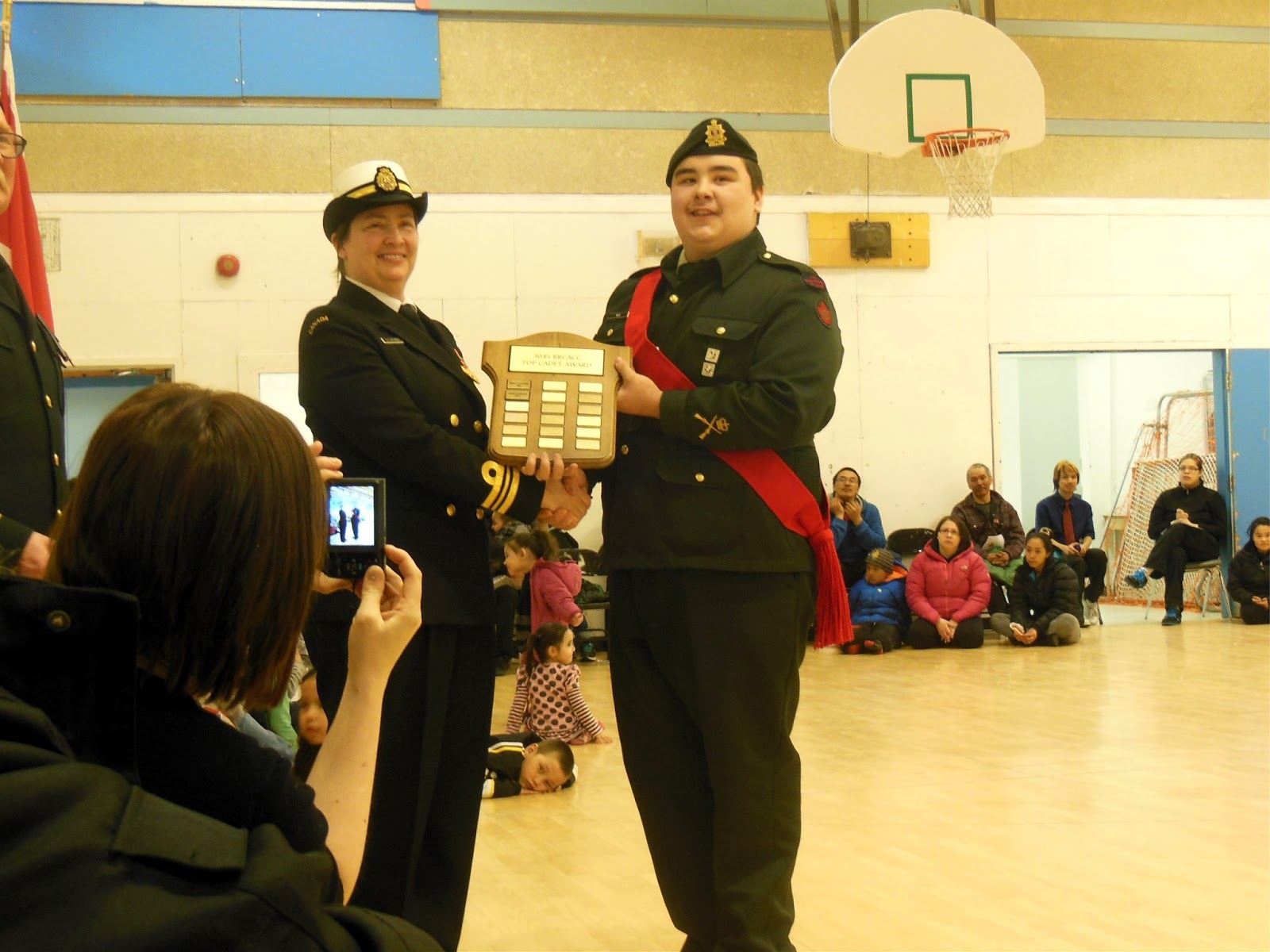
Lt. Com Otchenash presenting the award for Top Cadet to Sgt. A. Reid.
Lt. Com Otchenash was invited to present the last four awards for Best Boots & Deportment, Most Improved Cadet, Top Cadet, and Top Male & Female Athletes.  (Unfortunately, I have forgotten the names of the recipients, but I will find out shortly).
            
For the closing remarks, MLA Ron Elliott thanked everyone for attending the parade and for supporting the cadet movement.  He also congratulated the cadets for putting on a good show.  The parade continued with the playing of the national anthem 'O Canada' followed by the Advance in Review Order and General Salute.  Everyone in the audience remained standing as Lt. Com Otchenash and the reviewing party left the gym.  The cadets marched off to the sounds of the applauding audience. 
            
Retiring cadets WO Oyukuluk, Leslie and WO Attagutsiak, Bruno.
An after-ceremony reception was held just outside the gym with cupcakes, muffins, cookies and coffee being offered.  Most of the delicious sweets were prepared by Irene.  I mingled through the crowd, personally congratulating every cadet for completing the training year (even though there was still one month left).  All in all, it was a great parade.