Friday, April 5, 2013

Science Fair - Part 1


In 2002, a group of teachers, principals, and other professional educators came together and created the Elephant Thoughts Global Development Initiatives.  As a Canadian registered charity, Elephant Thoughts "promote[s] high standards of education worldwide despite economic or geographic barriers."  They do this in a variety of ways, such as: supporting schools, building schools in the developing world, and sharing resources with NGOs working in the same field.  Today, Elephant Thoughts (ET) works in more than 75 Inuit & First Nations communities across Canada, and in India, Nepal, Tanzania, and Nicaragua.
            
One of the many educational programs that ET brings to First Nations & Inuit communities are Science Workshops.  These can be done as class field trips, after school activities, or science fair.  For the last two weeks of March, ET hosted a science fair for the students of Inuujaq School.  Members of the public were allowed to attend after school hours.  The visit was the last part of a science fair tour of several Nunavut communities.
            
A sponsor covered the transportation costs for the two instructors and their equipment.  The instructors were Stevie and Marni.  To make sure the science fair ran smoothly, a schedule was put together.
           
Stevie welcomes students.
The first workshops I attended were with my English and Social Studies classes on the morning on March 22.  For the first half, the high school English and Math classes went down to the Home Economics room (aka Home Ec) where Stevie gave a presentation on electricity.  The high school Inuktitut language classes were upstairs in the library with Marni.  Stevie welcomed the students and instructed them to set aside any electronic devices so that they wouldn't get fried during the demonstrations.  I made sure to keep a close watch on my digital camera.
            
Stevie began her workshop by talking about Nikola Tesla and Thomas Edison.  Nikola Tesla, a Serbian-American inventor & electrical engineer, is known for pioneering the modern alternating current electrical supply system.  Thomas Edison was an American inventor and businessman, mostly known for inventing the light bulb, phonograph, and motion picture camera.  Stevie then moved on to static electricity, something that the teachers & students of Inuujaq School are all too familiar with.  After explaining how it works, she brought out a plasma globe and got several nervous students to touch it with their fingers and later, their noses.  I participated as well.
            
Donathan gets ready for an electrical current to be sent through him to the light bulb.
What followed were demonstrations of running electrical currents through human bodies.  Donathan, a guitar student of mine, was the first to volunteer.  In his right hand he held a fluorescent light bulb and in his left hand he held an electrical apparatus.  Before turning on the apparatus, Stevie stressed to Donathan to not let go, otherwise he would get a near fatal shock.  Slowly turning on the apparatus, the electricity flowed through his body and lit the fluorescent bulb.  Donathan described the sensation as being tickled.  The demonstration was repeated with a line of three students.  Everyone watched in awe as the light bulb again flickered to life.
            
When everyone took their seats, Stevie used the electronic apparatus to test the conductivity of various objects.  Wooden objects and a sheet of paper didn't conduct any sparks but the metal objects did.  What the students found intriguing was when Stevie placed a thin piece of paper on top of a metal plate and showed the electricity from the apparatus travelling through the paper to the plate. 
            
Setting the electrical apparatus aside, Stevie rolled up the small carpet on the floor to reveal a small grid made out of black electrical tape.  The 'Guess the Circuit Path' game called on participants to move from one x to the other in a chosen path.  You can move forward, back, and sideways; not diagonally.  The game is basically trial-and-error because you're guessing with every step you take.
            
Stevie and students examine a laser pack and gun.
The highlight and final activity of the workshop was when Stevie brought out the 8 laser guns and vests.  While she got them programmed for laser tag, several students and I turned the Home Ec room into a play area with obstacles.  Turning the lights off, two teams of four zapped each other with the laser guns for five minutes.  I participated in the first game, giving students a chance to shoot a teacher and not get in trouble for it.  For the second round, I stood off to the side and filmed it with my camera.  Playing laser tag brought back childhood memories of going to Laser Quest with my friends.
            
Marni introduces herself.
Mexican jumping bean.
The science fair continued after morning recess with the high school classes switching places.  Marni's workshop in the library focused on the biology of certain animals, insects, and plants.  Marni started her workshop by showing students Mexican jumping beans, seed pods that are inhabited by the larvae of a small moth.  The larvae eat the inside of the bean and can stay inside for months until it transforms into a moth.  The beans 'jump' when they're in a heated area because the larvae inside are trying to move into a cooler area.  The beans she brought were sitting in the sunlight and sure enough, they periodically moved all on their own.
            

Students dissecting owl pellets.
Marni then turned the students attention to the many different eating habits of animals, particularly the owl.  Since owls are birds, they don't have teeth.  They have to swallow their food whole.  An owl's diet typically consists of insects, mice, rats, and hares.  The owl regurgitates the parts that its body can't digest.  Up until that point, I didn't know that owls had to regurgitate the indigestible parts of their prey; I always thought it came out the back like with seagulls.  Learning that fact made me think whether it was wise for Western cultures to associate the owl with wisdom.  Anyway, I'm just glad the human digestive system doesn't work like that; eating in public or in private wouldn't look pretty.
            
Principal A. Salam and I examining the contents of an owl pellet.
Picture taken by Donathan.
Me looking at a mouse skull.
Picture taken by Marni.
Owls regurgitate what they don't digest into small pellets.  Marni explained that these pellets are often collected and sent to schools to be dissected by biology students.  People who go out and collect these pellets can earn around $2 per pellet.  Naturally, after Marni finished her explanations, she handed everyone blue plastic tweezers, diagrams of rodent bones, and an owl pellet wrapped in tinfoil.  We had to dissect and catalogue the bones we found inside.  Everyone had fun with the dissections; me included.  We all ended up dissecting a second pellet.  I found several skulls & bones belonging to mice and rats.  Marni gave everyone the option to keep what they found by handing out small plastic bags.  I chose to keep all the skulls.  Everything else was thrown in the garbage.
            
The last creature we studied was the honey bee, particularly how it produces beeswax, a natural wax used to build honeycomb cells in the hive.  We also looked at how humans use beeswax for candle making.  We each got a strip of beeswax and a piece of string.  Making a beeswax candle was very easy because all you had to do was wrap the beeswax around the piece of string.  The string serves as the wick to light the candle.  
            

Just before it was time to break for lunch, Marni presented two dinosaur plants that had just been placed into two small bowls of water.  In dry weather, the plants curl into tight balls but slowly open (in about 3 hours) when exposed to moisture.  They were her gifts to the schools.
            
I caught up with Stevie and Marni just as they were leaving for lunch.  I thanked them for their interesting and interactive workshops.       


To be continued . . .

Sunday, March 31, 2013

Survival & Guitars

Me holding a guitar. Drawn by one of my guitar students.


Going back to the beginning of the month, the people of Arctic Bay had a little scare: two teens were missing out on the land.  They had gone hunting with their father some fifty kilometres north of Arctic Bay.  The brothers were following their father on skidoo when they became separated on the ice.  Later, the father's skidoo broke down, prompting him to activate his GPS locator.  He was rescued on the morning of Tuesday, March 5th. 
            
The brothers continued towards the southeast, hoping to reach land but their skidoo ran out of gas.  With no GPS locator, radio, or sat phone, the brothers now had to rely on the knowledge and skills they learned from local Elders.  They abandoned their skidoo and walked along the ice.  They made sure not to follow the northern winds but to walk across them in the hope of reaching land.  Forced to overnight on the land, the brothers found a large mound of snow & ice, and slept on the side that was against the wind.  They huddled together to stay warm.  The brothers eventually made it to land and found a cabin with a radio inside.  They were picked up by rescuers later in the day, who had gone out three times looking for the brothers.
            
This whole ordeal was in the spotlight, from beginning to end.  One of the brothers, Jeremy, happened to be one of my students.  The school was kept informed through announcements.  Everyone breathed a collective sigh of relief when the announcement came that the two teens were found.  A day or two later, Jeremy was given the opportunity to talk about his experience in Iga's Inuktitut language class.  Even though I couldn't exactly understand what was being said, I got a simple understanding of what happened through body language.  From the look on his face, he was glad to be alive.  The story made the CBC news.  The father and two brothers recovered their skidoos several days later.


As an assignment, Iga's students wrote about the experience and posted it in the high school hallway for everyone to see.
            
Fast forward to the middle of the month, my English students have begun to review the key literary elements with examples from literature and in depth writing activities.  I'm thinking the completion of these worksheets will replace a written test.  The only downside is that the worksheets contain a lot of big words that need to be explained.  We're slowly working through them.
            
Skinned Polar Bear.
In Socials Studies, my students studied the 1970 Coppermine Conference, possibly the most important meeting in Inuit (land claims) history.  Since the late 1800s, the Inuit of Canada's North were subjected to a harsh policy of assimilation by the federal government and Christian missionaries and had little control over their lands & lives.  By the late 1960s, it became clear to them that the only way to ensure the survival and preservation of the Inuit language and culture was to become involved in the political process.  Inspired by the African-American Civil Rights Movement in the United States, young Inuit activists began meeting in communities and established two organizations: ITC (now Inuit Tapiriit Kanatami) and the Inuit Eskimo Association (IEA).
            
In 1970, the IEA sponsored a conference in Coppermine (now Kugluktuk), NWT, where delegates from 20 northern communities came together to voice their concerns about problems in the communities and how to take back control of their lives.  My students reviewed a transcript from one of the meetings and the problems discussed were: substandard housing, strict hunting regulations, land being developed without Inuit input, and Aboriginal rights.
 
Arctic Bay rock sign.
A follow up meeting was held in Toronto in February 1971 where the issues raised in Coppermine were stressed and reiterated.  It was interesting to see how the Inuit organized themselves and began making so much 'noise' that the federal government had no choice but to start listening.  It would have been nice to learn about this when I was in high school.  Following the Coppermine lessons, my students will look at Inuit land claims.
            
On Friday, March 15, my guitarists had another tabs test.  They had a choice of playing Johnny Cash or Eminem melodies.  They did very well.  Before the end of the period, we brought our guitars to Jill's Grade 4 class to do a sound demonstration.  Her students are studying sound and she had asked me if my guitarists and I could show how sounds are made on the guitar.  I happily agreed.  One of the activities Jill had prepared for her students was to build guitars out of small boxes, rubber bands, and popsicle sticks.
            
Jill's students are quite an energetic bunch but when I started the demonstration, they quieted down really quickly.  Was I like that when I was in Grade 4?  I started by explaining the parts of the guitar and how the strings are organized.  After plucking a few notes for them to hear the differences in pitch, I played several tunes for them (Mission Impossible, Smoke On The Water, & the James Bond Theme).  I then let my students come up one at a time and play a song or two that they wanted to share.  The Grade 4s really enjoyed it.  They now had an idea of what their guitars needed to sound like.
            
Speaking of guitars, my students have started an afterschool guitar club of sorts at the beginning of March.  For an hour after school, I let the high school students come in and jam on the guitars.  I just make sure they know not horse around with them and pluck on the strings too hard.       
            
Despite the town of Arctic Bay being surrounded by high hills and cliffs, it is prone to adverse weather.  There is fog now and then but a blizzard can also strike.  One blizzard happened on March 20 in the afternoon.  Cadets was cancelled that evening and the wind almost knocked me over when I was walking home.  It reminded me of the blizzards in Iqaluit.
            
And finally, I prepared a dinner meal for myself on March 25 with the Arctic Char I bought.  It was quite an eye opening experience; I wasn't expecting so much blood when I was cleaning it.  I made sure to thaw it out for 3 days before getting to work.  Looking at the dead fish before me, I whispered, "Mamianaq, (Sorry)," before slitting it open with my butcher knife.  (I have been told that Inuit hunters would shout this word before killing a seal(s) with their harpoon(s)).  I felt like a butcher . . . and a surgeon. 
            
After cutting off a few slices, I cooked them on an open frying pan for a few minutes.  I also had rice on the side.  The meal was delicious but there was a lot of cleaning up to do.  I placed the rest of the fish in Ziploc bags and put them back in the fridge.  I would be eating char for the next several days.  


Sunday, March 24, 2013

Recess Duty & Parent Teacher Interviews

Arctic Char.

The weekend of March 2 - 3 ended with the purchase of a large frozen Arctic Char fish from an Inuit local for $20.  Compared to how much it would cost down south (maybe double?), this was a good deal.  He was the same person from whom I bought bannock for $2 a piece at the Northern Store.  Just like in Iqaluit, if you're Qallunaaq, local Inuit artists, hunters, or residents who have something to sell will approach you to make a deal.  You can accept or politely decline.  With a large fish in my possession, I now had to figure out how to clean and prepare it.  Thankfully, there is plenty of information on the Internet and I can ask a local resident.
            
Inuujaq School hosted a Scholastic Book Fair on February 28, and March 1 & 8.  The book fair was also open to the public from 3:30 - 5pm.  The event was organized & coordinated by Amber, a Student Support Teacher.  Scholastic shipped a limited amount of books, posters, games, and learning kits, but also provided catalogues and order forms.  Shipping to and from Arctic Bay was covered by Scholastic.  The books ranged from preschool to young adult.  The posters were of comic book heroes, teen music artists, and film actors.  During the school day, students who wanted to make purchases and/or submit orders were escorted down to the library by their teachers.  Mail orders would take about a month to arrive.  The book fair was a success, bringing in around $1300.  Amber was pleased by the turnout and delighted that the school didn't have to cover any shipping costs.     
            
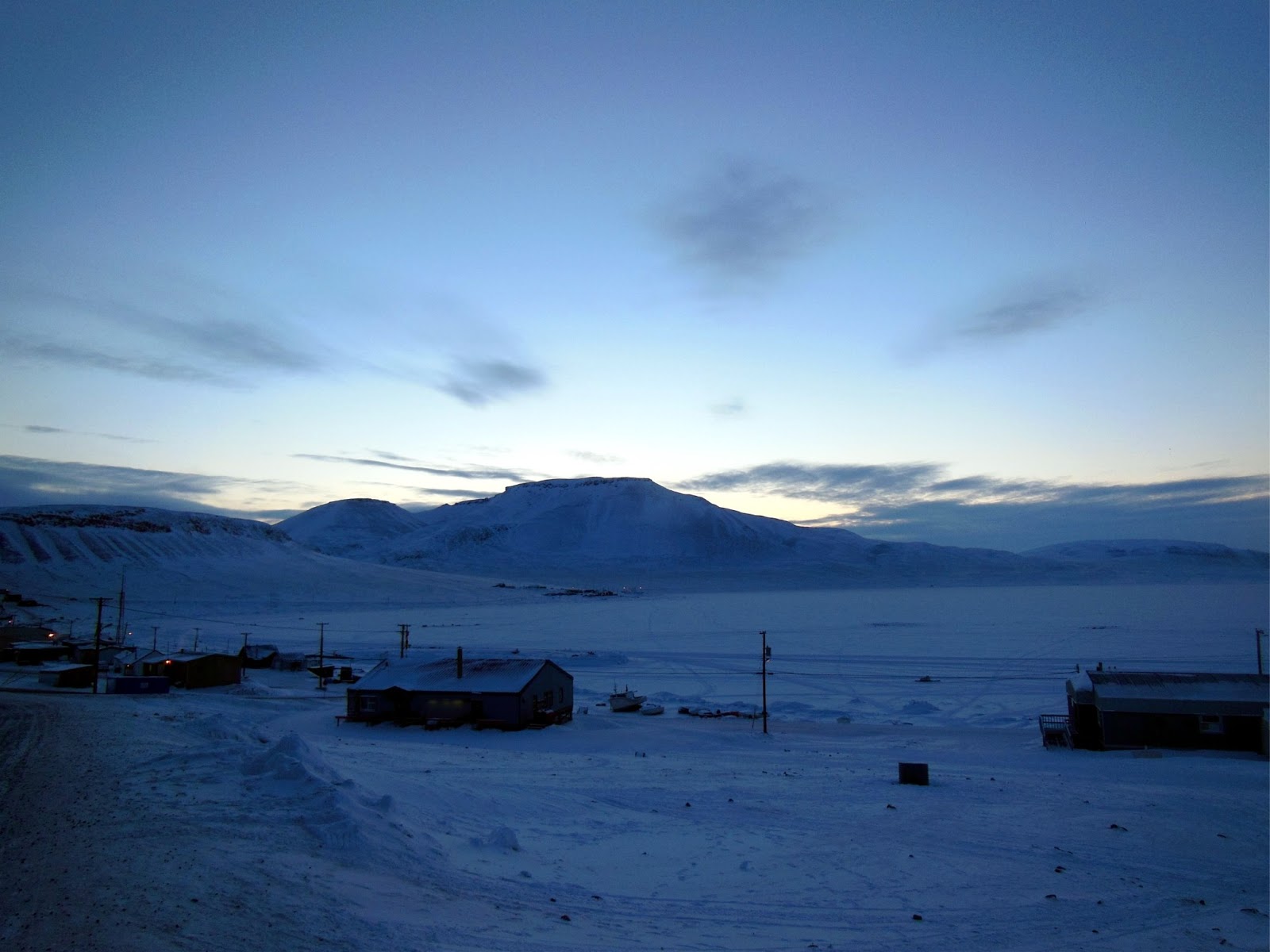
Morning Clouds. March 8, 2013
For the week of March 4 - 8, several Inuit teachers & I had morning and afternoon recess duty.  Teachers are assigned recess duties for an entire week rather than a day per week. For twenty minutes a day, my main task was to supervise the high school students, making sure they didn't smoke too close to the building, and keep the younger grades from coming over to the high school wing.  My other task was to make sure everyone got along.  What made my first recess duty week more interesting was that I was the only Qallunaaq teacher on duty.  I was essentially, the 'Token White Guy'.
            
Me in my Canada Goose Parka.
It was nice to get outside for some fresh air rather than spending the ten minutes photocopying in the main office.  But, it was unfortunate to see the vast majority of high school students smoking.  The price of cigarettes is around $20 a pack.  It was shocking to hear them talk about Inuit kids as young as 9 beginning to smoke.  I had several debates with students as to why they should quit, the most obvious reasons being: you live longer and you save a lot of money every year. 
            

Even though ten minutes is not a lot of time, the elementary students enjoy every minute of it, playing on the school's two play structures.  Some use pieces of cardboard as toboggans to slide down a nearby mound.  There were even a few snowball fights (no one was injured).  Overall, my recess duties were not as hard as I thought they would be and I was glad the high school students helped me improve my Inuktitut vocabulary.
            
Inuktiturunnaqsivalliajunga.  (I am learning to speak Inuktitut).
            
The morning of Sunday, March 10 was one of slight tension because it was time for a haircut.  I'm normally calm but this time I would be cutting my own hair.  Arctic Bay does not have a hair salon but there are locals who cut hair for a fee.  Wanting to save money, I stood in front of the mirror with the electric razor I received from a friend in Iqaluit.  When it comes to cutting my hair, it's like mowing a lawn.  I go for an army buzz cut.  Easy to maintain and you don't have to worry about getting head lice.  As for sideburns, I cut them as well.  To make a long story short (pun intended), I was satisfied with the end result and only had to sweep all the hair off the floor. 

King George V Mountain. March 13, 2013
Wednesday, March 13 was one of my toughest days yet because the afternoon was dominated by parent-teacher interviews (2 - 6pm).  Midterm report cards were also handed out that day.  I was expecting to see the parents / guardians of all my students, but only saw four.  There was one parent who required a translator because she did not know English.  I explained how their child was doing in my class regarding class work, attendance, participation, and attitude. 
            
There were two moments when I was waiting for parents that I spotted and photographed a convoy of ten snowmobiles driving across the frozen bay.  The first time they were driving to the industrial area to pickup gas.  The second time they were heading in the opposite direction.  Even though they weren't dragging any qamutiks (sleds), I assumed they were heading out on a land trip.  My assumption turned out to be correct because they were Canadian Rangers, going out on another patrol of the surrounding area.

Canadian Rangers Convoy.

Tuesday, March 19, 2013

Back From P.I.

The Arctic Sun - February 28, 2013.

Teachers and students returned to Inuujaq School on February 25, after the conclusion of Professional Improvement (PI) Week.  I knew several high school students would be happy with the continuation of the semester because they had been bored for the last week, or so they told me.  As for me, I liked having a week off from teaching but now I needed a break from learning Inuktitut.  So much new information had been crammed into my head that my brain needed time to process it all.  I started by using the weekend of the 23 & 24 to prepare lessons and my classroom for the upcoming week.  The teachers who were out of town for PI had to prepare their lessons before they left. 
            
Mishak, my Inuktitut instructor, helped me write two motivational quotes for me to post in my classroom:
            
Sapilingilutit ilinniarniqmik - (Don't give up on learning), and
            
Iqianngungillutit ilinniarvigmik - (Don't get tired of school).
            
As I explained in a previous post, everyone knows what everyone else is doing in a small town.  So, it was no surprise for me to hear that the entire student body knew that I had been learning Inuktitut for the past week.  The high school students decided to put me to the test.

"Qanuippit? (How are you?)" they would ask.
            
"Qanuinngittunga. (I'm fine)," I would reply.  "Ivvilli? (And you?)"
            
"Qanuinngittunga," they answered.  I did receive some other responses, such as, "Uirngaqtunga (I am sleepy)", "Niaqungujunga (I have a headache.)", and "Aamai (I don't know)."
            
I also made sure to say "Qauppattauq (See you tomorrow.)" when I dismissed my students. 
            

In English, we continued looking at short stories that addressed the most important literary elements (plot, setting, characters, etc) in depth, and worked on answering questions with full sentences.  The only challenge my students faced is using prepositions.  On a positive note, my students were gaining more confidence in reading out loud.
            
For Social Studies, I decided to take a break from the Staking The Claim Unit, and have my students look at the Idle No More Movement.  Idle No More is an ongoing Aboriginal protest movement, (spearheaded by First Nations), that was started by four activists in Saskatoon, Saskatchewan.  Nina Wilson, Sheelah Mclean, Sylvia McAdam, and Jessica Gordon were showing their displeasure and drawing the public's attention to Bill C-45, a large omnibus bill introduced by the current Conservative federal government.  They felt that the bill would seriously weaken environmental protection laws, Aboriginal communities (ie. reserves), Aboriginal treaties, and lead to more resources exploitation. 
            
Word quickly spread through social media resulting in teach-ins, sit ins, rallies, and flash mob in cities across Canada.  Idle No More protesters even blocked CN railway lines and major highways.  International media outlets picked up the story leading to solidarity protests in the United States, Sweden, Britain, Germany, and New Zealand.  The movement is now being used to address all Canadian Aboriginal concerns: Third World living conditions on reserves, the cancellation of the Kelowna Accords, the former residential school system, and not supporting Aboriginal interests. 
            
The Inuit have expressed solidarity towards the Idle No More movement and even held several rallies in Iqaluit.  Despite the settling of land claims across the north, there are still many Inuit issues that require the federal government's attention: high cost of living, mental health, education, job creation, and infrastructure.  These views were echoed by my students.  I hoped the federal government and Nunavut territorial government were listening.
            
In guitar class, we reviewed the basic guitar chords, worked on a few classic rock riffs, and looked at the national anthem "O Canada".  Since my guitarists did a really good job of following instructions and learning the required repertoire, I rewarded them by letting them watch the movie School of Rock on Friday (March 1).
            
Water delivery.
On Wednesday, February 27, the teaching staff had an after school meeting to discuss PI Week.  Each teacher took a minute to explain what activity they completed and how it has made them a better instructor.  Teachers spoke of doing crafts, sewing, jewelry, badminton, and making kamiks.  When it was my turn, I explained how I learned Inuktitut and was now picking up the root words.  I had to throw in an apology because I couldn't do the entire explanation in Inuktitut.  "Ilippaliajunga (I am learning)," I reassured the Inuit staff.     
            
Since it was the first week back from PI, the pace was slow.  'Vacations' always go by faster.  Every second Friday, there is a staff get together in the staff room where snacks are served by a group of teachers.  There are several rotating groups, and my group just happened to be assigned Friday, March 1.  I didn't have time to prepare something like several teachers did, but I did go over to the Northern Store and bought two shrimp rings and two small bags of Babybel cheese.  The other teachers in my group served bannock, crackers, chocolates, and vegetables & dip.  By the end, there was nothing left.  My group received many thanks from staff.

Morning Sun - March 2, 2013

Air rifle pellets.
Wednesday is not the only day the army cadets of 3045 have training.  There are also weekend activities to keep them busy.  For the last several weeks, Saturday was reserved for air rifle shooting in the morning and sports in the afternoon.  I had been 'voluntold' (military term) to help supervise the morning shoot on Saturday, March 2.
            
Barb, the community's social worker, picked me up in the early morning and drove us to Inuujaq School.  3045 Army uses the school's gym for indoor training.  The sun was shining brightly over the frozen bay.  Just across the street, a water truck was refilling a house's water tank.  Cadets arrived at 9:30am and set up the rifle range with targets, mats, tables, scopes, safety goggles, and signal flags (red - live firing; green - stand down).  The Daisy Air Rifles were carefully removed from the secured storage locker and carefully placed on the mats. 

            
Me firing from standing position.
The air rifles are single bolt action and fire very small metallic pellets at around 490 feet per second.  They are always pointed down range.  For each relay, cadets fired ten pellets and shot either in prone or standing positions.  At the end of each relay, the rifles were cleared & secured before cadets recovered their targets.  Barb examined the targets with a transparent chart and wrote down the scores.  I got a chance to participate in the last relay but I had to fire while standing.  I can't remember the last time I had fired the Daisy but I know it wasn't in standing position.  When I was a cadet, I usually fired in prone.  Reviewing my targets after the relay, I concluded that I did alright for firing in standing position.


Everything was packed up and put away by 11:30am.  The cadets broke for lunch and Barb dropped me off at my residence.