Saturday, March 29, 2014

The Ides of March


The month of February was dominated by media coverage of the 2014 Sochi Winter Olympics (Feb 6 - 23).  Since Canadians thrive on winter, it's only natural to assume that we were all glued to our TVs, computers, tablets, smartphones, newspapers, and magazines, eagerly watching and keeping up to date with the progress of our athletes.  Personally, I relied on the Internet and word of mouth.    
            
Sochi is located in southern Russia and is the first Russian city to host the Olympics after the collapse of the Soviet Union in 1991.  Despite a variety of controversies, (ie. bloated budget, corruption, treatment of LGBT athletes/tourists, incomplete venues, side-by-side toilets with no dividers), the Games were a success and Team Canada came home with 25 medals: 10 gold, 10 silver, and 5 bronze.  And of course, Canada still reigns supreme in hockey (Men's & Women's).  Bring on PyeongChang in 2018!
            
With the arrival of March, anticipation for an upcoming circumpolar sports event was growing across the Arctic.  The Arctic Winter Games is "a high profile circumpolar sports competition for northern and arctic athletes.  [They] provide an opportunity to strengthen sport development[,] promote benefits of sport, to build partnerships, and promote culture and values."  In short, they are the Olympics of the North. 
            
The Games were founded in 1969 to give circumpolar athletes a venue to compete "on their own turf and terms".  Beginning in 1970, the games have been held in Alaska, Canada, or Greenland every two years.  This year, the games were held in Fairbanks, Alaska, from March 15 - 22.  All nine contingents participated: Alaska (USA), Greenland, Northern Alberta (Canada), Northwest Territories (Canada), Nunavik (Quebec, Canada), Nunavut (Canada), Yukon (Canada), Sami people, and Yamalo-Nenets (Russia).  Arctic Bay sent a team of six males and two chaperons to Fairbanks.  The six young athletes competed under the Team Nunavut banner.  (More on their progress and return in next week's post).
            
Full Moon. March 14, 2014.
For the teachers of Inuujaq School, the month of March signaled the end of the first half of the semester, the issuing of midterm report cards, and parent-teacher interviews.  The first week of March was devoted to reviewing and testing.  My students had just four days to prepare for their midterm tests at the end of the week.  I reviewed all the course materials with my English and Social Studies students and gave them exercises to help them remember.  They also had to complete and submit any remaining class work to me before Friday, or else it wouldn't be included on their midterm mark.  My guitarists had a performance test that required them to select and play their favourite guitar riffs from a long list of choices.  I spent the weekend of March 8 & 9 correcting papers, recording marks, and writing comments.  I felt great when everything was completed.     
            
Parent-Teacher interviews occurred on Wednesday, March 12.  There were no afternoon classes that day.  Unfortunately, I didn't meet the parents of all my students, but I was glad that several did come to speak to me.  I explained their child's report card, their behaviour in class, and their strengths and weaknesses.
            

Friday, March 14th was a very busy day.  Administering midterm tests was just one of the many events that took place.  At the time, the Canadian Armed Forces and Rangers were conducting a joint Arctic warfare exercise; the Rangers were teaching several southern soldiers how to live, survive, and fight on the land.  I witnessed them riding into town Thursday evening - a convoy of black skidoos pulling long qamutiks.  Apparently, they had flown in all their equipment from Resolute.  On Friday, the Forces and Rangers visited the students of Inuujaq School and organized an evening community feast at the Community Hall.
            
As a way of "killing two seals with one harpoon", the soldiers and Rangers visited the school during our afternoon Attendance Award Assembly.  They were the Guests of Honour.  The school holds this kind of assembly every month to acknowledge the students who achieved perfect attendance for the previous month.  I know there are arguments for and against rewarding perfect attendance, but in a community where tardiness and absenteeism are a concern, any incentive to get students to attend school is a good thing.  After the awards were handed out, the visiting soldiers introduced themselves one-by-one and answered any questions the students had. 
            
After school, a number of teachers faced off against the junior boys basketball team.  It was quite an epic game, going into triple overtime.  Find out what happens next week!
            

The community feast was scheduled to begin at 6pm but things didn't get rolling until 6:45.  I was expecting a traditional feast with a long tarp in the centre of the floor filled with country food (ie. caribou, char, seal), but instead, rows of tables and chairs had been set up.  The southern soldiers and Rangers were in the kitchen preparing Arctic Char and going through excess boxes of Individual Meal Packages (IMPs), the food that soldiers eat in the field.  All the excess IMPs were given away for free; it was more cost effective than bringing them back to Resolute.
            
While I waited for the feast to begin, I spoke with several of the participating soldiers.  I told them that I had been involved in the cadet program for many years and was now a CIC officer.  They congratulated me on being sworn in last November and answered my questions about the winter exercise.  Out on the land, the Armed Forces and Canadian Rangers use the .303 Lee-Enfield No. 4 rifle because of its high reliability.  They mostly use it against natural predators instead of an enemy force.  Granted, if the Arctic was invaded, I'm sure the Rangers would use a more potent rifle.
            

The feast began with an Inuktitut prayer, followed by a short speech from the Sergeant in charge.  He thanked everyone for attending the feast and the town for welcoming and hosting the military contingent.  He presented a Plaque of Appreciation to the mayor, Philip Kalluk.  With the formalities out of the way, it was time to eat.  There was plenty of Arctic char to go around and the piece I ate was delicious.  These soldiers knew how to cook.  I had hoped to get some raw char to take home but all the locals got to it first.
     
As I was leaving the community hall, I took several pictures of my surroundings.  Next to the building sat ten Arctic Cat skidoos perfectly parked in a row and one long qamutiq loaded with red gas canisters.  Naturally, these belonged to the military.  In the distance, a full moon shone brightly above King George V Mountain.  And out on the ice, three Inuk boys were playing ball.     
            

Saturday, March 22, 2014

Back In The Game

Inuktitut Literacy Assembly. February 28, 2014
I only had Sunday to get both my classroom ready and my lessons prepped for the first day of classes in over a week.  Professional Improvement (PI) Week had come and gone and it was time to "get back into the game".  Thankfully, it only took a few minutes to put my classroom back in order.  For Monday, my English students would begin the poetry unit, learning several word techniques, poetry forms and genres.  My social studies students would begin studying the inner workings of the federal government, civil service, and legislative branches.  And my guitarists would learn some theory, new guitar chords & tunes, and have a performance test at the end of the week.  I stayed at the school well into the afternoon before calling it a day.  I felt confident and ready.
            
Monday, February 24, began like any other Monday.  The only difference was that I received many "welcome back" greetings from students and staff.  They all wanted to know how life was in the "big city" and jokingly asked if I had brought them back anything.  I told them that Iqaluit was still the same as it was but I only had enough money to buy things for myself and for my classroom. 
            
PI Week was the talk of Wednesday's staff meeting.  Everyone wanted to know what everyone else did during the week.  The NTA encourages teachers to share their learning experiences with coworkers because it will lead to more collaboration and sharing of resources.  I could spend a whole post explaining what everyone did but instead I'll give you the short version.  The teaching staff of Inuujaq School completed a wide variety of workshops, online courses, school-based activities, and land trips.  Topics of interest included: curriculum development, developing fine motor skills for children, Microsoft Office, website development, Inuktitut, art & painting, health & safety, setting up learning stations, and traditional Inuit sewing.  For the amateur & skilled hunters who went out on the land, only a few came back with any carcasses.  Overall, it sounded like a week well spent.       
            
Dora Levi - Grade 3
The last two weeks of February were dedicated to celebrating Inuktitut, the Inuit language.  Language based activities were organized and held all over Nunavut in schools, community centres, and workplaces.  Currently, there are around 35,000 Inuktitut language speakers in Canada.  Inuujaq School held an afternoon Inuktitut Literacy assembly in the gym on the last day of February, to coincide with the territory-wide festivities, 
            

Cameron Arnauyumayuq - Grade 5.
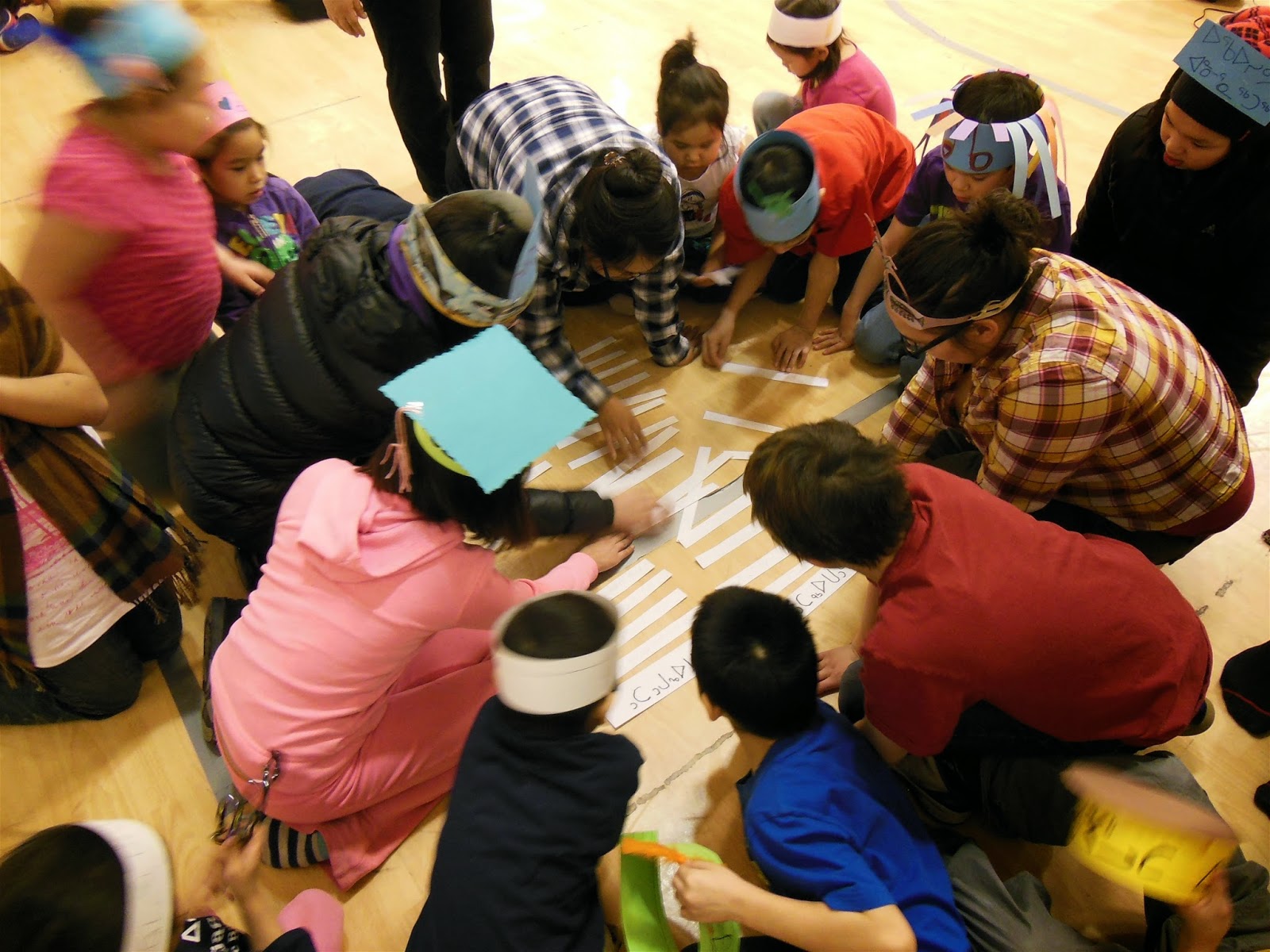
Prior to the assembly, classes were instructed to make paper hats to coincide with the upcoming event.  The hats could be of any design; everyone was free to use their imagination.  For K-4 classes, the hats could have simple Inuktitut syllabic symbols written on them, while 5-12 classes were instructed to write sentences in Inuktitut.  When the hats were completed, each class was required to choose an Inuit short story and pick a student who would read that story in front of the whole school at the assembly.  
            
Qayaq Kilukishak - Grade 7
The assembly began with a quick opening speech by Iga, the high school Inuktitut teacher.  She talked about the importance of speaking and retaining Inuktitut, as well as passing it on to future generations.  What immediately stood out for me was the "sea of hats"; they were everywhere.  It appeared as if the school was having a "crazy hat day."  I documented the event with my digital camera, snapping pictures of all the different colourful hats, and the students who read in Inuktitut.  Each student who read received an applause from the audience. It would have been nice if English-translated copies of the short stories had been prepared for us southern teachers, but I guess that would have gone against the point of the assembly. 
            
My understanding of Inuktitut is slowly improving with every passing day.  I'm picking up words and phrases here and there but I still reply in English when students speak to me in Inuktitut.  It's only after the conversation that I attempt to learn the Inuktitut sentence that was just spoken.                
Inuktitut Literacy Assembly - Spirit Teams
The assembly continued with Spirit Team activities.  Each spirit team was given an envelope containing sentences written in Inuktitut (syllabics) and English.  The challenge was to match the Inuktitut sentences with their proper English translations in the shortest amount of time.  Unfortunately my team, Team Rabbit, did not win the challenge.
          
Before the afternoon recess bell rang, the high school teachers were given a batch of Inuktitut flashcards to use in their classes.  On one side was a coloured picture of an item and on the other side was the Inuktitut word for that item, written in syllabics, and Roman orthography.  As an added bonus, it also included the English translation.  At the present time, I'm using the flashcards to teach myself Inuktitut.  When I'm ready, I'll get one of my students to quiz me.  
Team Rabbit scrambles to match Inuktitut sentences
with their proper English translations. 


Sunday, March 9, 2014

PI Week In Iqaluit


Famous Inuk country singer - 1953-2008.
I woke up very early on the morning February 16th, eager and excited to begin Professional Improvement (PI) Week in Iqaluit.  Of course, I first had to get there by plane.  Before I was given a ride to the airport, I ate a small breakfast and checked my suitcase to see that everything I needed was inside.  When it was time to go, I switched off all the lights and locked up.  I was one of the first Arctic Bay passengers to arrive at the airport.  The First Air flight flying down to Iqaluit originates from Resolute (Bay).  On this flight there were plenty of Resolute passengers.  The three hour flight to Iqaluit was uneventful; mostly everyone slept.  All regular passenger/cargo flights to and from Arctic Bay are serviced by First Air.  It is possible to charter a plane, but it will cost you quite a bit. 
            
I was the only teacher flying down to Iqaluit for PI.  The remaining teaching staff of Inuujaq School had chosen to remain in town.  I can understand because travelling outside the community is an expensive endeavour in the north.  The Nunavut Teachers Association (NTA) provides money for PI activities but there is a set amount for each northern community.  I was able to get the maximum designated sum for Arctic Bay but this only amounted to the cost of my round-trip plane ticket.  Basically, hotel, food, and other expenses were my responsibility.       
            

It was a clear sunny day in Iqaluit when the plane touched down on the paved runway at around noon.  I took in the familiar sites as the turboprop taxied off the runway and parked near a large First Air hanger.  Passengers disembarked and were driven to the main terminal by bus.  I was greeted by Verna and her husband Jim.  Verna works as an English/Social Studies teacher at Inuksuk High School and greatly assisted me when I taught there during the 2012-13 school year.  They gave me a ride to the Frobisher Inn, thus saving me $6 on a taxi ride.  (For $6, a taxi will take you anywhere in Iqaluit.  Keep in mind that it's $6 per person, per ride).  They invited me for a traditional Newfoundland dinner at their residence later that evening.  The food was delicious.
            
The ravens are big and everywhere
in the north.
There are several hotels to choose from when travelling to Iqaluit.  After researching my options, the Frobe (as it's locally known) turned out to be the least expensive.  Plus, the hotel is conveniently located in the centre of town.  The other hotels are: Discovery Lodge, Capital Suites, and Hotel Arctic.


Creekside Village.
Iqaluit hasn't changed much since I last ventured outside the town's airport in June 2013.  The town is a metropolis compared to Arctic Bay, with many amenities, vehicle traffic, and people.  There were a few noticeable differences when I explored the town on foot.  First, several new residential complexes were being built around the town centre.  A new row of houses being built on top of the previous row that had infamously burned down in February 2012 were nearing completion in the residential area known as Creekside Village.  Back in June 2013, only the steel pipe foundations were constructed.  As well, The Marketplace, (formerly known as Arctic Ventures), has stopped playing 'annoying' music in an effort to keep loiterers away from the main entrance.  Perhaps the general store no longer needs to carry on with the practice?  (I have mentioned this procedure several times in my Iqaluit blog).  Probably the most noticeable difference was the persistent presence of English speech.                
Beef Plate - Yummy Shawarma
When it came to food, I had plenty of options.  Iqaluit has several grocery stores, convenience stores, and fast food/formal restaurants.  If I really wanted to 'push the envelope' I could order room service.  I spent a good portion of my time eating at Yummy Shawarma, dining on sliced beef, vegetables, humus, garlic sauce, and other Lebanese delicacies.  I've had a shawarma craving since high school, which is inevitable when you live in Ottawa, a city that has become the 'Shawarma Capital of the World' over the last decade.  The staff at Yummy won't be forgetting my face anytime soon.
            
The Royal Canadian Legion is known as the place to be if you're in the mood to party and want good food.  On Wednesday, I joined a few friends at the Legion for wings and drinks.  For a good low price, you get a plate of twenty wings and a variety of sauces to choose from.  I chose the hot sauce.  We went back the following night for karaoke in the lounge section.  The place was packed with people who could sing.  And no, I did not get up and sing.  That'll never happen.  As for hotel room service, I only ordered something from the dinner menu on my last night in Iqaluit.  I had the 12oz Black Angus steak meal and it was awesome!  I was tempted by the Arctic Char meal but I just can't say no to steak.
            
Since coming to the north two years ago, it feels like mental health and the problems associated with it have taken centre stage all over the western world.  Everybody seems to be talking about it, in newspapers, journals, books, on the Internet, and in regular conversation.  To get a better understanding of mental health and be trained to respond to mental health situations at school, I signed up for a mental health first aid course in Iqaluit.  The three-day seminar was scheduled to take place at Joamie Middle School but the course was suddenly cancelled due to unforeseen circumstances.  Naturally, the teachers who signed up were disappointed by the unexpected announcement.  Hopefully, another workshop will be organized in the future.  To make up for lost time, I completed an online course that taught teachers how to better engage parents.  The course was done through ASCD.  If teachers and parents work together then the students benefit the most because they get the academic support & encouragement they need to succeed.       
            
It wouldn't be a trip to Iqaluit without visiting the high school where my northern adventure began in 2012.  Since it was PI Week, there were no regular classes at Inuksuk High School and only the teaching staff were present.  My former colleagues were surprised and delighted to see me.  I also briefly met Terry, the former principal who is now the president of the Nunavut Teachers Association
            
I only met a few of my former students around town.  Some were volunteering at Joamie Middle School, helping the staff run the sports day camp, while others were working at the NorthMart and The Marketplace.  I guess many were out on the land, had travelled down south, or were just taking it easy at home. 
            

On Saturday, February 22, I checked out of the Frobisher Inn and got a taxi ride to the airport.  The terminal was packed with people, with flights heading to Ottawa and many northern communities.  I noticed several Inuit teaching staff from Inuujaq School were waiting for the Arctic Bay flight.  They had travelled down to Iqaluit several days earlier for medical appointments.  The Arctic Bay-Resolute flight was full; the people on standby would have to wait until Monday.  The Inuit passengers were bringing back a lot of things that one cannot buy in Arctic Bay, such as, Timbits.  As for me, I bought plenty of school supplies but mailed them back in a big box.  They would arrive the following week.  Although the plane felt cramped, the three-hour flight passed without incident.                      
Industrial Area.

Overall, I had a fun week in Iqaluit.  It was a working week but also a short vacation.  The weather was cold and windy but there was a lot of sun.  I hung out with old friends, ate good food, and learned how to be a better teacher. 
        
This is off topic, but since it's now March, I think it's time to make the announcement.  In previous posts, I mentioned that I had applied for a $10K MusiCounts Band Aid Grant.  The money goes towards purchasing new instruments and repairing those instruments that are in use.  Any school in Canada can apply for a $6K or $10K grant.  I'm happy to announce that Inuujaq School was one of only two Nunavut schools that were awarded the grant.  The other was Qaqqalik School in Kimmirut.  The task ahead is to decide what new instruments to purchase.        


Friday, February 28, 2014

The Second Week of February

King George V Mountain. February 9, 2014
It was great to have the sun back but already people were complaining that it was too bright.  All over Arctic Bay, curtains were being drawn shut to keep the sun out.  I'm certain this action is repeated in all high arctic communities.  It's ironic considering residents have been wanting to have the sun back for the last two and a half months.  Similarly, this kind of behaviour can be found all over the world; humans are forever searching for that unattainable equilibrium.  When it's too dark inside, the curtains are open.  When there's too much natural light, the curtains are closed.
            
February 10, 2014
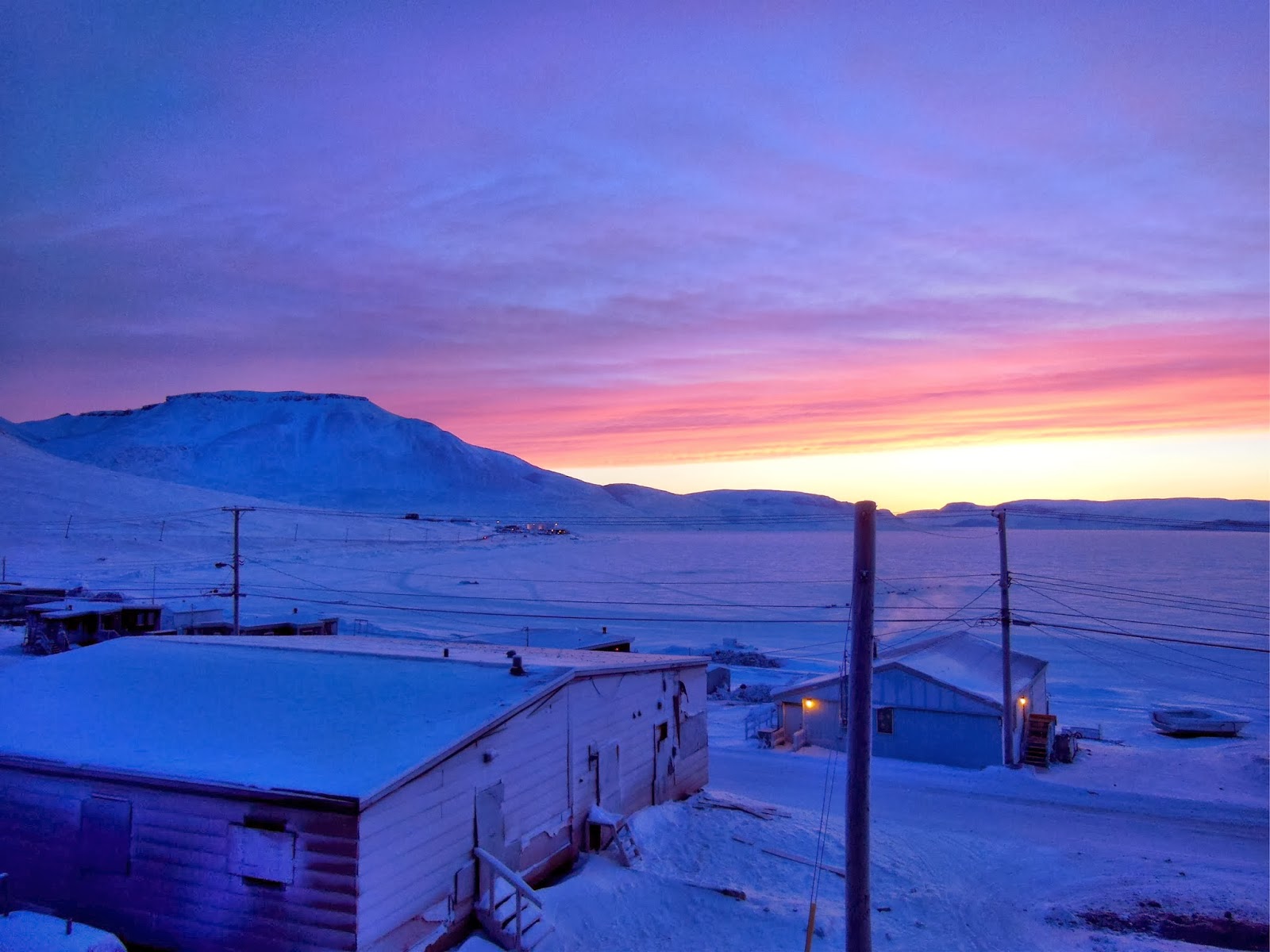
The arctic landscape appears more striking when the sun is up in the sky.  The land is bathed in a wide assortment of colours, giving amateur photographers such as myself more opportunities to snap pictures.  During the second week of February, I took some great shots of the sun rising over the surrounding mountains.  King George V Mountain in particular was "drenched" in colours of orange, white, pink, and purple.
            
Feeding time!
The town's sled dogs were howling quite a bit during the week for reasons I have yet to determine.  So far, I've narrowed the possibilities down to hunger, boredom, cold temperatures, approaching humans, communication, and singing.  Like any loud noises, the howls can get annoying.  Maybe one day I'll go out onto the ice and howl with the sled dogs.  Bring some seal meat and have a "grand old time".  I must commend the owners for being able to stand the howls when they go out on the ice to feed the pack.  I would be wearing ear plugs.  Unfortunately, I haven't had the time to go dog sledding with the locals.  My current plan is to go at least once before June.


The second week of February concluded on Friday the 14th - Valentine's Day.  Staff and students were encouraged to wear red and/or pink clothes.  The only Valentine's Day colour I had was red, in the form of a dress shirt and tie.  To celebrate the occasion, the entire student body assembled in the gym after afternoon recess for Spirit Team Activities.  The gym was decorated with red ribbons and hearts.  Upon entering the gym, students and teachers went to their respective teams.  I co-lead Team Rabbit with Piuyuq, the school's acting vice-principal.
            
The Spirit Team Assembly was organized by a small committee of teachers, chaired by Iga, the high school Inuktitut teacher.  She acted as the MC for the assembly.  They had prepared a few competitive games for the teams to play.  The first was a puzzle where teams had to assemble six hearts in the shortest amount of time.  What made the game challenging was that the hearts were of different colours and they had been cut up into a variety of shapes.  We did our best but unfortunately, Team Rabbit did not win the challenge.  However, we successfully assembled the six hearts.
            

The second was a dice throwing game where if you rolled a certain number, you place a sticker on a poster chart that has your team name on it.  To play this requires participants to form a circle around the poster chart that's on the floor.  Ten rounds were played (preschool to high school).  Unfortunately, I forgot which team won the game.
            
The third and last game was 'Hot Potato' or in this case 'Hot Yellow Ball'.  Spirit teams each chose one person to sit in a circle in the middle of the gym to play the game.  As the music played, the ball was quickly passed around, and the teams cheered until there was one person left standing.  I believe the Polar Bears won the game.
            
To conclude the assembly, students were given chocolates in the shape of hearts.  Afterwards, everyone was dismissed for the weekend and following week.
            
Bilingualism in Nunavut.
There would be no regular classes for the third week of February because it is reserved for all Nunavut teachers and administrators.  The week is known as Professional Development (PD) Week or Professional Improvement (PI) Week and Nunavut educators take the time to upgrade their knowledge and skills in a variety of areas.  Educators can stay in Nunavut or leave the territory for the week.  All you need to do is complete the necessary paperwork and get your application approved by the school board.  For this year, I would complete my PI in Iqaluit (more on this in an upcoming post).  Travelling back to the 'big city' would also give me the opportunity to revisit the place where my Arctic adventure began back in 2012.  Last year, I stayed in Arctic Bay and learned how to read, write, and speak basic Inuktitut.        
           
And finally, when it comes to Arctic housing, people like it when their residences have cold rooms to store fish, frozen foods, and animal skins.  The cold room is usually the first room you walk into before entering the heated residence.  I think this design is based on the igloo where the entrance area is lower than the sleeping platform, thus acting as a cold trap.  I don't have a cold room at my residence but some of the southern teachers do.  And it can get pretty cold in there, with ice forming on the walls and door.  


Cold Room.


Saturday, February 15, 2014

The Return of the Sun

February 4, 2014
As I mentioned in a previous post, 2013 saw the highest number of recorded suicides in Nunavut.  The final tally at the end of the year was forty-five.  The rate is dangerously getting close to one suicide per week.  Suicide has been a big problem since the territory's creation in 1999.  In response to last year's high suicide count, the territory's chief coroner, Padma Suramala, is calling a special inquest into the high suicide rate.  As well, ASIST workshops would be held in fifteen communities starting in February.
            
February 4, 2014
Applied Suicide Intervention Skills Training (ASIST) is a two day, 15-hour workshop, designed and administered by LivingWorks.  The "highly interactive, practical, [and] practice-oriented workshop", gives participants the tools and skills needed to help "prevent the immediate risk of suicide."  Classes can be taught in English, French, and Inuktitut.  Teaching the course in Inuktitut is made possible by the 17 local Inuit ASIST trainers in the territory.  LivingWorks is hoping to increase this number in the near future.
            
Arctic Bay was the first community to receive ASIST training on February 4th & 5th.  The participants would be the teaching & administrative staff of Inuujaq School.  Naturally, regular classes were cancelled for those two days.  The English instructor was an RCMP officer and was accompanied by an Inuit instructor.  A local Inuit lady was hired to provide English-to-Inuktitut translation for the school's two unilingual Inuit teachers.  The workshop consisted of interactive lectures, instructional videos, group sessions, and acting out scenarios requiring intervention.  ASIST uses a speaking intervention model; physically stopping a person from committing suicide is left to the police and emergency services. 
            
I really liked the ASIST workshop because I learned a lot and feel better prepared should a student or adult come to me and say that they have had feelings of suicide.  As well, I am trained to detect some of the warning signs and in response, approach that person and talk to them about what they are feeling.  I liked how all the teaching materials were Inuit-oriented.  Most of the teaching resources in the north come from the south, making it a challenge for learners to see the relevance. 
            
At the same time, the workshop was (a little) stressful for many because suicide touches everyone in the north.  It appears that every Inuk has had a family member(s) or close friend(s) that has committed suicide.  No one wants to relive those painful memories.  I was aware of suicide when I was growing up down south but it never affected me until I began teaching up north.  One of my students in Iqaluit chose to end his life in December 2012.  I didn't know about it until another student came and told me.    
            
Everyone received a certificate for successfully completing the two-day workshop and posed for a class photo.  The ASIST trainers departed for Resolute on February 5th, the next community to host the ASIST workshops.
            
The Sun arrives.
Supposedly, the sun arrived on February 5th at around noon, except no one in town could see it due to low overcast clouds.  Mother Nature was forcing everyone to wait an extra day.  At least we were treated to colourful clouds on the morning of February 4th.  Everyone got a good look at the sun when classes resumed on the 6th.  The mood in the air was anticipation; think of the large crystal ball in Times Square making its descent during the New Years Eve celebration.  I briefly interrupted my second period Social Studies class to take a picture of the sun as it slowly crept over the distant mountains.  A few high school students from other classes briefly came over to my class to get a glimpse of the sun.  At lunchtime, I grabbed my camera and headed over to the Northern Store to get a better shot of the sun.  I didn't want any power lines in the picture.
            

Inuujaq School held a sun celebration on the morning of Friday, February 7th in the gym.  Before 9am, the staff cleaned the gym, hung posters made by elementary classes, and set up chairs and tables for a morning breakfast.  Invitations were extended to parents, elders, and community leaders.  Teachers and students were wearing bright clothing and traditional Inuit sunglasses made out of cardboard. 
            
Inuujaq School student Rosalie lights the qulliq.
The celebration began with the lighting of the qulliq, a traditional Inuit oil lamp.  The lamp was lit by Rosalie, a high school student.  Then the middle school students performed an Inuit song that welcomed back the sun.  The girls sang the lyrics with Eunice, one of the middle school teachers, while the boys played on Inuit drums.  The performance was well received by everyone present.  The last act before the breakfast was a yoga exercise led by Dane, the grade 4 teacher.  He explained that it was a way to say "Good morning" to the sun.  Everyone followed Dane's movements and it was interesting & entertaining to watch.  


Breakfast consisted of various fruits, yogurt, hard boiled eggs, bannock, coffee, tea, and juice.  Inuujaq School staff served the people in attendance, handing out plates of food, juice boxes, yogurt, and spoons.  If people wanted seconds, they had to help themselves at the long row of tables at the front of the gym.  When breakfast was finished, everyone helped in the cleanup before returning to their normal routines.  Regular classes continued for the rest of the school day.  Everyone was happy that the sun was back.  I could only imagine how envious the people of Resolute and Grise Fiord were because I heard they wouldn't see the sun until the end of the month.  


Arctic Bay's mayor, Philip Kalluk, distributes breakfast to hungry students.