Saturday, September 28, 2019

Operation Hill Top 19 – Part 2

The Rangers' Tent.

Those who rode in the back of the pickup trucks had to pull their hoods up to protect themselves against the cold wind.  The Nanisivik Airport sits at an altitude of 2,069ft above sea level.  It took us about 10 minutes to drive down to the Second Bridge.  We were greeted by the first-year cadets.  The second-year cadets returned their red backpacks to the Supply/Command tent.
            
A short period of rest followed.  I asked the first-year cadets if they enjoyed the 7km hike?  I think all of them said yes.  The senior cadets got to work firing up the Coleman stoves and boiling two large pots of water.  There were going to be many mouths to feed for dinner due to the arrival of the first-year cadets.  American-made MREs were on the menu.  For some junior cadets, this would be their first time trying military rations.  In the military, junior ranks usually eat first.  I made sure everyone had a meal before selecting an MRE bag.
            

After dinner I had all the cadets form up near the road for a group photograph.  The sun was setting and I wanted to get a good picture before the sun disappeared behind a mountain.  The two Rangers also joined in.  We all faced the sun so that my camera could clearly capture our faces.  I set the timer to 10 seconds and ran to my spot before the camera snapped a picture.  The second attempt produced the best picture.  I’m glad I didn’t trip and fall down. 
            

On Friday, when the cadets were loading all the camping equipment into trucks, I made sure to include 4 pylons, two frisbees, and a soccer ball.  FTXs can’t be “all work and no play.”  Time needs to be set aside for cadets to do something else and give instructors a break from teaching.  The Rangers set up the pylons and got the cadets to play a game of ultimate frisbee.  They played the version where you don’t take any steps when in possession of the frisbee.  I chose to observe and document this game for the corps’ Facebook page.  I took pictures and filmed a few short clips.  The game lasted for about an hour.
            

The bonfire began at 7:30pm.  Wood was brought by Frank & his helpers on Friday.  The pieces came from the large wood pile at the shoreline behind the airport.  We would be burning discarded pieces of sealift crates.  The senior cadets assembled the wooden pieces while the junior cadets brought over the bonfire supplies.  On the menu were marshmallows, hot dogs, hot chocolate, juice boxes, and assorted condiments.  The fire was lit using matches and fire starter sticks. 
            
It took some time for the fire to grow into an actual bonfire.  When the fire grew to an acceptable size, the roasting sticks were distributed, and the food was made available for roasting and consumption.  I also joined the festivities, roasting & eating a few hot dogs and marshmallows.
           
About an hour into the bonfire, we spotted a parade of lights coming from the direction of Arctic Bay.  These were headlights from several cars coming to pickup the first-year cadets.  The cars stopped next to the bonfire.  I greeted & thanked the parents for driving all the way out here to take the first-year cadets home.  The cadets said their goodbyes and got into the waiting vehicles.  The convoy left for Arctic Bay.
            

The bonfire continued for another 20 minutes before we began extinguishing the flames.  In the past, we used shovels to dump snow on the glowing embers but with no snow on the ground this year, we were forced to find a safer alternative.  We retrieved the large metal pots from the Supply tent and filled them with water from the nearby river.  We then carried the now heavy pots to the firepit and poured the water onto the embers.  The fire was fully extinguished after several trips.  The remaining bonfire supplies were brought back to the Supply tent.  I dismissed the remaining cadets to their tents for the night.
            

Sunday, September 22 was all about having breakfast and tearing down the camp.  Everyone was up by 8am and breakfast was being served by 9am.  Low hanging clouds surrounded the camp.  I wondered if the sun was shining in Arctic Bay?  The cadets who finished eating early were directed to begin packing their belongings and move everything out of their tents.  The remaining cadets joined later.
            

The teardown of the camp was in full swing just after 10am.  Two piles were created for personal belongings and corps equipment.  The tents were taken down and packed.  By this time Frank arrived with another pickup truck.  One truck was loaded with personal belongings while the corps equipment went into the other truck.  I did a final inspection of the firepit, making sure there were no glowing embers.  The cadets did a garbage sweep of the campsite.  When I was satisfied that the campsite was clean, I instructed the remaining cadets to form up for a quick debriefing.
            
Firepit.
I congratulated the second-year cadets for completing the 7km hike and for taking down the campsite.  I added that they were now prepared to handle the more challenging hikes down south.  I also thanked the two Rangers for keeping us safe from “aggressive wildlife”.  I asked for a few volunteers to help me unload all the corps equipment at Frank’s Shop.  The cadets were then dismissed to find seats on the waiting trucks.  Frank would drive the cadets who didn’t volunteer home.
           
It took me and the cadet volunteers about 20 minutes to unload all the corps equipment from the truck and place them back where we found them.  We also unpacked a white tent and hanged it inside Frank’s Shop to air-out.  The same would be done for the other tents in the coming days.  I dropped the cadets off at their homes before driving to my residence.  I brought all my personal stuff inside and then took a long shower.
            
Overall, Operation Hill Top 19 was a success in my mind.  All our objectives were met and everyone came back alive.

End of Operation Hill Top 19 Mini-Series.

Wednesday, September 25, 2019

Operation Hill Top 19 – Part 1

A first year cadet holds a support beam for a white Fort McPherson tent.

Operation Hill Top 19 was going to be a little different than the previous field training exercises (FTX) held by 3045 Cadet Corps in mid-September.  This FTX is the first of two during the regular training year and is primarily for the first & second-year cadets.  The main requirement is to complete is a 7km hike.  The first-year cadets just have to walk the distance while the second-year cadets have to hike and carry backpacks filled with supplies.  The hike prepares these young minds for the more arduous FTXs down south.  Senior cadets can join for supervision and to practice their leadership skills.
            
The corps’ recruitment efforts are going very well.  It’s only been a month and half since the start of school and we’ve managed to recruit around 10 new cadets.  This has led the ranks to grow to almost 30 cadets on parade.  That’s quite good for a community just shy of 1000 people.  However, the influx of recruits caused corps administration to rethink the planning & execution of the FTX.
            
Cadets packing the green tent.
September 11.
There would be 22 cadets out in the field and, unfortunately, the corps does not have enough tents for everyone to stay for two nights.  (The FTX is usually a two-night affair).  It was decided the new recruits would stay out for a day, do the hike, remain for the bonfire, and then be driven home in the evening.  Everyone else would leave the following day.  I think the last time something like this was done was in 2013 when I first arrived in Arctic Bay.  The Canadian Rangers assigned two Rangers to provide polar bear protection.  We need two Rangers because of the high number of cadets.
            
Second Bridge.
Planning & preparation began several weeks in advance.  The cadets checked the tents & Coleman stoves on September 11 and packed sleeping bags on September 20.  It was a good idea teaching the new recruits these skills even though they wouldn’t be sleeping at the camp site.  The decision would pay off some time in the future.
            

Operation Hill Top 19 began on the evening of Friday, September 20.  Everyone involved, except for the first-year cadets, assembled at the school’s gym at 6pm for roll call and to load the trucks with supplies.  We then drove to Frank’s Shop to pick up more supplies and then continued to the camp site by the Second Bridge.  The Second Bridge has been the go-to area for this FTX since 2013.  We camp here because we’re next to the Road to Nanisivik.  It’s easier to hike 7km on a road and if there’s an emergency, we can quickly evacuate someone or everyone to Arctic Bay.  We arrived at the Second Bridge at 7:30pm. 
            

Frank recruited a few helpers to help him set up a white Fort McPherson tent the day before.  They also stored some supplies in the tent so that we wouldn’t have to make two trips to bring everything to the camp site.  Thank you.  This tent would serve as the Supply & Command tent.  The cadets immediately went to work setting up the remaining tents and moving their personal belongings into their assigned tents.  All the food and cooking supplies would be stored in the Supply tent.  I would also sleep here.  The male cadets would sleep in a different white tent and the female cadets would sleep in a green tent.  The Rangers brought their own tent.  It took about an hour to get the campsite ready.
            

Snacks were given out & hot chocolate was prepared for the cadets once everything was in order.  Everyone then retired to their respective tents and slowly fell asleep.
            
Breakfast MREs.
Reveille was at 7:00am on Saturday, September 21.  I was the first one to emerge from my tent.  The weather was cold but there was no snow on the ground.  Slowly, the cadets & Rangers woke up and got ready for the day.  The Coleman stoves in my tent were lit and large metallic pots were filled with water collected from a nearby river.  Breakfast MREs were opened and distributed to the cadets.  The Supply/Command tent became the Mess tent for the next hour.
            
I taught several classes after breakfast.  The class the cadets enjoyed the most was using proper radio communication procedures because they got to play with walkie-talkies.  The other classes I taught were identifying types of clouds, packing a backpack for a hike, and what to do when you’re lost.  These classes get taught every year but it never hurts to review.  There’s only so much stuff we can cram and keep inside our minds. 
            
Ice over a stream.
The second-year cadets were given a break because the senior cadets needed the Supply tent to prepare lunch.  Lunch consisted of more MREs.  The first-year cadets ate their lunch at the local Anglican church.  They would then be driven to the First Bridge to begin their 7km hike.  Coincidentally, the distance between the First & Second Bridges is 7km.
            
First-year cadets about to begin the 7km hike.
Second-year cadets begin their 7km
hike.
The main event had finally arrived.  The second-year cadets were given bright red backpacks and packed them with garbage bags, toilet paper, juice boxes, and granola bars.  One cadet had the honour of carrying a small first aid kit.  The cadets were also given walking sticks.  One Ranger would drive up and down the road, checking on both groups, while the other would walk with the first-year cadets.  I would hike & supervise the second-year cadets.  We began walking up the road towards Nanisivik at 1:30pm.
            
Operation Hill Top 19 Camp Site.
The hike is always the same, but the experience is different due to the cadets involved.  I was supervising 7 cadets.  The biggest hurdle was at the beginning: walking up a steep hill.  Once we were over the top, we continued along the road at a steady pace.  The size of the group stretched with every step we took.  It became obvious that some cadets had more energy than others.  I stayed at the back, making sure no one was left behind.  I should have instructed the cadets to come back together but I could see for many kilometres, so I let the cadets walk at their own pace.  The risks of encountering polar bears at this high altitude are very low.  Plus, I was able to take several interesting landscape pictures with the cadets in various spots.  We stopped twice for snacks and bathroom breaks.


I used my GPS device to inform everyone when we walked 7km.  The 7km mark is just past the long straight portion of road known as “The Stretch”.  The road bends to the left up a hill, and several metres after that, you’ve walked 7km from the Second Bridge.  Ranger Roland was waiting for us in a red truck to take us back to camp.  When I walked up to greet him, he informed me that we had completed the hike way ahead of schedule.  I looked at my watch and realized that he was right.  I had originally scheduled the hike to take 4 hours but it had only taken us just under 2 hours.  Ranger Roland suggested using the extra time by visiting the old Nanisivik Airport.  I agreed after gaining approval from the cadets.  I hopped in the back of the truck and we were on our way.
            

Nanisivik Airport.
It’s been quite some time since I visited the old, abandoned, and decrepit Nanisivik Airport.  I think it’s been a few years.  The Nanisivik Airport was built in the 1970s and ceased operations in 2011.  Its gravel runway was long enough to accommodate jet planes and it serviced the Nanisivik Mine & Arctic Bay.  (The mine closed in 2002).  Since the airport’s closure, the remaining structures and equipment have been left to rust & decay.  I still wonder if the territorial & federal governments are even talking about cleaning up the site or repurposing it, since the Nanisivik Naval Facility is close to completion?  Hopefully, something will be decided soon.


The airport was devoid of life until we arrived.  The weather was a little colder because we were high up in the mountains.  Ranger Roland drove around the main buildings and stopped in front of the Maintenance Garage.  We all got out and went inside.  The large orange bulldozer & yellow CAT loader were still inside.  The top floor was full of stacked cardboard boxes, discarded papers, old electronics, tools, nails, screws, and just junk.  It would take too long to list every item we found. 


“If humans were to just disappear from the face of the Earth all at once, this is what we would leave behind,” I commented to the cadets.  “It would be like that tv show, After Humans.”

Creepy Hallway.
Nanisivik Airport Terminal. What's left of it.
We walked through the creepy hallway that connects the Maintenance Garage to the Terminal Building.  The terminal appeared to be in far worse shape.  Everyone had to watch where they stepped.  There was broken furniture & pieces of wood all over the floor.  Many ceiling tiles were missing and all the glass windows were broken.  It was as if the building had been turned into a rage room.  This place definitely needs to be cleaned out.  At least the old orange payphone from my previous visit was still here.


We continued our exploration by checking out the First Air cargo sheds.  One is a half-cylinder structure and the other looks like a small house.  There were only large open spaces and defunct heaters inside these structures.


The last structures we examined were the power generators and electrical shack.  The generators are located inside blue sea can-like boxes and the electrical shack is a separate yellow structure.  The generating equipment looks disabled but I told my cadets not to touch anything.  I didn’t want a sudden, shocking emergency situation.  Thankfully, no one got hurt.

Disabled generators.
Abandoned dumpsters, oil barrels, &
vehicles.
Another pickup truck arrived at the airport just as we were getting ready to leave.  The driver was Frank.  He had come looking for us.  I quickly told him how we ended up here.  He told me the first-year cadets were at the camp site, sipping hot chocolate and waiting for us.  My cadets got into both pickup trucks.  I did a head count, making sure we weren’t leaving anyone behind.  I gave the go ahead and we drove back to the Second Bridge. 


To Be Continued . . .

Tuesday, September 17, 2019

Boats & The Terry Fox Run


My sealift order arrived on September 9 on an NSSI ship.  All my stuff had been tightly packed into a large wooden crate that occupied almost two cubic metres of space.  I met the Shore Captain and signed some documents to claim the crate.  I made arrangements with a local to move it to my place.  I spent an afternoon opening the crate with a heavy crowbar, hammer, and screwdriver.  Wooden crates are sealed with nails and heavy staples; strong enough to withstand a journey at sea but not too strong to make it impossible to open.  Trial & error has taught me that the best way to “attack” a wooden crate is from the corners.  You just have to be careful not to damage the goods inside.
            
It took me about three hours to move everything inside my residence and find places to put them away.  A portion of the items would be moved to the school for my classroom and cadets.  The rest, which happened to be the majority, would stay because it was non-perishable food and other things I needed at home.  The mass influx of stuff forced me to restock my cupboards and storage room.  By the end of the day, I was glad I had enough supplies for the next 10 months.  I felt prepared to survive a major crisis, like a zombie apocalypse.
           
The NSSI vessel stayed in Arctic Bay for a day & a half and then continued sailing to the next community.
            

The Ocean Adventurer, owned and operated by Quark Expeditions, arrived in Arctic Bay on September 14.  The company was established in 1991 and operates numerous expeditions in the Arctic and Antarctic.  You can check out their website for more details.  According to its website, the Ocean Adventurer accommodates 128 guests.  The large vessel anchored in the bay and its crew began bringing the tourists to shore on Zodiac boats.  All the tourists were wearing yellow jackets.  The tourists were given a few hours to explore the town, take pictures, visit the stores, and speak to any locals.  The tourists were ferried in groups.  The Ocean Adventurer would leave the next day. 
            
The red and white French boat Vagabond also arrived in Arctic Bay and would be wintering in the community.  The boat is run by a French family who have been travelling & living all over the high Arctic since 2000, conducting expeditions for scientific projects, climate research, and circumnavigation.  You can check out their blog here for more information.
            
Smaller boats owned by local Inuit were coming and going.  September is the last month of the year to hunt by boat so many hunters were not letting the good weather go to waste.  I managed to take a good photo of two boats coming back from a hunt. 
            
The Hamlet Office of Arctic Bay organized a Terry Fox Run (TFR) event on Sunday, September 15.  The TFR is “an annual non-competitive charity event held in numerous regions around the world in commemoration of Canadian cancer activist Terry Fox, his Marathon of Hope, and to raise money for cancer research.”  I’m not sure what the cancer rate is in Nunavut but it is high due to the high number of smokers in the territory.  Countless lives have been lost to the deadly disease but many have recovered and continue to fight for a cure.
           
The event began at 2:15pm behind Inuujaq School.  The community’s firetruck was borrowed to act as the Starting Point of the Run.  Participants slowly began assembling around the firetruck waiting for the directions from the organizer.  Several minutes later, a registration table was setup behind the school’s gym.  People lined up to have their names recorded on a list.  They would receive a congratulatory certificate for completing the TFR after they crossed the Finish Line. 
            
Participants were free to run or walk the designated route.  The route was from the school to the Gas Station and then back, totaling a distance of 3km.  There would be bottles of water waiting for participants at the Gas Station. 


A makeshift Start Line was created by placing CAUTION tape across the road a few feet in front of the firetruck.  Everyone lined up along the Start Line.  The Event Organizer welcomed everyone to the TFR, briefly explained its purpose, and described the route participants were to take.  He counted down to zero and the Run officially began at 3pm.


Inuit youth took off at various running speeds while the adults, elders, and little children walked.  I could have joined the youth and ran the distance but I chose to walk and take pictures.  I think a lot of youth underestimated the distance of the route because when I got to the straight gravel road that links Arctic Bay with the Gas Station, I saw many of them walking.  They must have used up all their energy in the opening sprint.  I already saw several high school students jogging back while holding water bottles in their hands.  I took several pictures of the students as they jogged by me.   


The only traffic participants had to avoid were the large Caterpillar trucks carrying dirt away from the construction site of the new fire hall.
           
Arctic Bay Mayor Frank May walks
with a young participant.
I did reach the Gas Station and was given a water bottle by a volunteer.  I walked back to Inuujaq School.  The Event Organizer was still handing out certificates when I walked across the Start/Finish Line.  I was one of the last participants to cross.  The event was over by 4pm.
            
Many cadets participated in the TFR.  They participation would be counted towards their community service obligations.
            
I would say the event was a success.  Many people came out to participate and show their support for cancer research.  I think the Hamlet Office collected donations but I don’t know how much money they raised. 

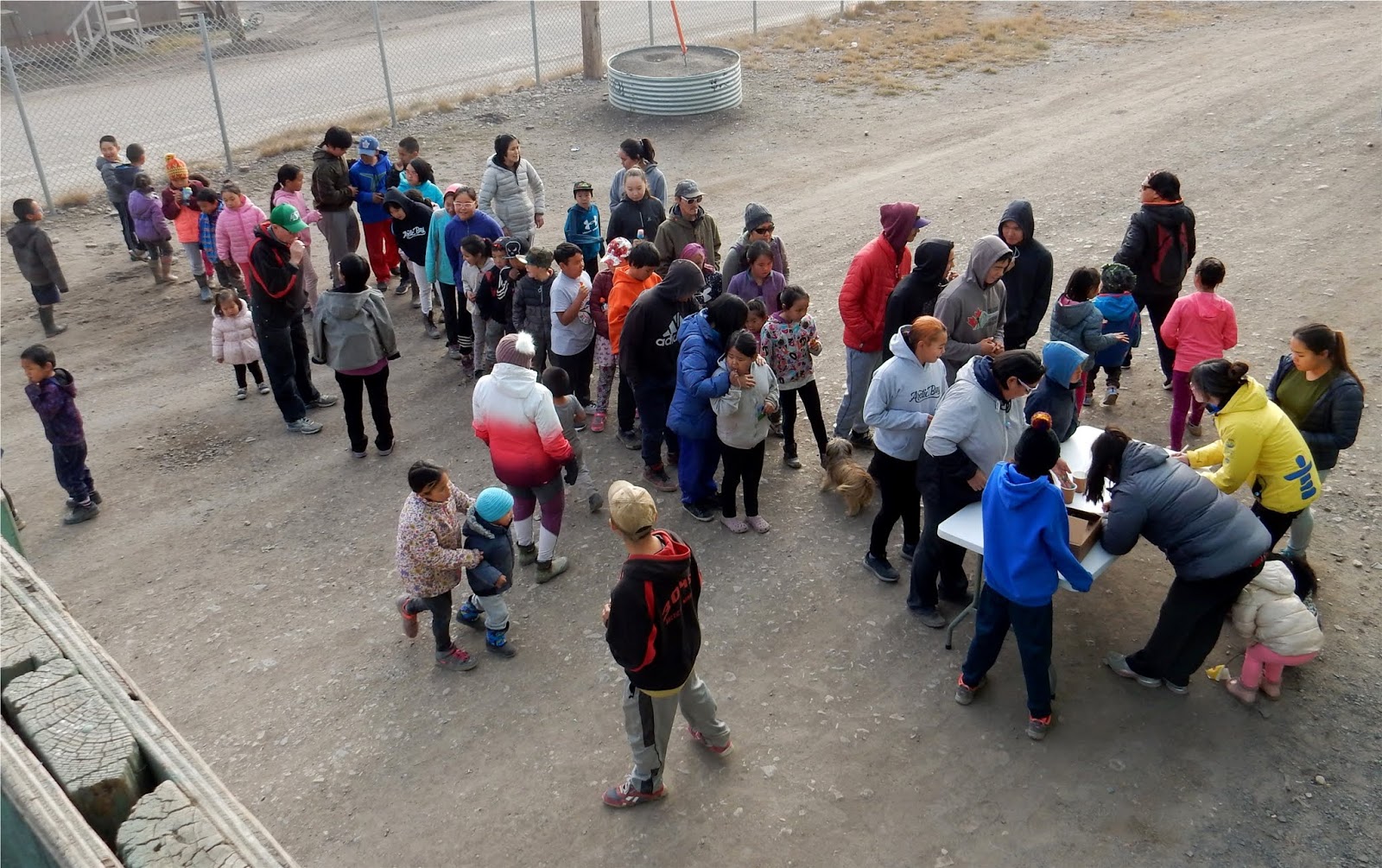
Participants receiving their certificates.