Saturday, May 6, 2023

Stage III Marksmanship (2023) – Part 1

Marksmanship plays a large role in the Canadian Cadet Program, teaching & promoting accuracy, dedication, focus, and teamwork.  Tournaments are held every year to promote friendly competition and determine the best shooters in Canada.  Cadets develop and perfect their shooting skills on the Daisy .177 calibre air rifle.  A regional marksmanship competition was held in Winnipeg for the Northwest Region in late April.  Four of my cadets participated and I also attended as coach & escort officer.

Marksmanship competitions are divided into four stages.  Stage 1 happens at the corps level where team tryouts are held.  Stage 2 is where teams compete in their respective zones.  These are done as mail-ins and in person.  Cadet corps in the territories usually do Stage 2 as mail-ins because air travel is very expensive.  Paper targets are mailed to the corps, the cadets shoot them once, and then they’re returned down south to be graded.  Teams with the highest scores advance to Stage 3, the regional competition.  The winners of Stage 3 advance to Stage 4, the national competition.  Unfortunately, there was no Stage 4 this year. 

3045’s Marksmanship Team practiced shooting prone & standing on the weekends.  The cadets selected their shooting jackets & air rifles and labelled them.  Participating corps are required to bring their own rifles, shooting jackets, safety glasses, and any other equipment they may need.  We packed everything the night before our departure.  

We arrived at the airport on the morning of April 27.  We flew down to Iqaluit where we met the Iqaluit team and their coach at the airport.  My cadets enjoyed lunch before going through security.  The flight down to Ottawa lasted three hours.  It was the late evening when we exited the terminal with our luggage and rifle cases.  Two officers escorted the two teams to waiting vehicles and drove us to Connaught Cadet Training Centre for the night.  We were given boxed dinners and then assigned tents with bedding.  I had a tent to myself.

The metal bunk beds and lockers brought back memories of my time spending many summers at cadet camp as a cadet, staff cadet, and civilian instructor.  Although, in the early 2000s, we slept in sleeping bags on cots.  And the tents were green and modular.


Everyone was out of bed and dressed at 6:15am on the morning of April 28.  We headed over to the mess hall for breakfast.  The menu consisted of eggs, bacon, hashbrowns, and various fruits, a standard across cadet camps.  Breakfast lasted an hour.  We returned to our tents for some downtime. 


Our flight wasn’t until the afternoon, so the Iqaluit coach & I decided to take the cadets on a tour of the camp.  I had previously visited the camp on many occasions, so I already knew my way around. 

We started at the shooting ranges, large open flat grasslands with big number signs at one end to show the individual shooting lanes.  None of the ranges were in use.  The cadets were more interested in trying out a set of 4 chin-up bars.  A few managed to get a high number before their arms got tired.


We continued walking along a main road, stopping several times to inspect various military vehicles & a helicopter on display.  The had been turned into outdoor museum displays.  We followed the road for quite some time, passing an M109 Howitzer, and eventually ended up at Shirleys Bay.  We stayed there for 30 minutes, resting, and enjoying the view of the Ottawa River.

We returned to camp following a different road, passing an obstacle course that featured many different, um, obstacles.  Unfortunately, we did not have clearance to try them out.  Maybe another time.

The escort officers drove us to the Ottawa Airport after lunch.  We thanked the escort officers for their help, checked in, and went through security.  We flew direct to Winnipeg, landing in the evening.  Two different officers met us in the Arrivals area and helped us recover our luggage & rifles from the baggage carousel.  We loaded everything into military vans and were driven to the hotel.  We were assigned rooms.  One more team from out of town arrived in the late evening.  The cadets & coaches were instructed to get some much-needed rest.  Tomorrow was going to be a very busy competitive day.      

                                                                    To Be Continued . . . 

Wednesday, April 26, 2023

Qamutik Cup 2023

Qamutik Cup is an annual hockey tournament that began in 2009.  The tournament mostly sees teams from north Baffin Island communities compete, but communities on the mainland, such as, Naujaat (Repulse Bay), and Sanirajak (Hall Beach), have participated in the past.  Arctic Bay hosted this year’s tournament, April 20 – 25.  Five teams competed for the trophy: Igloolik, Sanirajak, Pond Inlet, and Arctic Bay.  Arctic Bay had two teams: Impact & North Stars.

Visiting teams try to fly to the host community, but the high cost of air travel makes it challenging.  Fundraising can only do so much, and Canadian North isn’t willing to lower prices, especially since they hold a monopoly.  Teams travel by skidoo & qamutik if conditions are right.  It would be nice if all Nunavut communities were connected by road, but unfortunately, we’re not there yet.

As mentioned in the previous post, Qamutik Cup began right after Nunavut Quest.  Arctic Bay felt like the centre of Nunavut with these two large events happening side-by-side.  The hotel and old bed & breakfast were full, and locals opened their houses for visitors to stay.  I think some still resorted to camping in their tents.  I hope more houses are built next year.

I left the community hall at the end of the Nunavut Quest awards ceremony and walked over to the hockey arena to watch the first game between Sanirajak and Pond Inlet.  The game had already started and there was a sizeable crowd cheering both teams.  I found an empty spot in the stands and watched the action unfold in front of me.  The players, as well as the audience, were in high spirits.  I stayed until the end of the game.  I think Pond Inlet won.

Games were mostly scheduled in the afternoon, the earliest beginning at 3pm, however, a few were played in the morning.  I wanted to attend more games, but my schoolwork got in the way.  Or maybe I just work too hard and need to take a break occasionally.  The final game was held on the evening of April 25.  In the end, Arctic Bay Impact won the game and the tournament!  The Qamutik Cup will stay in town until next year.  The trophy is modelled after the Stanley Cup but is a little smaller.

I’m going to be taking a short break from my blogging duties because I’m going to be out of town until early May.  The flight leaves tomorrow morning, so I need to get packing!  You’ll read all about it when I come back!      


Monday, April 24, 2023

Nunavut Quest 2023

Nunavut Quest is an annual dog sledding rally competition that began in 1999 to celebrate the creation of Nunavut.  The race alternates between Arctic Bay, Pond Inlet, and Igloolik.  This year, the race began in Igloolik and finished in Arctic Bay.  Participants compete for money, fame, and status.  The competition keeps the history & knowledge of Inuit dog sledding alive.

Running a good, competitive dog team (qimuksiqtut) requires a lot of time, effort, and passion.  Your dogs must work with you otherwise you won’t get anywhere.  They need to be trained to run vast distances for long periods of time, follow commands, know when to rest, eat the right foods, and not fight each other.  The dog musher must also train to endure & operate in the tough and unforgiving Arctic climate. 

Speaking of training, one competitor, Jovan Simic, put his dogs & himself through an intensive warmup, travelling from Iqaluit to Igloolik over land to get to the starting point.  According to CBC News North, the distance between the two communities is 887km.  He was assisted by his partner, Annie, who drove a skidoo pulling two qamutiks (sleds) loaded with supplies.  The journey took 19 days.  You can read more about his incredible journey here. 

I’ve heard of competitors travelling with their dogs over land to get to the starting point, but not a distance of 887km.  I think this is the first time since 1999.  I’ll have to ask around town for confirmation.  Previous competitors have flown their dogs and equipment at a high cost.      

The musher and their dogs are not alone for the race.  Each musher has a support team that travels ahead and sets up camp at designated rest stops.  A timer & judge also travel ahead to these stops to record the time it took for each musher to reach them.  The rally times are compiled at the end of the race and whoever’s total time is the shortest is declared the winner.

The Qikiqtani Inuit Association (QIA) sponsored the race, pledging $100,000 to assist organizers plan & run the competition, and educate people on the importance & history of dog teams to the Inuit.  The race was originally scheduled to run April 11 – 17, but two more days were needed because of bad weather.  The support teams, mushers, and Nunavut Quest staff arrived in Arctic Bay on Wednesday, April 19.  I cancelled cadets for that day.

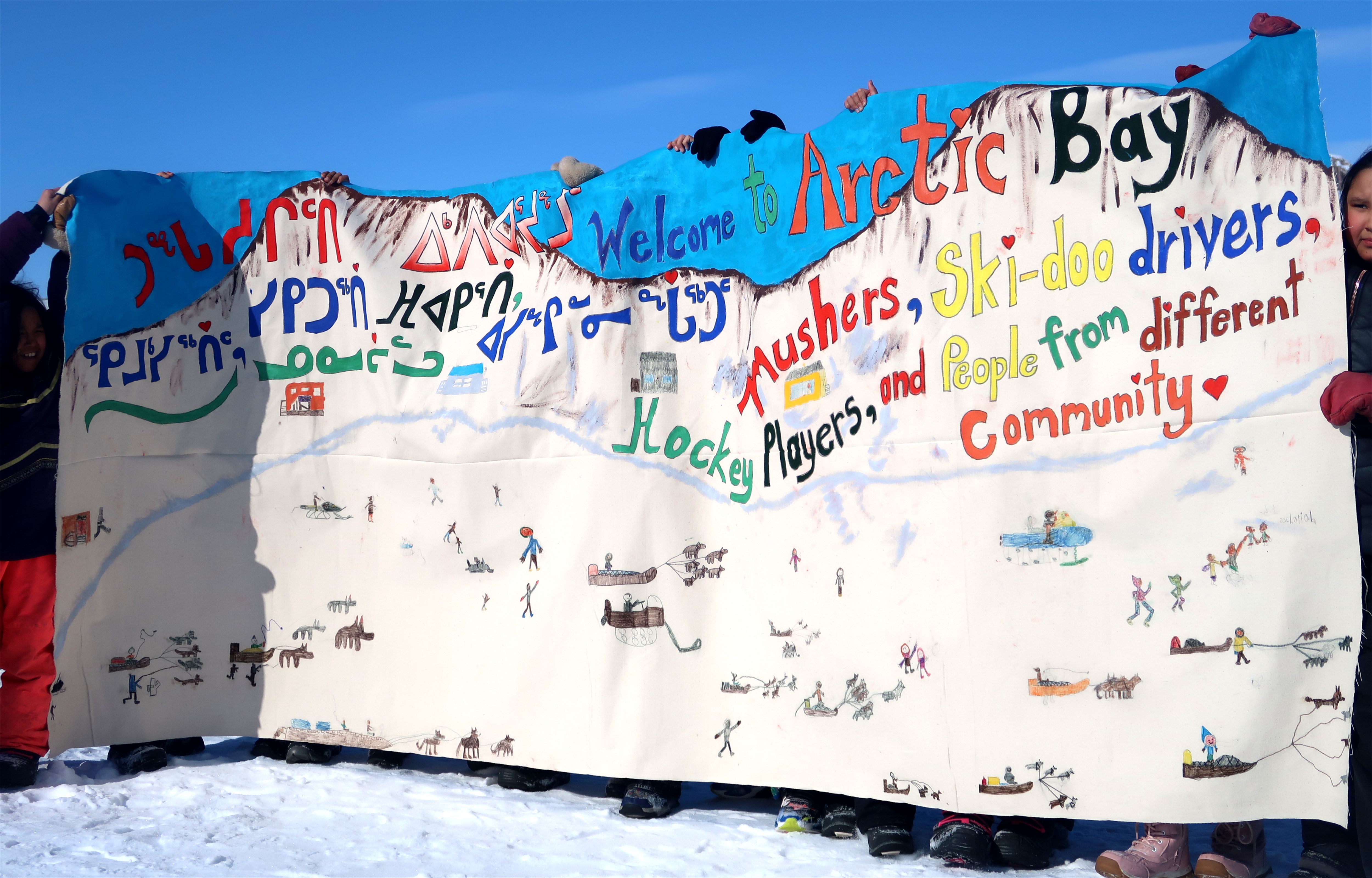
The lead up to the arrival had everyone in town excited.  Updates on the mushers, dogs, and weather were frequently posted on Facebook.  Students at school made large welcome posters and signs.  The race was on everyone’s minds.  The population of Arctic Bay was about to increase with an influx of visitors.  The influx would be much larger this year because the Qamutik Cup hockey tournament would begin immediately after Nunavut Quest.  (More on this in a future post).

People headed down to the ice at 12:30pm to welcome the support teams.  I’m guessing a lot of people didn’t have time to finish their lunches.  The school posted a message on Facebook instructing students & staff to immediately head down to the ice because there wouldn’t be classes in the afternoon.  I managed to get there in time with the help of my skidoo.

The support teams arrived in a long convoy from the south.  I filmed the long procession of skidoos & qamutiks as people around me waved, clapped, and cheered.  The convoy drove in one big circle before breaking up and coming to a stop in front of the large crowd.  I switched from filming to taking many pictures of the meet & greets happening around me.  I also photographed the skidoos, qamutiks, and packed supplies.  An RCMP officer brought his mini drone and filmed everyone from above. 

I’ve wanted to document Nunavut Quest (NQ) up close by following the competitors and support teams from start to finish.  Unfortunately, I can’t get time off work, and I don’t have all the necessary resources & supplies to do it.  I suppose I could try being on a support team, but I think that would take me away from taking pictures & videos.  Hopefully I’ll be able to fulfill my goal one day.  It would make an epic mini-series for this blog.

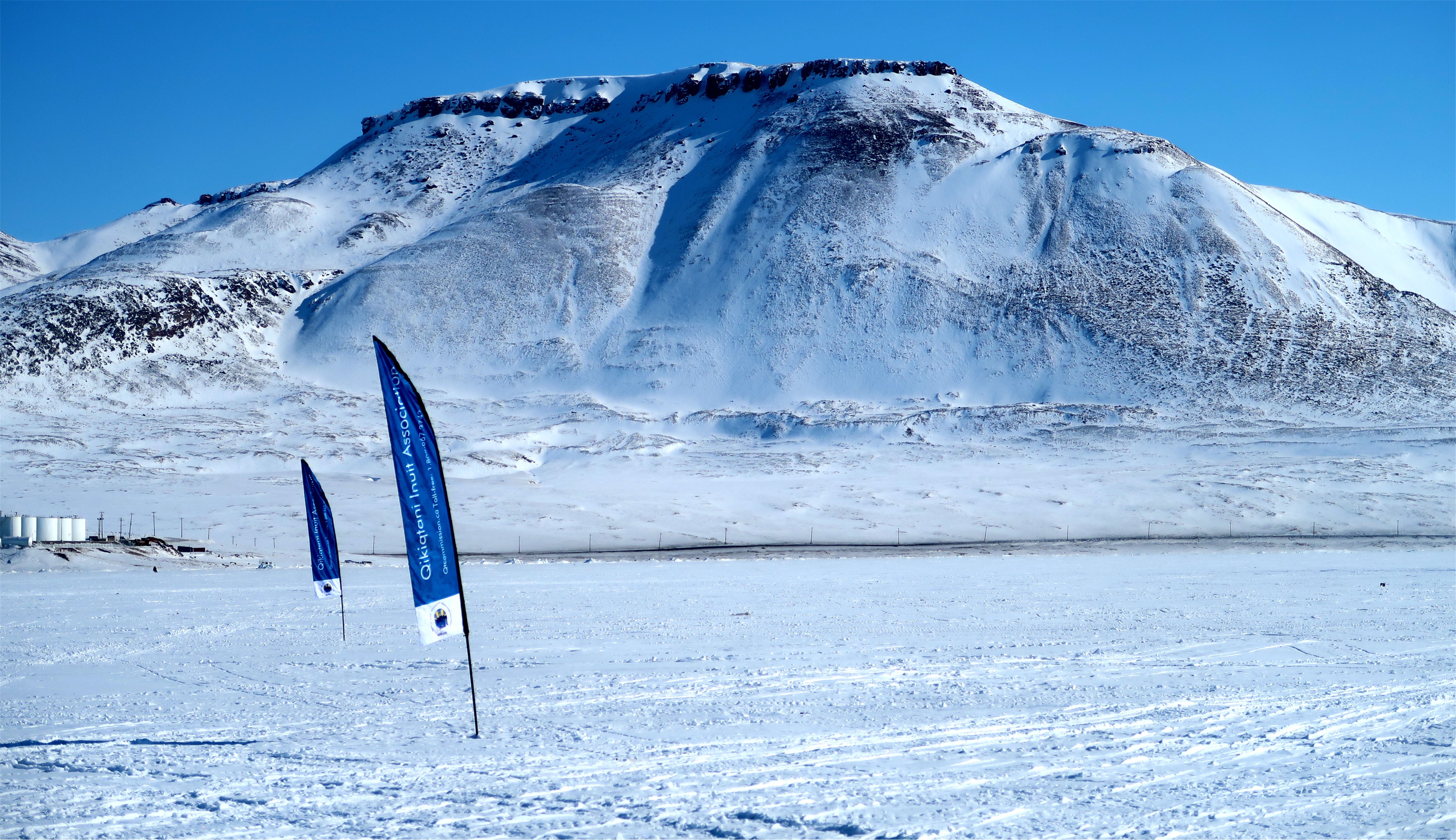
The finish line was marked by two QIA flag poles.  NQ staff had to tell people to stay away from these flag poles so that the mushers could see them and give space for the dogs to pass between them.  Everyone anxiously waited for the arrival of the mushers.  I photographed the very large welcome sign made by the Grade 4 class.  The first competitor was spotted in the distance at 3pm.

Jovan Simic, wearing the number 6 on his jersey, was the first musher to cross the finish line.  Several people in the crowd lifted him & his qamutik in the air.  He raised his fists in delight.  He was lowered to the ground after a few moments.  He moved his dogs off to the side and let them rest. 

The second competitor, Number 7, arrived at 3:15pm.  He too was lifted into the air by the crowd to signify he had reached the end.  Number 2 was the third competitor to cross the finish line at 3:20pm.  Of course, he celebrated his finish by raising his arms into the air, while the crowd held him & his qamutik in the air.  The fourth competitor to arrive was Number 10 at 3:25pm.  Just like the previous three, the crowd lifted him & his qamutik into the air to celebrate his finish.

Word began to spread around this time that the remaining 8 competitors were running late.  Quite a few people decided to head back into town to get something to eat and return later.  I decided to follow the rest of the crowd and returned to school because I had work to do.  The remaining competitors arrived safely in Arctic Bay, the last one being around 5:00pm. 

The awards ceremony was held the following evening at the community hall.  The place was packed with people.  The twelve mushers sat on stage while their support teams sat in front of the stage.  A large Nunavut Quest banner made by QIA hung on the backstage wall.  The ceremony began with welcome speeches by NQ organizers.  The twelve mushers and their support teams were introduced.  This was followed by brief speeches by the main timekeeper and judge.

The final times were announced in order of last to first.  In the end, David Oyukuluk won first place and Jovan was given runner-up status.  David received a trophy, cash prize, and bragging rights.  He was proud of his achievement.

There were a few congratulatory speeches thereafter and then the awards ceremony came to an end.  Many people, including myself, went over to the hockey arena to watch the first game of the Qamutik Cup hockey tournament.

-  

Update: Sorry for the very, very long wait.  Other priorities got in the way of putting together a short video of Nunavut Quest 2023.  Better late than never.  You can view the video here on my YouTube channel.  Enjoy!


Friday, April 14, 2023

Nanisivik Roundtrip

I decided to take my new Backcountry skidoo for another test drive out on the land on April 9.  It was the Easter long weekend and I wanted to get out of the house.  The skidoo had been repaired just two days prior, but I had faith the new bolt in the left shock would hold.  However, I decided to limit the distance by travelling as far as the Nanisivik Naval Facility.  If something should go wrong, I could walk back to town along a skidoo trail or following the Nansivik Road.

I packed the same amount of supplies I took on April 7, but wore Canada Goose outer clothing instead of camouflage.  I also wore a helmet to protect my head & face from frostbite. 

I removed the right-side panel of the skidoo to expose the muffler to cold air, thereby preventing overheating.  I attached a 12-litre gas can to the back of my skidoo in case I needed to refuel.  I also carried a bottle of oil in my backpack.

My daytrip began at 10:30am.  I drove north towards Victor Bay because I wanted to check out an iceberg.  Several coworkers had mentioned this frozen natural landmark and I wanted to see what all the excitement was about.  The iceberg was a lot smaller than the one I saw two days ago.  The visible parts had similar shapes and it was easy to stand on one of them.  I walked around the iceberg a few times and took pictures.  I hopped on my skidoo and continued driving north.

I crossed Victor Bay and reached Graveyard Point.  I stopped and photographed the point while the sun shined brightly in the clear blue sky.  There was no one around.  The frozen landscape was desolate, quiet, and majestic. 

The drive to Nanisivik from Graveyard Point took about 40 minutes.  The ice & snow was rough the first half of the journey, then gradually smoothed out.  I looked in all directions, looking for hungry polar bears, sunbathing seals, and prowling Inuit hunters.  There were none.  There were only me, my thoughts, and the continuous drone of the skidoo engine.  I followed a skidoo path of a previous traveller but then created my own.  The previous traveller’s trail had suddenly turned around. I wasn’t worried about creating my own trail because I’ve travelled in Strathcona Sound several times already. 

The Nanisivik Naval Facility (NNF) slowly came into view, the buildings and two large fuel tanks taking shape.  I stopped in front of the NNF and turned off the skidoo engine.  Dead silence enveloped me.  I stretched my legs and photographed my skidoo with the facility in the background.  I photographed the skidoo trail I created from Graveyard Point, started up my machine, and drove off the ice. 

I entered the deserted NNF and looked around to see if anything had changed since my last visit.  Nope. Nothing.  I took several more photographs, rested for a bit, and let the skidoo engine cool down.  I headed home after 20 minutes.

I followed the road that snaked its way up a hill.  Unfortunately, there wasn’t a lot of snow, so I had to drive over many small rocks.  I apologized to my skidoo, behaving like a stereotypical Canadian.  There was more snow on the main road when I reached the former town site, enabling me to increase my speed.  I photographed the T-intersection and then turned right towards Arctic Bay.  If I continued driving forward, I would have ended up at the old Nanisivik Airport. 

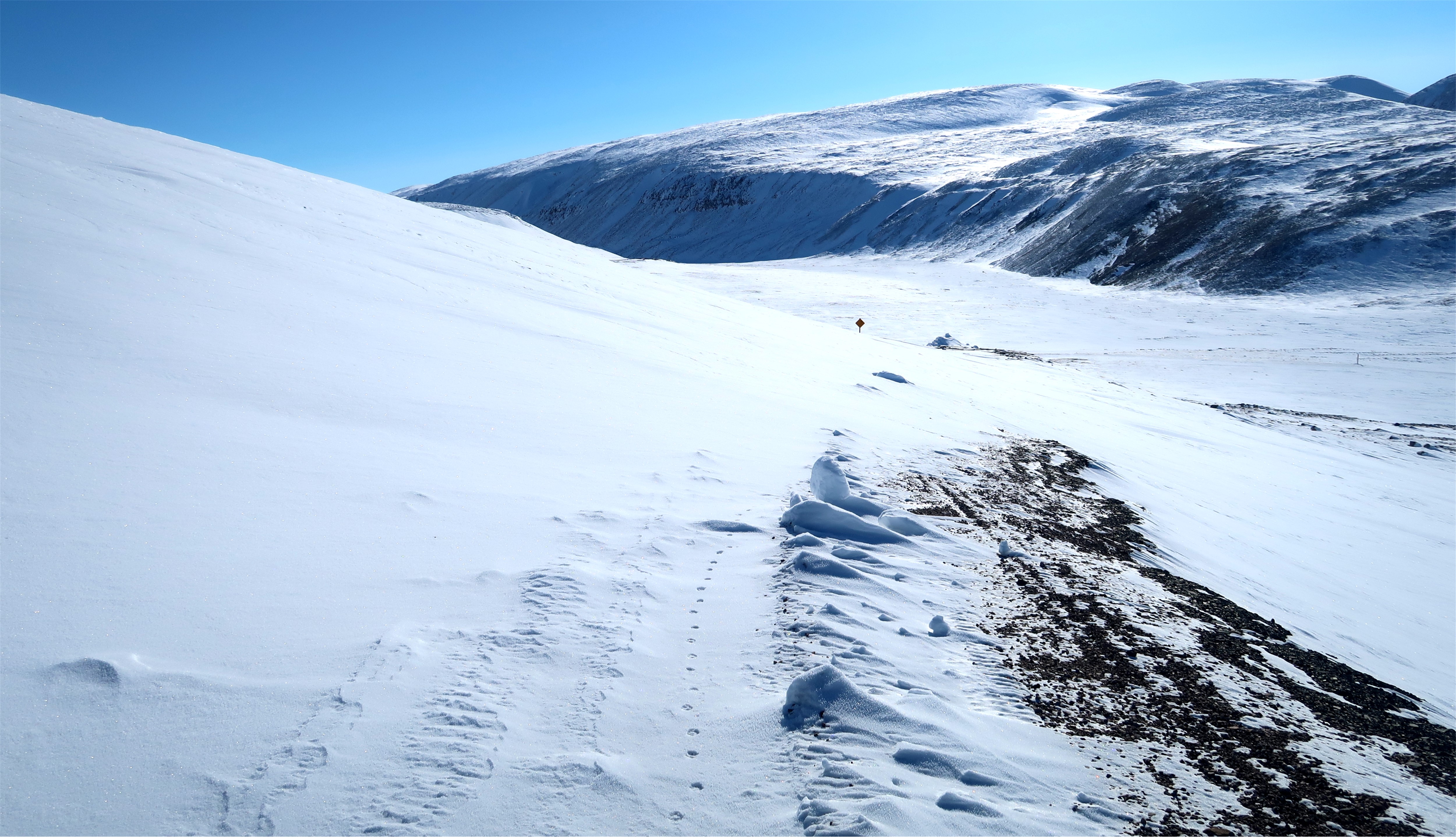
I drove where the snow was the thickest so my skis wouldn’t get damaged.  This forced me to alternate between driving on the road and on the land next to it.  Even though I was driving at a high altitude I still looked around for hungry polar bears.  Better safe than sorry.  Eventually the road descended and curved around a tall hill.  The Second Bridge came into view at the bottom of a large valley.

I stopped in front of a large snow drift that covered a section of the road.  The Road to Nanisivik isn’t plowed during winter so this probably happens a lot.  I inspected the snow drift and decided to drive halfway across it and then down towards the Second Bridge over open terrain.  I hopped back on my skidoo and put my plan into action.  It worked.

I drove across the Second Bridge and followed the main road for quite a while, passing the No Alcohol liquor signs, and arriving at the right-hand curve before the First Bridge.  I decided to turn left and drive down to a large enclosed frozen lake.  From here, I could drive much faster, hop across a short stretch of land, and then drive onto the frozen bay that’s also called Arctic Bay.  The community was in full view, and I drove straight towards it.  I did stop to get a good wide landscape photo for this blog post.  I was home by 3:00pm.

My Backcountry skidoo survived its second on the land trip without difficulty.  I got to see the Nanisivik Naval Facility again and spend some time outside.  I’m now looking into buying additional parts for my machine, such as, a skid plate, extra seat, larger windshield, and rearview mirrors.  These additions will increase the skidoo’s longevity and make me a safer rider.